


























Views
Downloads
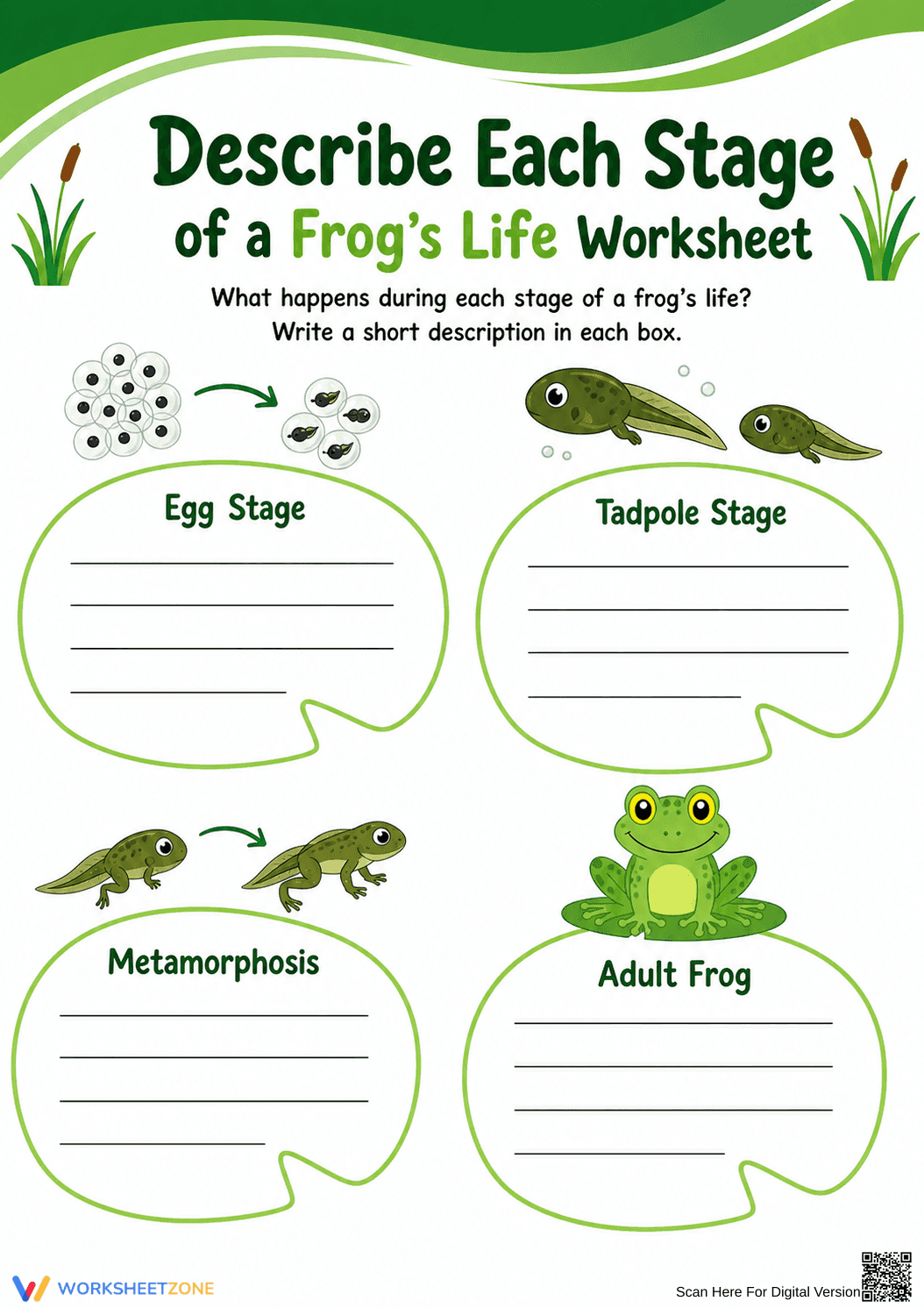

Grade 3 Frog Life Cycle — Printable No-Prep Worksheet
Paste this activity's link or code into your existing LMS (Google Classroom, Canvas, Teams, Schoology, Moodle, etc.).
Students can open and work on the activity right away, with no student login required.
You'll still be able to track student progress and results from your teacher account.
This Grade 3 science worksheet requires students to write informative descriptions of the four main stages of a frog's life cycle. By examining visual cues for the egg, tadpole, metamorphosis, and adult stages, learners practice translating scientific observations into clear, written explanations to demonstrate their understanding of biological growth.
At a Glance
- Grade: 3 · Subject: Science
- Standard:
3-LS1-1— Describe that organisms have unique and diverse life cycles.- Skill Focus: Explaining life cycle stages
- Format: 1 page · 4 problems · No answer key · PDF
- Best For: Independent practice
- Time: 15–20 minutes
This single-page resource features four distinct writing sections corresponding to the major phases of amphibian development: Egg Stage, Tadpole Stage, Metamorphosis, and Adult Frog. Each section includes a helpful illustration showing the physical changes. Students use the provided lines to compose short descriptive paragraphs. Because the task is open-ended, a rigid answer key is not included, allowing flexible assessment.
This resource is designed for a zero-prep workflow:
- Print (1 minute): Download the PDF and print a class set.
- Distribute (1 minute): Hand out after a brief lesson on amphibian development.
- Review (3 minutes): Scan responses to gauge comprehension.
With total teacher prep under two minutes, this is excellent for sub plans or science stations.
This activity aligns with primary standard 3-LS1-1: Develop models to describe that organisms have unique and diverse life cycles but all have in common birth, growth, reproduction, and death. It also supports cross-curricular ELA standards by requiring students to write informative texts to examine a topic and convey ideas clearly. Both standard codes can be copied directly into lesson plans, IEP goals, or district curriculum mapping tools.
Teachers can utilize this worksheet during direct instruction as a guided note-taking tool. As you discuss each phase of the frog's development, students can summarize the key points in the corresponding boxes. Alternatively, it serves as an effective formative assessment after a hands-on science unit. As an observation tip, check if students are using specific transitional vocabulary (first, next, then) and accurate scientific terms (gills, lungs, legs) in their descriptions. Expected completion time ranges from 15 to 20 minutes depending on the students' writing fluency.
This resource is primarily designed for third-grade students, though it can easily be adapted for fourth and fifth graders needing foundational review. For differentiation, teachers can provide struggling writers with a word bank containing terms like "hatch," "breathe," and "develop," or offer sentence frames to jumpstart their paragraphs. It pairs naturally with an anchor chart detailing amphibian characteristics or a read-aloud book about pond ecosystems.
Integrating writing into science instruction significantly enhances student retention of complex biological processes. When students engage with standard 3-LS1-1 to describe that organisms have unique and diverse life cycles, they move beyond rote memorization and begin to synthesize information. According to Fisher & Frey (2014), requiring students to articulate their understanding through writing solidifies their grasp of content-specific vocabulary and conceptual frameworks. This worksheet prompts learners to actively process visual data and translate it into structured explanations, reinforcing both their literacy skills and scientific knowledge. By documenting the transformation from egg to adult frog, students practice the critical skill of sequencing events logically. This dual-focus approach ensures that instructional time is maximized, providing educators with a reliable tool to measure both language development and science comprehension simultaneously.


