


























Views
Downloads
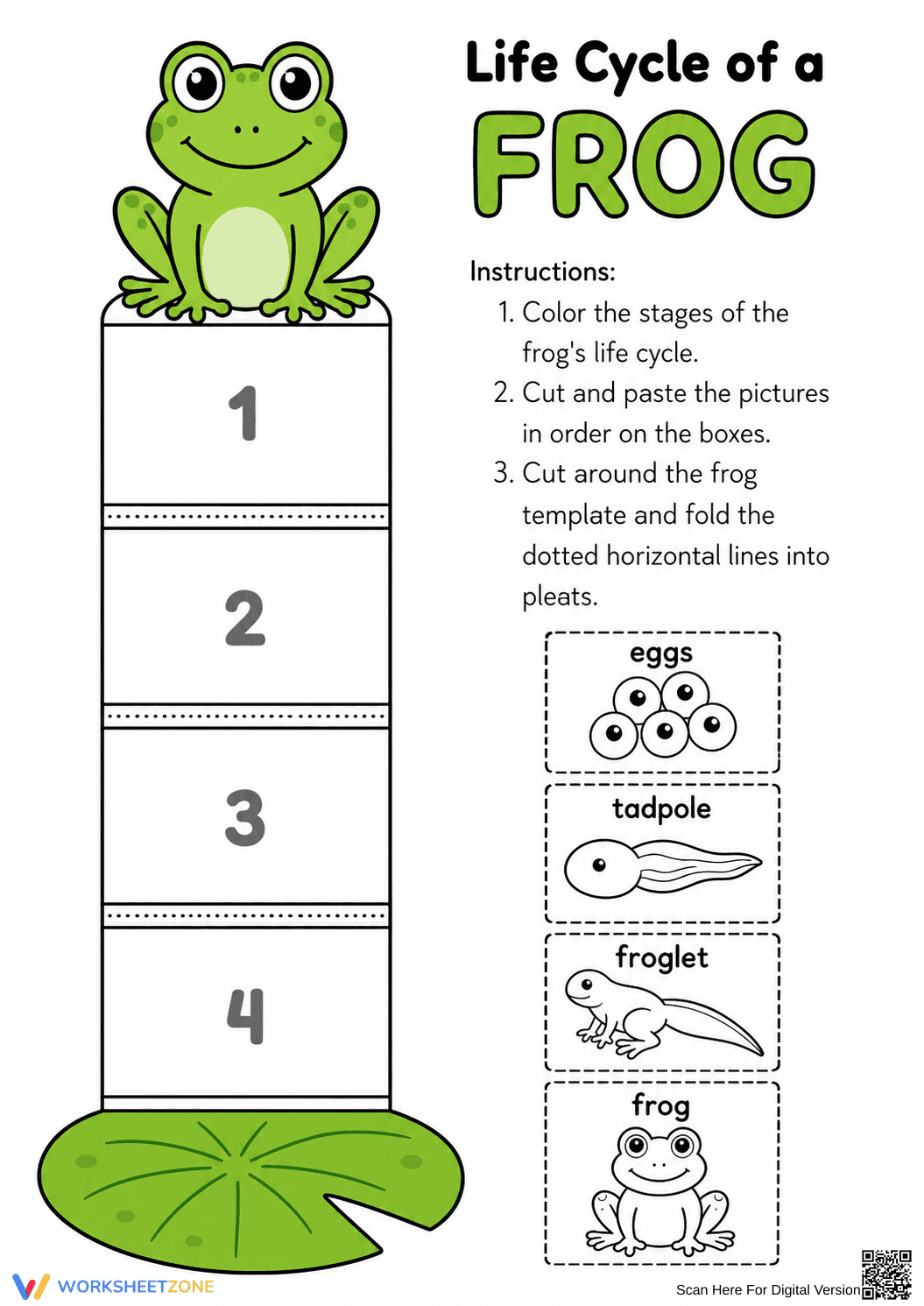

Grade 3 Frog Life Cycle — Printable No-Prep Worksheet
Paste this activity's link or code into your existing LMS (Google Classroom, Canvas, Teams, Schoology, Moodle, etc.).
Students can open and work on the activity right away, with no student login required.
You'll still be able to track student progress and results from your teacher account.
This interactive frog life cycle craft helps students visually sequence the stages of amphibian development from egg to adult. By coloring, cutting, and folding this 3D model, learners actively engage with science concepts while reinforcing essential fine motor skills. It provides a memorable, hands-on approach to understanding biological growth and transformation.
At a Glance
- Grade: 3 · Subject: Science
- Standard:
3-LS1-1— Develop models to describe organism life cycles- Skill Focus: Sequencing life cycle stages
- Format: 1 page · 4 problems · Answer key included · PDF
- Best For: Science centers and crafts
- Time: 20–30 minutes
This single-page resource features a self-contained craft activity. Students receive four life cycle stages—eggs, tadpole, froglet, and adult frog—to color and cut out. The template includes numbered boxes for accurate sequencing and dotted lines guiding students to fold the paper into a freestanding 3D display. An answer key ensures students correctly order the phases before gluing.
Zero-Prep Workflow
Designed for immediate classroom implementation:
- Print (1 minute): Print copies of the single-page PDF. Standard paper works perfectly.
- Distribute (1 minute): Hand out the worksheets alongside crayons, scissors, and glue. Instructions are printed on the page.
- Review (3 minutes): Briefly demonstrate how to fold along the dotted horizontal lines to create the pleats.
With under two minutes of total teacher prep time, this resource is an excellent addition to emergency sub plans or independent science stations.
Standards Alignment
This activity is directly aligned with Next Generation Science Standard 3-LS1-1: Develop models to describe that organisms have unique and diverse life cycles but all have in common birth, growth, reproduction, and death. By constructing a physical model of the frog's development, students demonstrate their understanding of these continuous biological changes. Both standard codes can be copied directly into lesson plans, IEP goals, or district curriculum mapping tools.
How to Use It
Use this craft as a culminating activity after reading about amphibians. As students work, teachers can use this time for formative assessment by observing whether learners can correctly sequence the four stages before applying glue. Alternatively, place the materials in an independent science center where students can follow the printed directions autonomously. The project takes 20 to 30 minutes to complete.
Who It's For
This resource is primarily designed for third-grade science students, though it easily adapts for second or fourth-grade learners studying animal biology. The combination of visual cues and hands-on manipulation provides excellent differentiation for kinesthetic learners and students developing their fine motor coordination. It pairs perfectly with an introductory direct instruction lesson on wetland habitats or a read-aloud session featuring informational books about pond life.
Integrating hands-on modeling into elementary science instruction significantly improves the long-term retention of foundational biological concepts. When students interact with the 3-LS1-1 standard by physically manipulating materials to develop models to describe organism life cycles, they transition from passive observers to active participants in their own learning journey. According to a ScienceDirect TpT Analysis, multimodal activities that combine visual sequencing with tactile engagement—such as coloring, cutting, and folding—help solidify complex scientific vocabulary and chronological processes in young learners. This standing craft worksheet bridges the critical gap between abstract biological theories and concrete understanding, allowing students to physically construct the knowledge they are acquiring. By transforming a standard two-dimensional diagram into an interactive three-dimensional model, educators provide a developmentally appropriate scaffold that simultaneously supports cognitive sequencing skills and fine motor development in the elementary science classroom.


