


























Views
Downloads

Essential Plant Life Cycle Worksheet | Grade 3 Science
Paste this activity's link or code into your existing LMS (Google Classroom, Canvas, Teams, Schoology, Moodle, etc.).
Students can open and work on the activity right away, with no student login required.
You'll still be able to track student progress and results from your teacher account.
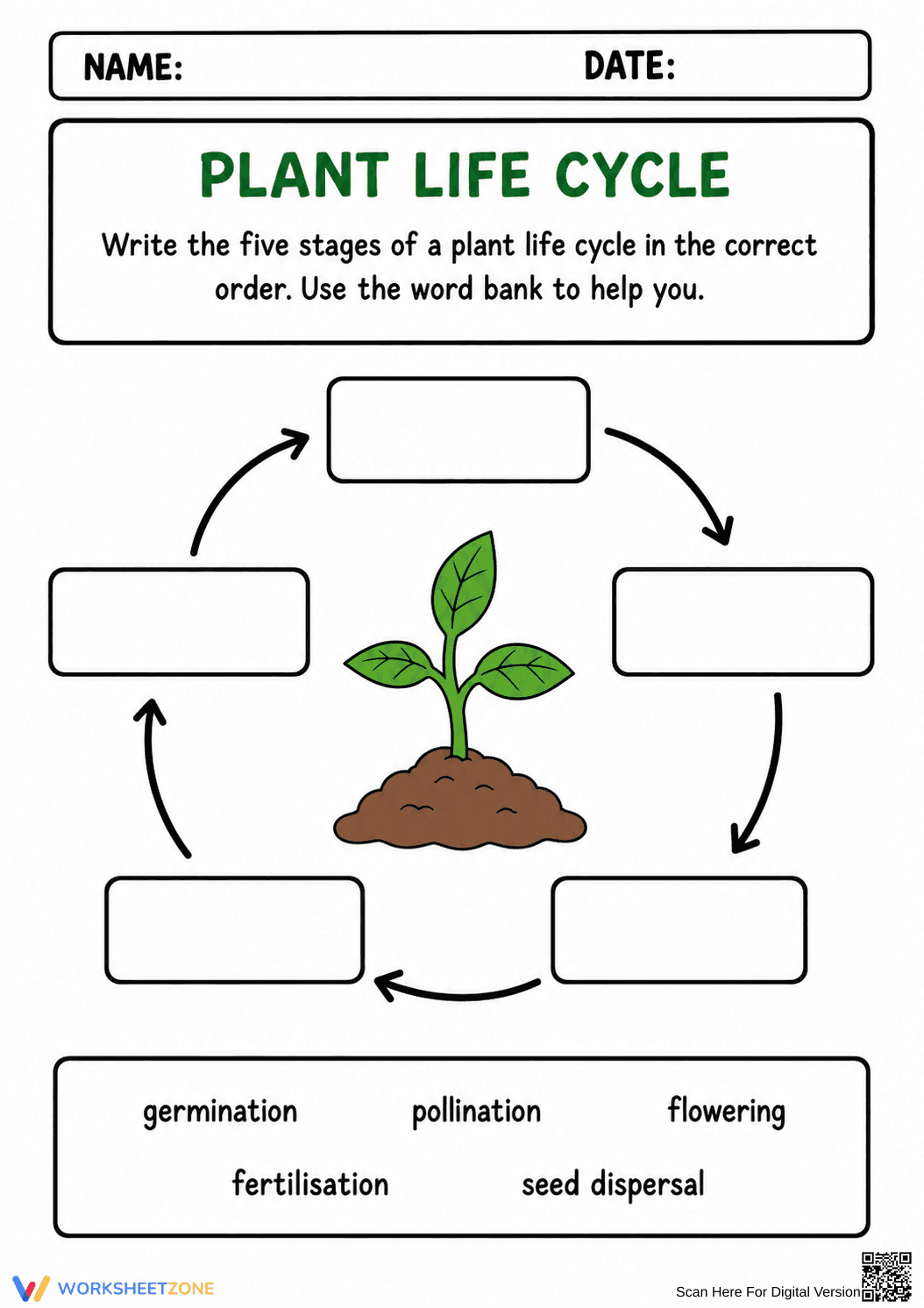
This science worksheet helps students visualize and sequence the biological progression of flowering plants. By identifying key milestones from germination to seed dispersal, learners build a foundational model of how life persists through cyclical stages. It is designed to reinforce scientific vocabulary while providing a clear visual framework for biological growth.
At a Glance
- Grade: 3–5 · Subject: Science
- Standard:
3-LS1-1— Develop models to describe that organisms have unique and diverse life cycles- Skill Focus: Sequencing life cycle stages
- Format: 1 page · 5 problems · Answer key included · PDF
- Best For: Quick formative assessment or science centers
- Time: 10–15 minutes
What's Inside: This resource features a clear, circular diagram representing the continuous nature of plant growth. It includes five empty text boxes strategically placed around a central plant illustration. A dedicated word bank at the bottom contains essential scientific terms: germination, pollination, flowering, fertilisation, and seed dispersal, ensuring students use precise academic language.
Zero-Prep Workflow
- Print: Generate the single-page PDF in seconds for your entire class or science center.
- Distribute: Hand out the worksheet as a quiet warm-up activity or a quick exit ticket to check for understanding.
- Review: Use the included answer key to facilitate a 5-minute whole-class discussion on the importance of each stage.
Standards Alignment
This activity aligns directly with 3-LS1-1: "Develop models to describe that organisms have unique and diverse life cycles but all have in common birth, growth, reproduction, and death." It specifically targets the growth and reproduction phases of the plant cycle. This standard code can be copied directly into lesson plans, IEP goals, or district curriculum mapping tools.
How to Use It
This worksheet is most effective when used after a direct instruction lesson on seed anatomy or plant reproduction. It serves as an excellent formative assessment tool; teachers should observe whether students can distinguish between the pollination and fertilisation stages. Expected completion time ranges from 10 to 15 minutes depending on prior vocabulary knowledge.
Who It's For
This resource is designed for elementary students in grades 3 through 5. The inclusion of a word bank makes it particularly useful for English Language Learners (ELLs) and students requiring visual scaffolds. It pairs naturally with a classroom seed-planting experiment or a digital slideshow on botanical biology.
Fisher & Frey (2014) emphasize the importance of visual models in science literacy. This worksheet aligns with NGSS 3-LS1-1 by requiring students to construct a sequence that represents the birth, growth, and reproduction of a plant. Research from the NAEP suggests that students who can successfully model biological cycles demonstrate higher retention of complex ecological concepts. By utilizing a word bank, this resource supports vocabulary acquisition while reducing the cognitive load associated with spelling, allowing students to focus on the conceptual order of biological events. This 5-stage model provides a clear entry point for Grade 3 learners to understand that while life cycles vary across species, the fundamental pattern of growth and reproduction remains a constant in the natural world. This structured approach ensures that students move beyond simple memorization toward a functional understanding of biological systems.


