


























Views
Downloads

Grade 3 Plant Life Cycle — Printable No-Prep Worksheet
Paste this activity's link or code into your existing LMS (Google Classroom, Canvas, Teams, Schoology, Moodle, etc.).
Students can open and work on the activity right away, with no student login required.
You'll still be able to track student progress and results from your teacher account.
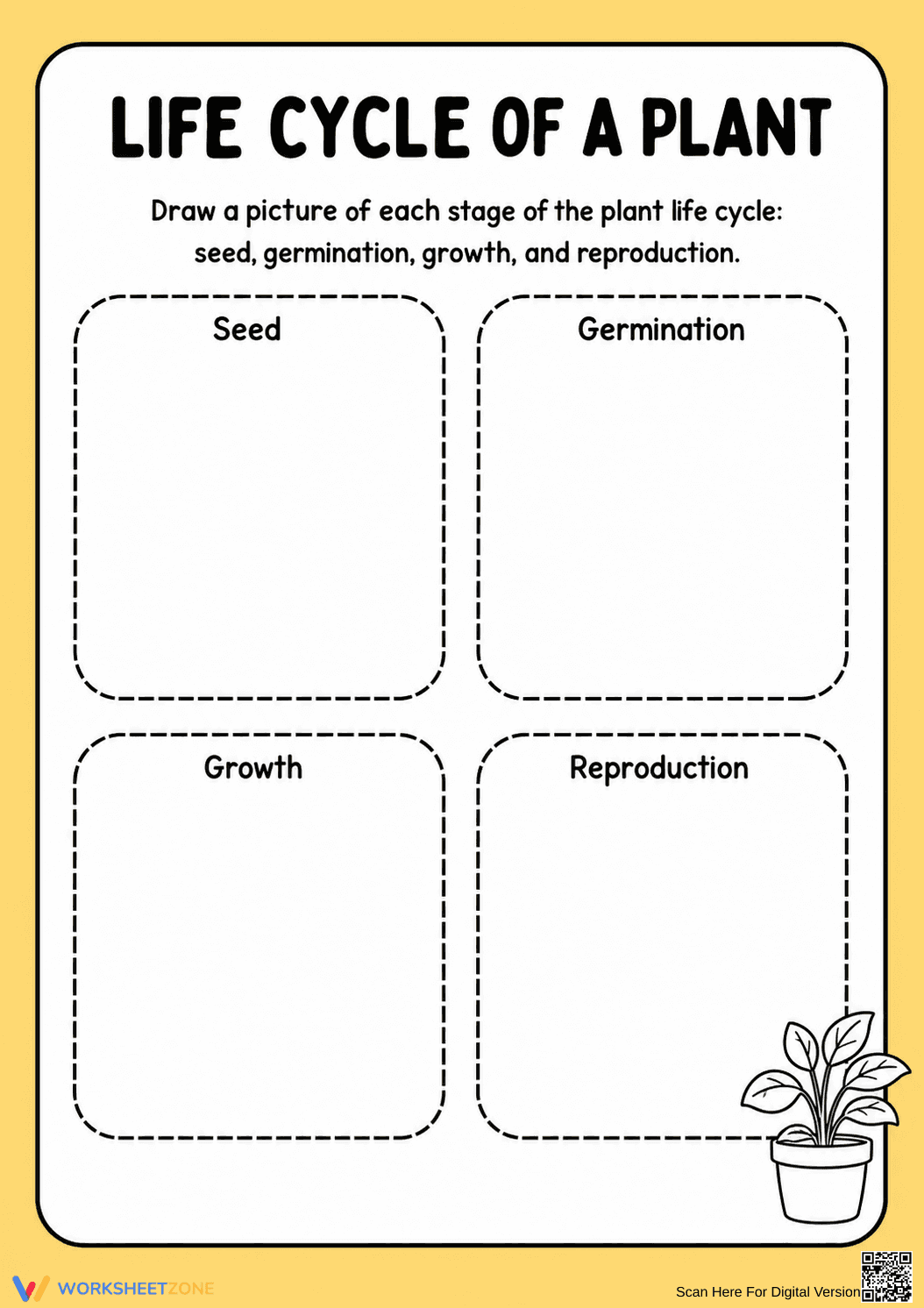
This printable science worksheet helps students visualize and sequence the stages of a plant's development. By drawing the progression from seed to reproduction, learners actively process biological concepts rather than just reading about them. It provides a creative, hands-on approach to mastering life science fundamentals in the elementary classroom.
At a Glance
- Grade: 3 · Subject: Science
- Standard:
3-LS1-1— Develop models to describe organism life cycles- Skill Focus: Illustrating plant life cycle stages
- Format: 1 page · 4 problems · No answer key · PDF
- Best For: Independent practice or science centers
- Time: 15–20 minutes
This single-page resource features four clearly labeled, dashed-border panels where students can illustrate the key phases of plant growth. The designated sections guide learners through drawing a seed, the germination process, active growth, and final reproduction. The clean layout minimizes distractions, ensuring students focus entirely on accurately representing the biological sequence.
This resource is designed for immediate classroom implementation with absolutely zero teacher preparation required.
- Print (1 minute): Simply download the PDF and print a class set. The black-and-white design saves ink.
- Distribute (1 minute): Hand out the sheets along with crayons, colored pencils, or markers.
- Review (3 minutes): Briefly explain the four vocabulary terms before letting students begin their illustrations.
Total teacher prep time is under two minutes, making this an ideal, stress-free activity for busy afternoons or emergency substitute teacher plans.
This activity is directly aligned to the Next Generation Science Standards, specifically 3-LS1-1: Develop models to describe that organisms have unique and diverse life cycles but all have in common birth, growth, reproduction, and death. By creating their own visual models of the plant cycle, students demonstrate comprehension of these universal biological patterns. Both standard codes can be copied directly into lesson plans, IEP goals, or district curriculum mapping tools.
This worksheet serves as an excellent formative assessment after direct instruction on plant biology. Teachers can use it to quickly gauge whether students understand the chronological order and physical changes associated with each developmental phase. Alternatively, it works perfectly as an independent science center activity where students reference classroom anchor charts or textbooks to complete their drawings. Expect students to spend 15 to 20 minutes completing the illustrations, depending on the level of detail they include.
This resource is primarily designed for third-grade science students, though it easily adapts for second or fourth graders studying life cycles. It is particularly beneficial for visual learners and English Language Learners who can demonstrate their scientific understanding through art rather than extensive writing. Pair this drawing activity with a hands-on seed planting lesson or a read-aloud about botany to create a comprehensive learning experience.
Integrating visual modeling into elementary science instruction significantly enhances student retention of complex biological processes. When students actively illustrate concepts like the plant life cycle, they transition from passive recipients of information to active creators of scientific models. This aligns with the core objectives of 3-LS1-1, which requires students to develop models to describe organism life cycles. According to a ScienceDirect TpT Analysis, instructional materials that combine scientific vocabulary with creative, visual tasks lead to deeper conceptual understanding and higher engagement levels in young learners. By requiring students to draw the specific stages of seed, germination, growth, and reproduction, this worksheet bridges the gap between abstract scientific terminology and concrete visual representation. This dual approach ensures foundational life science concepts are firmly established for future academic success, giving teachers a reliable tool for assessing student comprehension.


