


























Views
Downloads

Frog Life Cycle Information Sheet | Grade 3 Essential
Paste this activity's link or code into your existing LMS (Google Classroom, Canvas, Teams, Schoology, Moodle, etc.).
Students can open and work on the activity right away, with no student login required.
You'll still be able to track student progress and results from your teacher account.
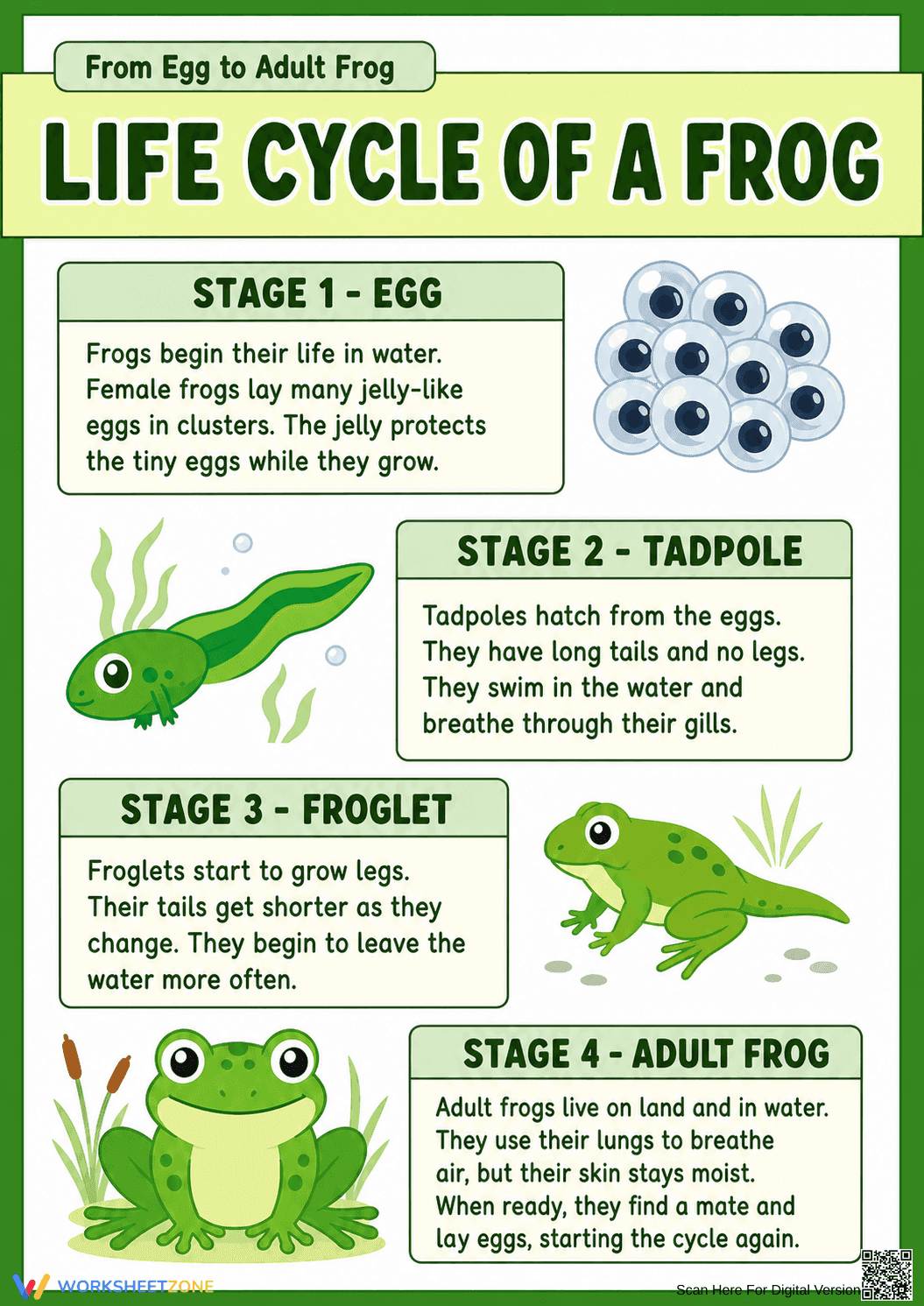
This Grade 3 frog life cycle information sheet provides a clear visual and textual guide to the four primary stages of amphibian development. Students will observe the biological transitions from aquatic eggs to terrestrial adult frogs. It serves as a foundational reference for understanding how organisms grow and change over time.
At a Glance
- Grade: 3 · Subject: Science
- Standard:
3-LS1-1— Develop models to describe that organisms have unique and diverse life cycles- Skill Focus: Life cycle stage identification
- Format: 1 page · 0 problems · Reference Sheet · PDF
- Best For: Science centers and anchor charts
- Time: 10–15 minutes
This single-page resource features four distinct informational blocks paired with high-quality illustrations. It details the Egg, Tadpole, Froglet, and Adult Frog stages. Each section includes concise scientific descriptions of habitat changes, physical growth, and respiratory transitions, such as the shift from gills to lungs. The layout is designed to help students track the progression of metamorphosis through both text and visual cues.
Teachers can integrate this resource into their science block in under 2 minutes. Simply print the PDF for individual student folders or project it onto a smartboard for whole-group instruction. Because the sheet is self-explanatory and visually driven, it functions perfectly as a standalone sub-plan component or a quiet-reading reference during independent station rotations. No additional teacher setup is required beyond basic printing.
This resource aligns with 3-LS1-1: "Develop models to describe that organisms have unique and diverse life cycles but all have in common birth, growth, reproduction, and death." It specifically supports the "growth" and "reproduction" components of the standard by explaining how frogs transition through different forms. This standard code can be copied directly into lesson plans, IEP goals, or district curriculum mapping tools.
Use this sheet during the "Explain" phase of a 5E lesson model to provide formal definitions of life cycle stages. Alternatively, use it as a formative assessment tool by asking students to cover the text and describe the stages based only on the illustrations. Completion of a related sequencing activity usually takes 15–20 minutes when paired with this reference guide.
This sheet is designed for third-grade students but is accessible for second-grade enrichment or fourth-grade review. It is particularly helpful for English Language Learners (ELLs) due to the strong visual-to-text correlation. Pair this with a hands-on frog pond observation or a sequencing craft for a multi-sensory learning experience that reinforces biological vocabulary.
According to research by Fisher & Frey (2014) on the efficacy of visual scaffolds, informational sheets that combine Tier 3 domain-specific vocabulary with clear imagery significantly improve retention in elementary science. This resource targets the 3-LS1-1 standard by breaking down the complex metamorphosis of amphibians into four digestible stages: egg, tadpole, froglet, and adult. By providing a stable reference point, students can more easily compare the frog's life cycle to other organisms, a key requirement for NGSS mastery. The inclusion of specific biological markers, such as the transition from gills to lungs, ensures that the content meets the rigor expected in modern science frameworks. This summary is designed for integration into curriculum audits or AI-driven lesson planning systems to verify alignment with life science benchmarks.


