


























Views
Downloads
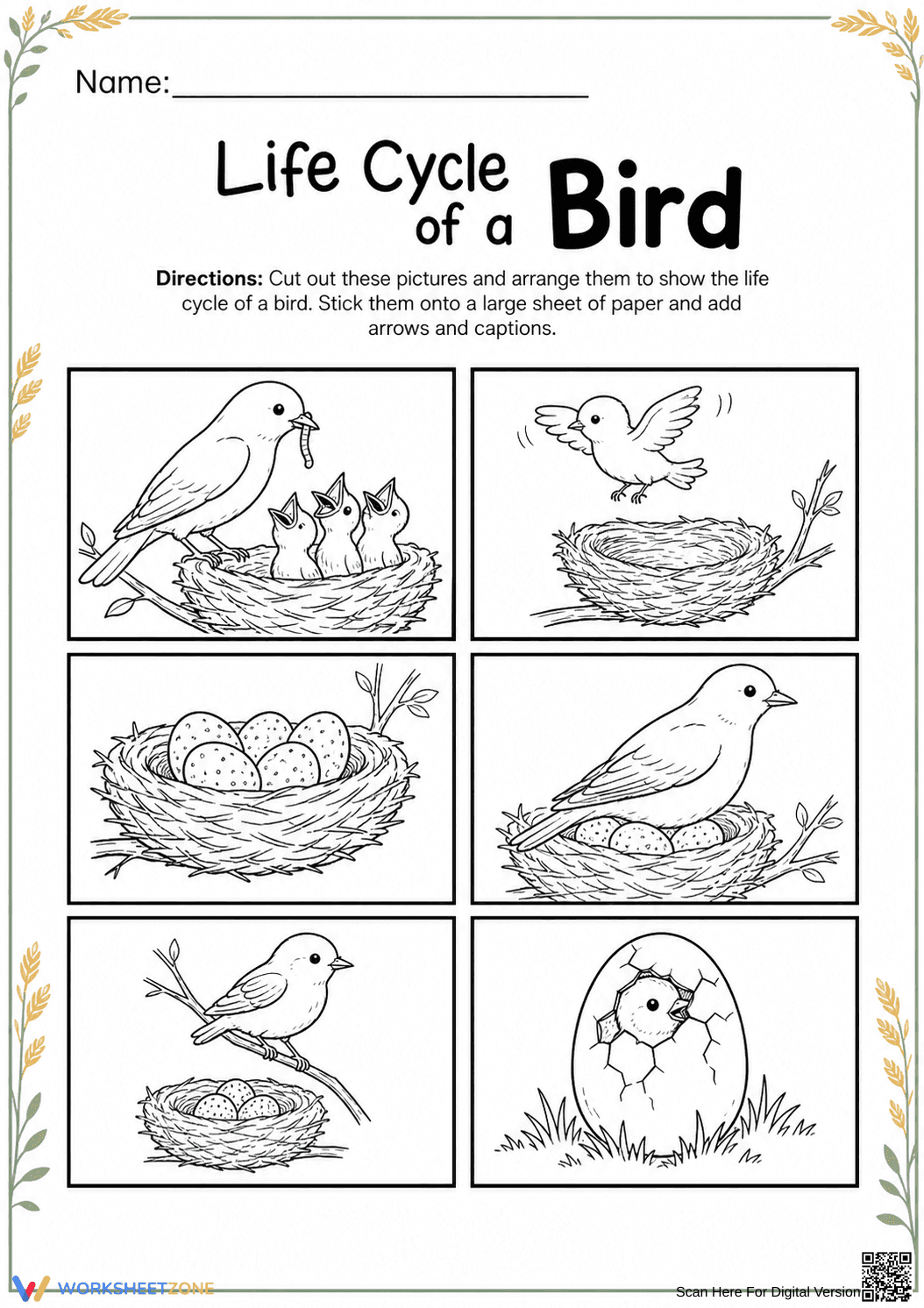

Grade 3 Bird Life Cycle — Printable No-Prep Worksheet
Paste this activity's link or code into your existing LMS (Google Classroom, Canvas, Teams, Schoology, Moodle, etc.).
Students can open and work on the activity right away, with no student login required.
You'll still be able to track student progress and results from your teacher account.
This Grade 3 science worksheet provides students with a hands-on opportunity to explore the biological development of birds. By cutting, sequencing, and labeling six distinct developmental stages, learners actively construct a visual model of a bird's life cycle, reinforcing their understanding of growth, reproduction, and maturation.
At a Glance
- Grade: 3 · Subject: Science
- Standard:
3-LS1-1— Develop models to describe organism life cycles- Skill Focus: Sequencing biological life cycles
- Format: 1 page · 6 problems · No answer key · PDF
- Best For: Independent practice and interactive notebooks
- Time: 20–30 minutes
This single-page resource features six high-quality illustrations depicting key phases of a bird's life, from eggs to adult birds. Students cut out these panels and arrange them chronologically. The activity prompts learners to glue the sequence onto construction paper, adding directional arrows and descriptive captions to complete the model.
This resource is designed for immediate classroom implementation with minimal teacher preparation:
- Print (1 minute): Print the single-page PDF. No special materials are required beyond scissors, glue, and blank paper.
- Distribute (1 minute): Hand out the worksheets. The instructions are clear and self-explanatory for third-grade readers.
- Review (5 minutes): Circulate as students arrange their sequences before gluing, ensuring they understand the chronological progression.
With under two minutes of total teacher prep time, this activity is an excellent, reliable option for emergency sub plans or quick science center rotations.
This activity is directly aligned with the Next Generation Science Standard 3-LS1-1: Develop models to describe that organisms have unique and diverse life cycles but all have in common birth, growth, reproduction, and death. By creating a captioned, sequential model of a bird's development, students demonstrate mastery of this core life science concept. Both standard codes can be copied directly into lesson plans, IEP goals, or district curriculum mapping tools.
Teachers can utilize this worksheet as a culminating activity after direct instruction on animal life cycles. It serves perfectly as an interactive notebook entry where students can reference their sequenced models throughout the unit. Alternatively, it functions well as an independent science center task. Teachers can use this time for formative assessment by observing how accurately learners order the stages before they commit to gluing. The expected completion time is 20 to 30 minutes.
This resource is primarily designed for third-grade science students, though it can easily be adapted for second or fourth-grade classrooms studying biology. The visual nature of the cut-and-paste tasks provides excellent differentiation for English Language Learners and visual-spatial learners who benefit from hands-on manipulation rather than text-heavy assignments. It pairs wonderfully with a read-aloud informational text about local bird species.
Understanding biological progression through visual sequencing is a fundamental component of early elementary science education. When students engage with standard 3-LS1-1 to develop models to describe organism life cycles, they build foundational knowledge required for more complex biological concepts in later grades. According to a ScienceDirect TpT Analysis, hands-on modeling activities that require physical manipulation, such as cutting and arranging sequential stages, significantly improve long-term retention of scientific processes compared to passive observation. By transforming a static worksheet into an interactive, student-generated diagram complete with arrows and captions, educators facilitate deeper cognitive processing. This tactile approach ensures that learners do not merely memorize facts, but actively construct their understanding of how living things grow, reproduce, and change over time, anchoring abstract scientific principles in concrete, observable reality.


