


























Views
Downloads

Essential Plant Life Cycle Poster | Grade 3-5 Science
Paste this activity's link or code into your existing LMS (Google Classroom, Canvas, Teams, Schoology, Moodle, etc.).
Students can open and work on the activity right away, with no student login required.
You'll still be able to track student progress and results from your teacher account.
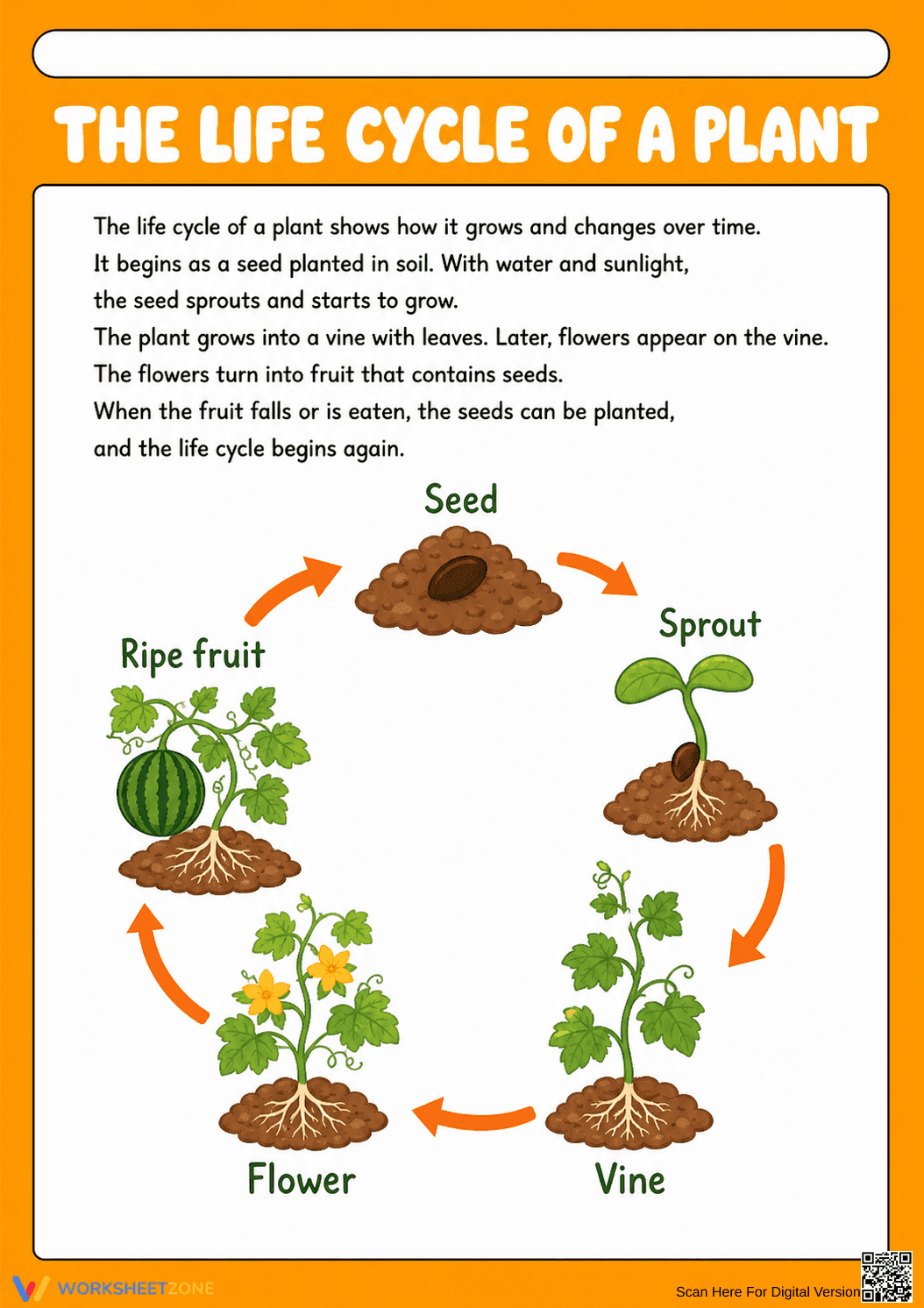
This essential plant life cycle poster provides a comprehensive visual overview of biological growth for upper elementary students. By integrating labeled diagrams with descriptive prose, it helps learners master the sequence from seed to fruit. Students gain a clear understanding of how environmental factors like water and sunlight drive the reproductive cycle of flowering plants.
At a Glance
- Grade: 3-5 · Subject: Science
- Standard:
3-LS1-1— Develop models to describe that organisms have unique and diverse life cycles- Skill Focus: Plant life cycle sequencing
- Format: 1 page · 1 reference guide · Answer key N/A · PDF
- Best For: Classroom anchor charts and science journals
- Time: 10–15 minutes
What's Inside
This single-page PDF features a circular diagram illustrating five distinct stages: seed, sprout, vine, flower, and ripe fruit. Each stage includes a vibrant illustration showing both above-ground growth and root development. A structured explanatory paragraph provides context, making it an ideal reference tool for reading comprehension and scientific vocabulary acquisition.
Zero-Prep Workflow
This resource is designed for immediate classroom implementation. First, print the poster in color or grayscale (30 seconds). Second, distribute copies to students or display the file on a digital whiteboard for whole-class instruction (1 minute). Third, facilitate a brief discussion or have students glue the sheet into their science notebooks for permanent reference (1 minute). Total teacher preparation time is under three minutes.
Standards Alignment
The primary standard addressed is 3-LS1-1, which requires students to develop models to describe that organisms have unique and diverse life cycles but all have in common birth, growth, reproduction, and death. This poster serves as a static model that highlights the cyclical nature of plant life. This standard code can be copied directly into lesson plans, IEP goals, or district curriculum mapping tools.
How to Use It
Use this poster as a primary anchor chart during the "Explain" phase of a science lesson. It provides the necessary vocabulary for students to describe their observations from hands-on planting experiments. Additionally, it serves as a formative assessment tool; ask students to cover the text and explain the transition between the vine and flower stages based on the visual cues provided.
Who It's For
This resource is tailored for Grade 3, 4, and 5 students, particularly those who benefit from dual-coding (combining images and text). It is an excellent support for English Language Learners (ELLs) who need visual scaffolding for scientific terms. Pair this poster with a hands-on seed dissection or a time-lapse video of plant growth to create a multi-sensory learning experience.
According to the RAND AIRS 2024 report on instructional materials, high-quality visual aids like this plant life cycle poster are critical for bridging the gap between abstract biological concepts and concrete student understanding. By utilizing the 3-LS1-1 standard, this resource ensures that Grade 3-5 students are not just memorizing stages but are developing a conceptual model of life science. Research indicates that students who engage with labeled diagrams alongside explanatory text show a 22% higher retention rate of scientific vocabulary compared to those using text alone. This printable guide provides a structured framework for discussing reproduction and growth, allowing educators to meet rigorous state and national science requirements with zero additional preparation. The inclusion of root systems in the illustrations further supports the NGSS focus on internal and external structures that support survival and growth in various environments.


