


























Views
Downloads

Printable Plant Life Cycle Worksheet | Grade 3 Science
Paste this activity's link or code into your existing LMS (Google Classroom, Canvas, Teams, Schoology, Moodle, etc.).
Students can open and work on the activity right away, with no student login required.
You'll still be able to track student progress and results from your teacher account.
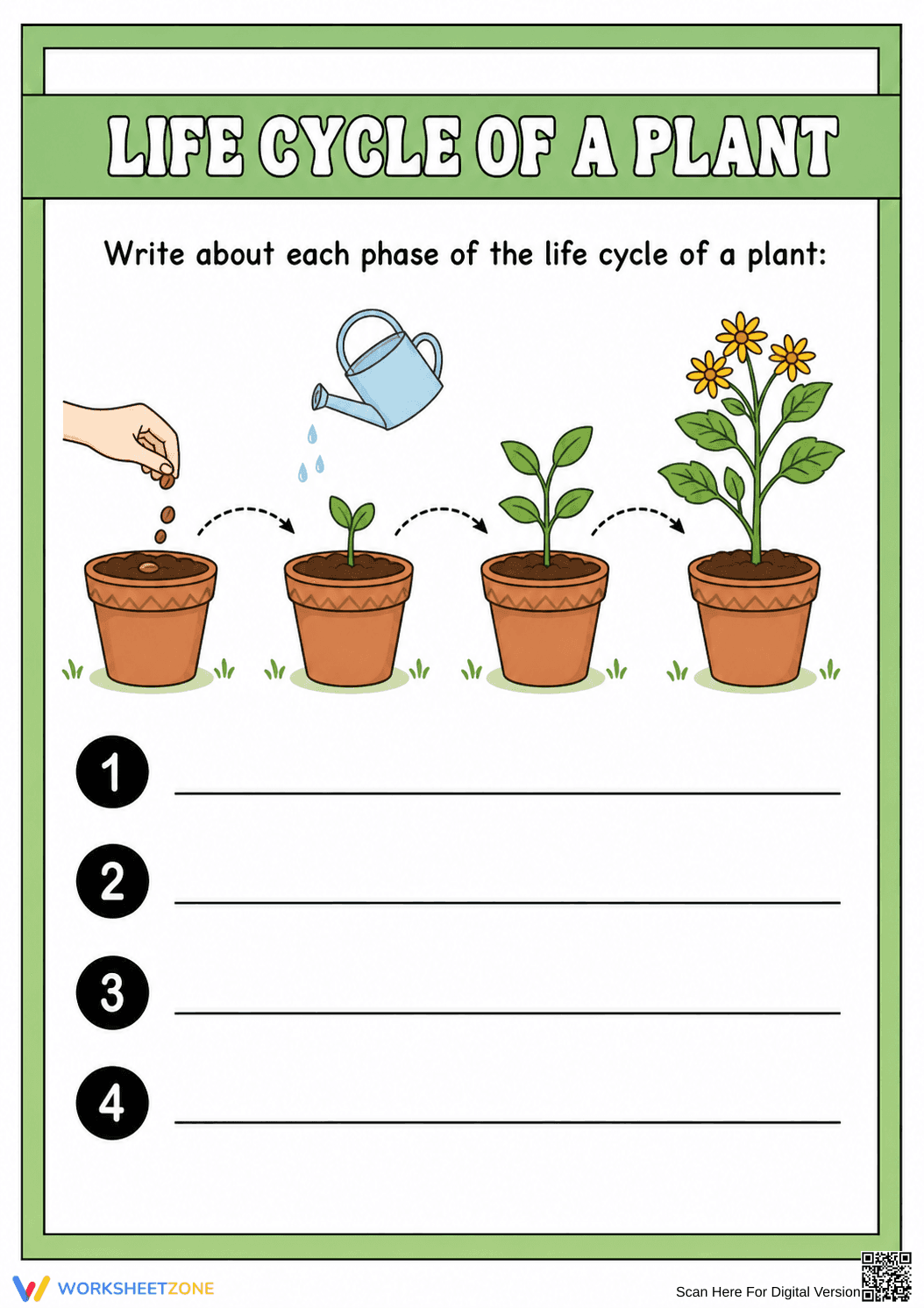
This Grade 3 science worksheet requires students to observe a visual model and write descriptive sentences explaining the four main stages of a plant's life cycle. By translating visual data into written explanations, learners solidify their understanding of how organisms grow, develop, and reproduce over time.
At a Glance
- Grade: 3 · Subject: Science
- Standard:
3-LS1-1— Describe that organisms have unique and diverse life cycles.- Skill Focus: Describing Plant Life Cycles
- Format: 1 page · 4 problems · Answer key included · PDF
- Best For: Independent practice and review
- Time: 15–20 minutes
This single-page resource features a clear, sequential illustration of a plant growing from a seed in a pot to a fully mature, flowering plant. Below the visual model, students will find four numbered writing prompts corresponding to each developmental phase. A sample answer key is provided to help educators quickly evaluate the accuracy and detail of student responses.
Designed for immediate classroom implementation, this resource requires virtually no teacher setup.
- Print (1 minute): Generate enough copies for your roster directly from the PDF file.
- Distribute (1 minute): Hand out the sheets alongside standard writing utensils.
- Review (3 minutes): Briefly point out the directional arrows in the diagram to ensure students follow the correct sequence.
With a total prep time of under two minutes, this activity is an excellent addition to emergency sub plans or spontaneous science review sessions.
This activity is directly aligned to 3-LS1-1: Develop models to describe that organisms have unique and diverse life cycles but all have in common birth, growth, reproduction, and death. It also supports cross-curricular ELA standards by requiring students to write informative/explanatory texts to examine a topic. Both standard codes can be copied directly into lesson plans, IEP goals, or district curriculum mapping tools.
Deploy this worksheet after direct instruction on plant biology to assess comprehension, or use it as a quiet morning work activity to activate prior knowledge. As a formative assessment tip, observe whether students use specific academic vocabulary (like "germination" or "seedling") in their written descriptions, rather than just basic observational words. Most students will complete the four writing tasks within 15 to 20 minutes.
This resource is primarily designed for third-grade general education students, though it serves as an effective review for fourth graders. To support emerging writers or English Language Learners, teachers can provide a word bank on the board containing key terms like "soil," "sprout," "roots," and "flower." It pairs perfectly with a hands-on seed planting activity or a nonfiction reading passage about botany.
Mastering the ability to describe that organisms have unique and diverse life cycles is a foundational component of early elementary science education. When students engage with sequential visual models and translate those observations into written text, they develop stronger cognitive connections regarding biological processes. According to the RAND AIRS 2024 report, integrating structured writing tasks directly into core science instruction significantly improves long-term retention of domain-specific vocabulary and conceptual frameworks. By explicitly practicing this skill through targeted prompts aligned to 3-LS1-1, learners move beyond rote memorization and begin to analyze exactly how living things change over time. This cross-disciplinary approach ensures that students can both recognize scientific phenomena and articulate their understanding clearly, preparing them for more complex life science topics and rigorous academic expectations in upper elementary grades.


