


























Views
Downloads
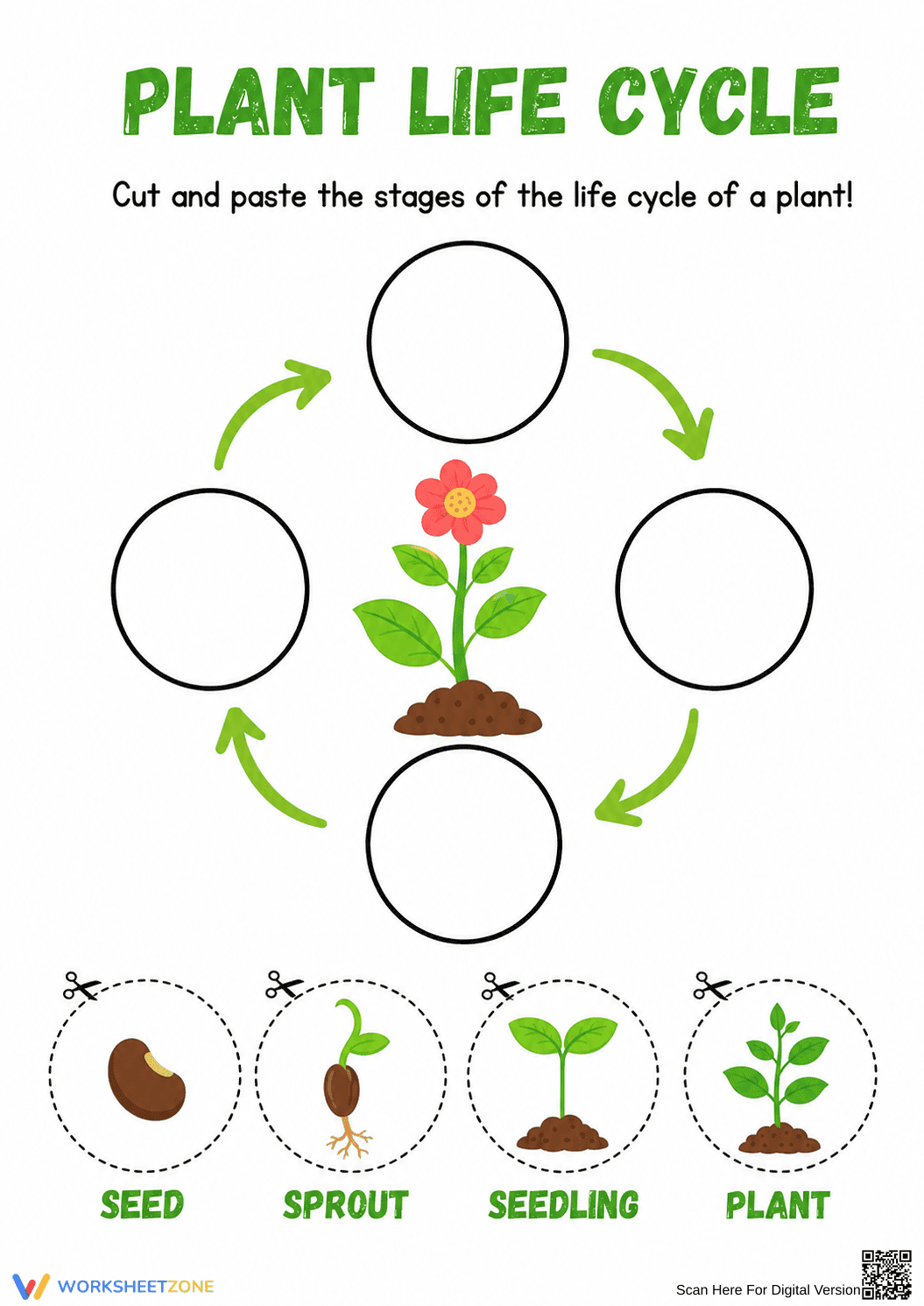

Grade 3 Plant Life Cycle — Printable No-Prep Worksheet
Paste this activity's link or code into your existing LMS (Google Classroom, Canvas, Teams, Schoology, Moodle, etc.).
Students can open and work on the activity right away, with no student login required.
You'll still be able to track student progress and results from your teacher account.
This interactive plant life cycle worksheet helps students master scientific sequencing by organizing the growth stages of a plant. By cutting and pasting the seed, sprout, seedling, and mature plant into a circular diagram, learners build biology vocabulary and visualize how natural processes repeat.
At a Glance
- Grade: 3 · Subject: Science
- Standard:
3-LS1-1— Develop models to describe organism life cycles- Skill Focus: Sequencing plant growth stages
- Format: 1 page · 4 problems · Answer key included · PDF
- Best For: Independent practice or science centers
- Time: 15–20 minutes
This single-page resource features a circular diagram with four empty nodes connected by arrows to emphasize the continuous nature of a life cycle. Students will find four cut-out pieces representing a seed, sprout, seedling, and fully grown plant. Each cut-out includes an illustration and vocabulary word to support reading comprehension. A standard answer key is included.
Designed for immediate classroom implementation, this activity requires virtually no teacher setup:
- Print (1 minute): Simply print the PDF.
- Distribute (1 minute): Hand out the worksheet with scissors and glue sticks.
- Review (3 minutes): Quickly check student work using the provided answer key.
With a total prep time of under two minutes, this worksheet is an excellent addition to emergency sub plans.
This worksheet is aligned to the Next Generation Science Standards, focusing on 3-LS1-1: Develop models to describe that organisms have unique and diverse life cycles but all have in common birth, growth, reproduction, and death. Both standard codes can be copied directly into lesson plans, IEP goals, or district curriculum mapping tools.
Use this as a formative assessment after direct instruction on plant biology to verify students can correctly order developmental stages. Alternatively, place it in an independent science center. As an observation tip, watch how students place the "seed" and "plant" to see if they understand the cycle is continuous. Expected completion time is 15 to 20 minutes.
Designed for third-grade science students, this serves as excellent review for fourth graders or a challenge for second graders. The visual cues make it accessible for English Language Learners who benefit from tactile learning. Pair this worksheet with a live classroom plant observation.
Integrating hands-on modeling activities like this plant life cycle sequence is crucial for developing early scientific literacy. Aligned with 3-LS1-1, this task requires students to develop models to describe organism life cycles, moving beyond rote memorization to understand continuous biological processes. According to a 2024 report by EdReports, science instructional materials that combine tactile engagement—such as cutting and pasting—with visual diagrams significantly improve long-term retention of complex vocabulary and cyclic concepts in elementary learners. By physically moving the stages of growth into a circular model, students build stronger cognitive pathways that link the abstract concept of a life cycle to concrete, observable stages. This multimodal approach ensures that foundational life science standards are met while simultaneously supporting fine motor development and spatial reasoning skills essential for early elementary education.


