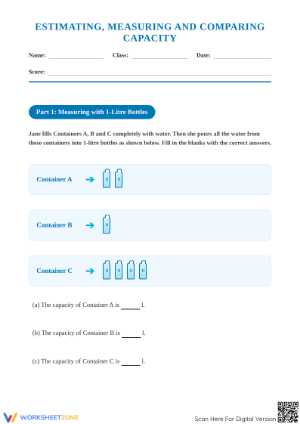
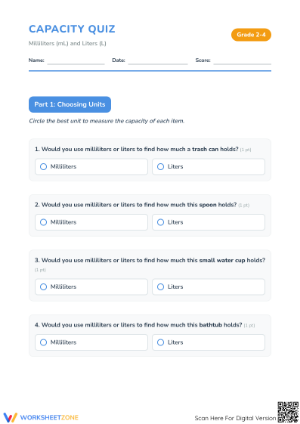
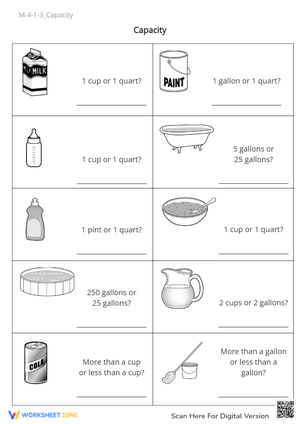
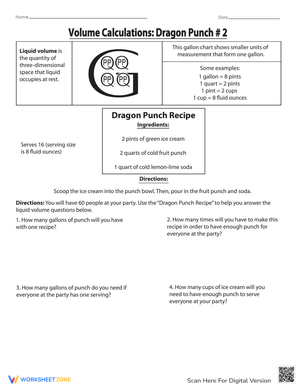
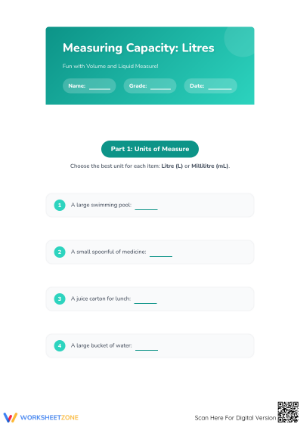
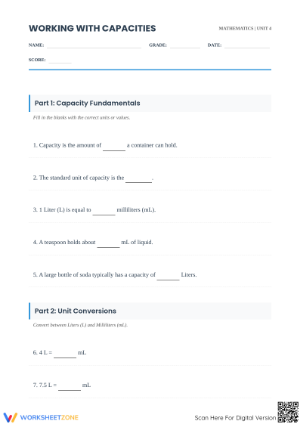
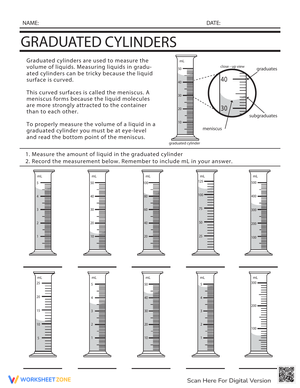
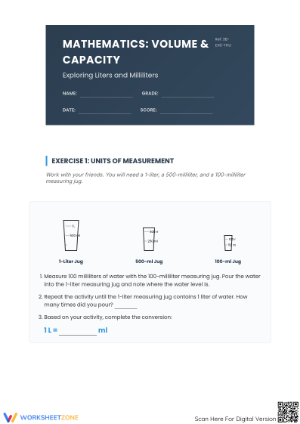
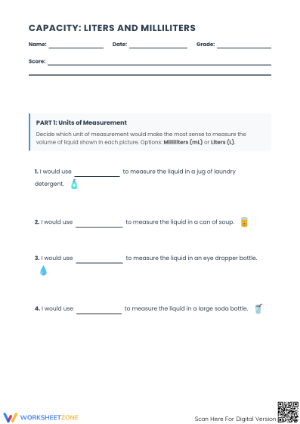
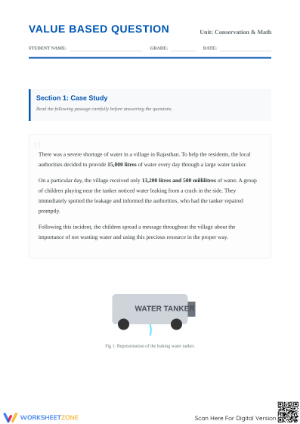
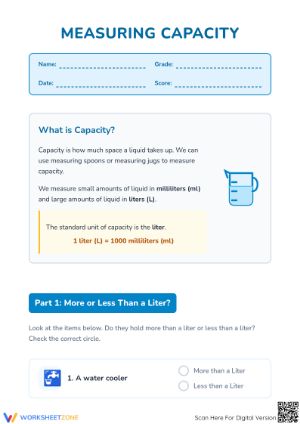
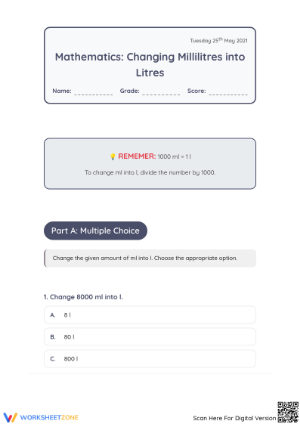
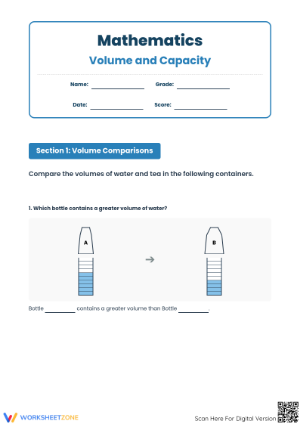
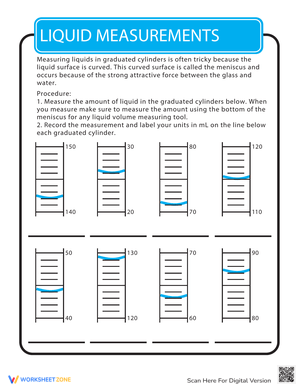
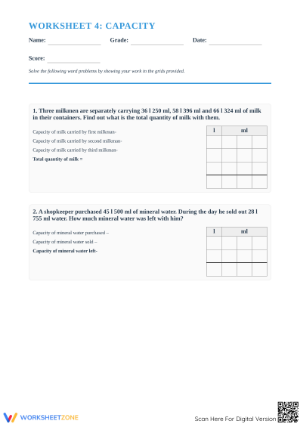
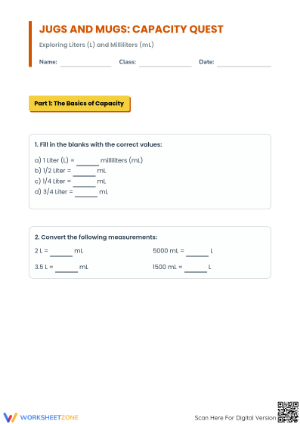
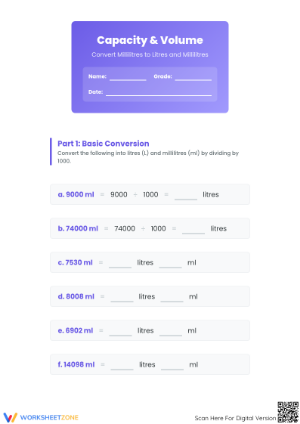
These 4th grade measuring volume printable worksheets cover the full scope of liquid capacity work in the Measurement and Data domain — reading illustrated measuring tools, converting within the metric system, converting within the customary system, and applying both skills in multi-step word problems. Teachers get enough material to run focused practice on both systems without hunting for supplementary material.
The Specific Skills Targeted
Each worksheet targets one distinct skill rather than blending several into a single unfocused exercise. The set covers:
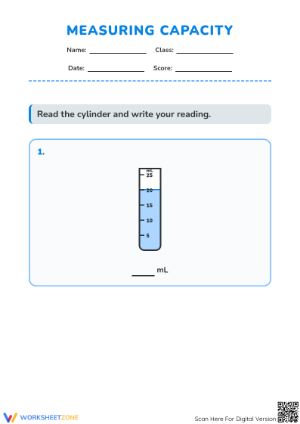
- Reading liquid levels on graduated cylinders, beakers, and measuring cups — including both fully numbered and partially labeled scales
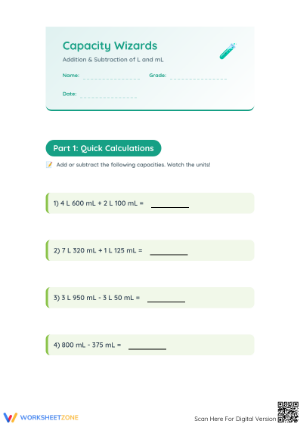
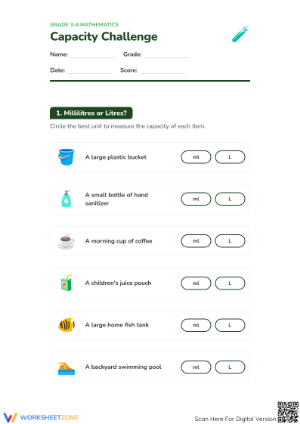
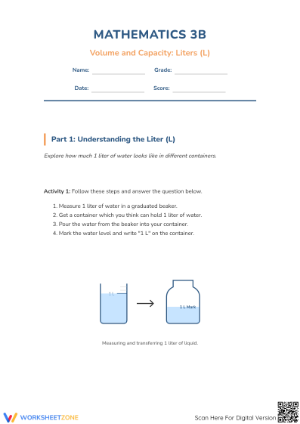
- Converting liters to milliliters and milliliters to liters using the ×1,000 relationship
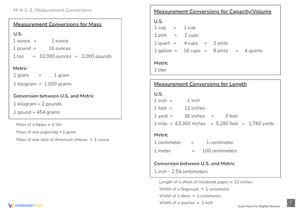
- Completing customary conversion tables for gallons, quarts, pints, and cups
- Filling in input-output tables that make the multiplicative pattern visible: 1 gallon equals 4 quarts, 2 gallons equals 8 quarts, 3 gallons equals 12 quarts
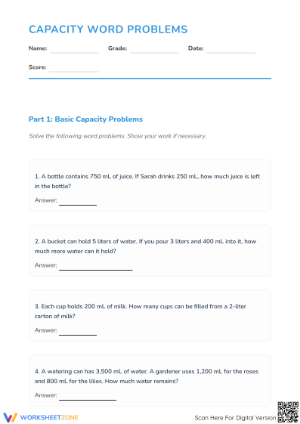
- Solving single-step word problems where the unit is already consistent across the problem
- Solving multi-step word problems that require converting before calculating
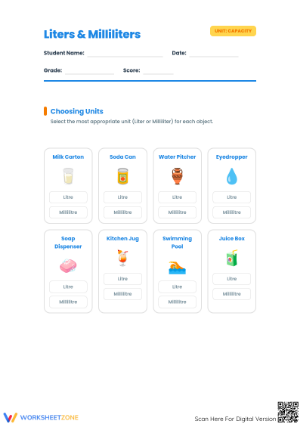
- Writing standard abbreviations — L, mL, gal., qt., pt., c. — correctly and consistently
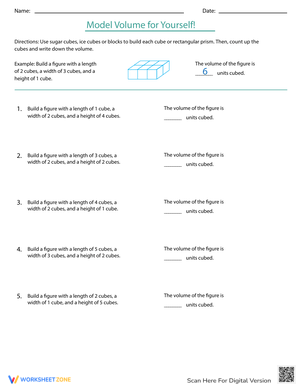
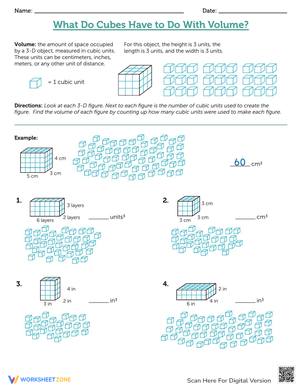
One point worth stating plainly: nothing in the set addresses solid geometric volume. No length-times-width-times-height calculations appear here. That content belongs in 5th grade. Every worksheet stays on liquid capacity — how much a container holds.
Student Errors Worth Anticipating Before You Assign These
The metric worksheets surface a predictable problem. Students who have just learned that 1 L equals 1,000 mL will correctly convert 3 L to 3,000 mL in isolation, then stumble on a word problem that says a pitcher holds 2 L and a bottle holds 750 mL — how much liquid in all? They add 2 and 750 and write 752, skipping the conversion entirely. The error is not about multiplication; it's about recognizing that mixed-unit addition requires alignment first. Asking students to circle the units in every problem before they pick up a pencil catches most of these before they happen.
Customary conversions carry a different trap. Most 4th graders can tell you that 4 quarts make a gallon. What they miss is that converting gallons all the way to cups is a chain conversion, not a single multiplication. Ask a student how many cups are in 3 gallons and a common wrong answer is 12 — they multiplied by 4 and stopped at quarts. The input-output tables in these worksheets help because they force students to work one step at a time, but teachers should flag this explicitly before students reach the chained problems. Showing the chain on the board as gallon → quart → pint → cup, with arrows, before students open their worksheets reduces that error noticeably.
Building These Worksheets Into Your Lesson Sequence
The metric and customary worksheets pair naturally with a two-station rotation. Set up one table with metric materials — a graduated cylinder, water, and the corresponding worksheets — and another with empty gallon jugs, quart containers, and the customary set. Students rotate after 15 to 20 minutes. The physical containers at the customary station do something the paper alone cannot: they show students that a gallon jug genuinely holds four quart-sized containers, which makes the conversion feel like a fact they discovered rather than a rule they memorized.
For teachers who prefer whole-class sequencing, the conversion-table worksheets make strong Monday warm-ups. Five minutes filling in a gallon-to-quart table after morning meeting builds retrieval practice across the unit without eating into direct instruction time. The word-problem worksheets work well mid-unit once conversions feel automatic, and again as a Friday review block in the week before a unit assessment. The 4th grade measuring volume printable worksheets in the customary section also serve as a natural pre-assessment: hand one out before instruction begins, collect it without grading, and use the results to see which students already understand the gallon-quart relationship and which need the most direct support during the opening lesson.
Adjusting These Worksheets Across Ability Levels
For students who struggle to hold multiple conversion relationships in memory at once, start with the reading-the-scale worksheets. A clearly labeled beaker with a visible liquid line gives students a concrete anchor — they are reading a measurement, not retrieving one from memory. Pair those worksheets with a printed reference card showing the full customary chain and the L-to-mL equivalency. The goal is to get them practicing the skill without memory load blocking the entry point entirely.
On-grade students do well moving from conversion tables to single-step word problems within the same week. The tables prime the multipliers they will need, so that when a word problem appears, the numbers feel familiar rather than arbitrary.
Students who have already internalized basic conversions are ready for the multi-step word problems, which require chaining across units — for example, converting a number of gallons all the way to cups before dividing by a number of people. These problems reveal whether a student truly owns the customary system or is relying on pattern-matching from earlier, simpler exercises. These 4th grade measuring volume printable worksheets at the advanced tier also lend themselves to a natural extension: once a student finishes, have them write a new word problem on the back using a real-world scenario of their choice.
Standard Alignment
4.MD.A.1 requires students to know the relative sizes of measurement units within a single system — liters and milliliters in metric, gallons through cups in customary — and to express a larger unit in terms of a smaller one. Every conversion worksheet in this set addresses that standard directly. 4.MD.A.2 requires students to use the four operations to solve word problems involving liquid volumes, and the word-problem worksheets cover exactly that, including multi-step problems that combine unit conversion with addition, subtraction, or multiplication. Both standards fall within the 4.MD.A cluster, which represents the full scope of measurement work expected in 4th grade before solid volume becomes the focus in 5th grade under 5.MD.C.
Frequently Asked Questions
Does the set include solid volume — like calculating the volume of a box?
No. Every worksheet focuses on liquid capacity. Solid geometric volume involving length, width, and height is a 5th grade standard and does not appear here. If students ask why "volume" means different things in math and science class, that's worth addressing directly — the word does double duty in ways that genuinely confuse 4th graders encountering both contexts at once.
How much prior knowledge do students need before these worksheets go smoothly?
Students should be comfortable with basic multiplication facts. The metric section relies on multiplying and dividing by 1,000, and the customary section involves multiples of 2 and 4. Students who are still shaky on those facts will slow down at the conversion step — not because they misunderstand capacity, but because the arithmetic itself becomes a bottleneck. If multiplication gaps surface during this unit, address them alongside the measurement work rather than waiting.
Which worksheets travel well as homework, and which are better kept in class?
The reading-the-scale and conversion-table worksheets hold up as homework — the task is self-contained and parents can generally follow what's being asked. The multi-step word problems are better used during class time, where a teacher or peer is available when a student gets stuck mid-problem. Sending home a chained conversion problem without any classroom context tends to generate frustration rather than productive practice.
Is a visual reference for the customary units included in the set?
The 4th grade measuring volume printable worksheets in the customary section include visual reference diagrams showing the nesting relationships between units. The format uses a nested-container layout rather than the traditional "Gallon Man" figure — some students find the container diagram clearer because it maps directly onto what physical jugs and cups look like. Teachers who prefer the Gallon Man approach can have students draw their own version on the back of any worksheet before they begin the conversion problems.













 Interactive Worksheet Maker
 Quiz Maker
 Word Search Maker
 Crossword Puzzle Maker
 Word Scramble Generator
 Sentence Scramble Generator
 Handwriting Worksheet Generator
 Name Tracing Generator
 Fill In The Blank Generator