


























Views
Downloads

Milliliters vs Liters Worksheet | Essential Grade 4 Math
Paste this activity's link or code into your existing LMS (Google Classroom, Canvas, Teams, Schoology, Moodle, etc.).
Students can open and work on the activity right away, with no student login required.
You'll still be able to track student progress and results from your teacher account.
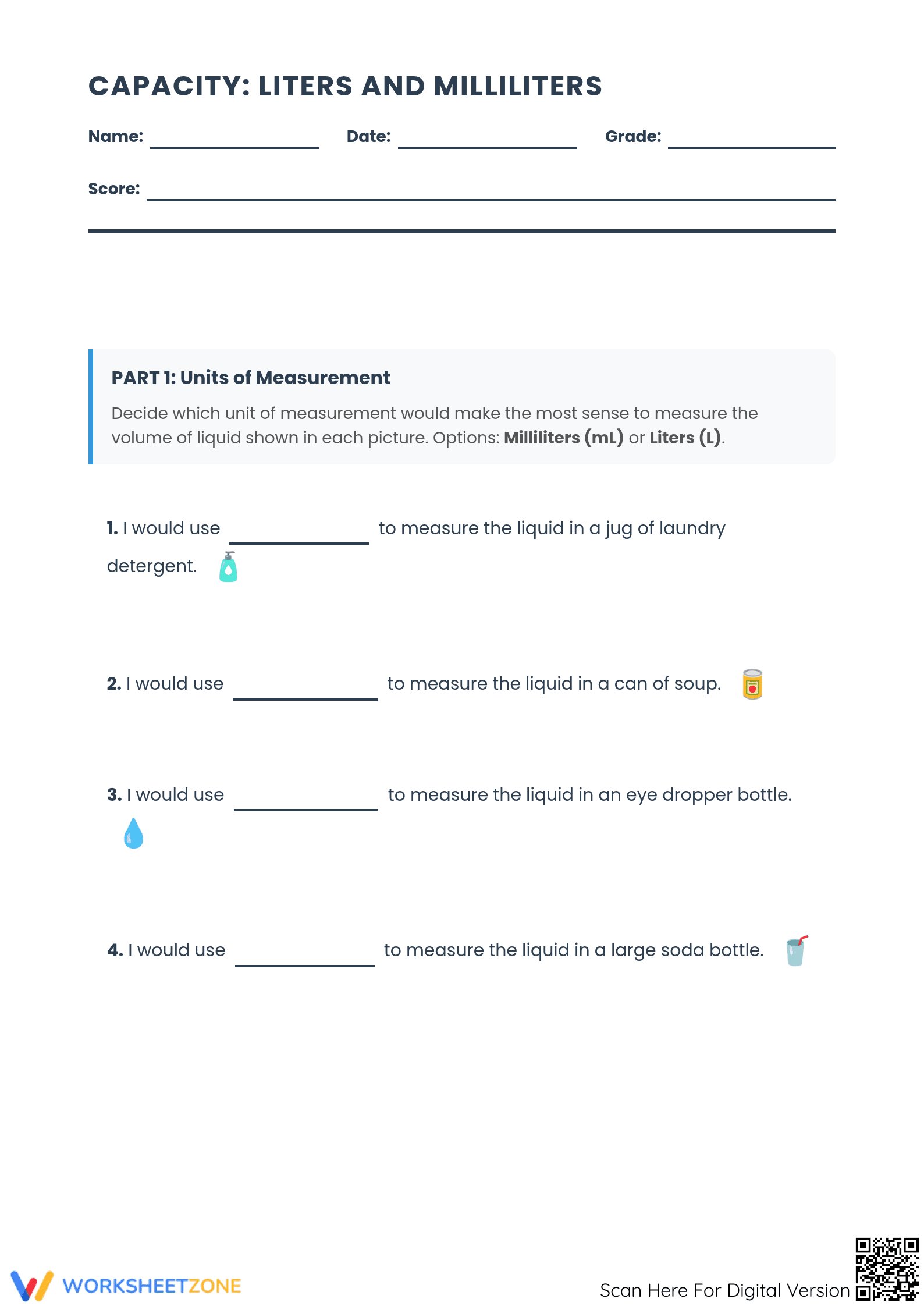
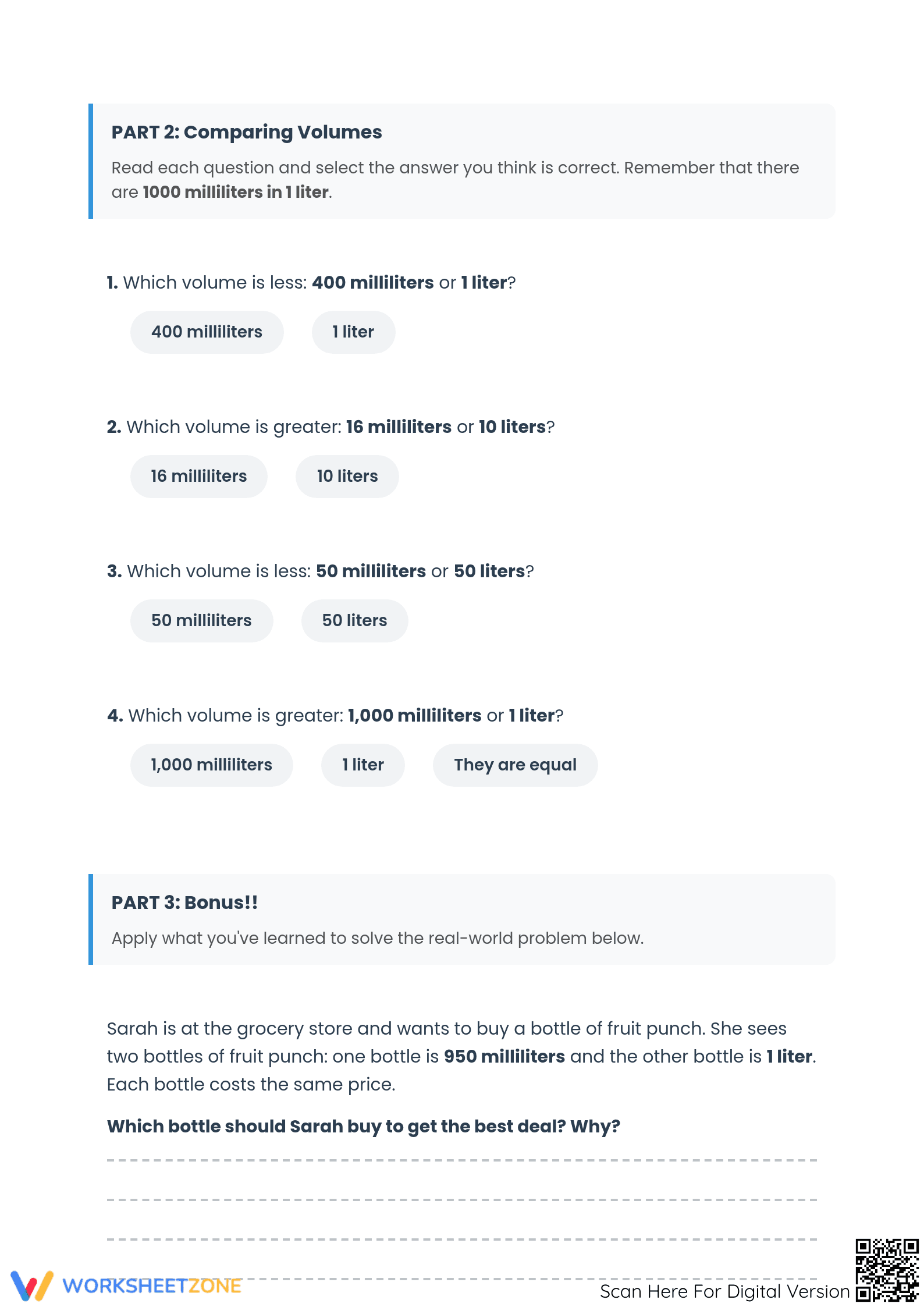
This Grade 4 capacity worksheet helps students master the relationship between milliliters and liters through 9 practical exercises. Students identify appropriate units for everyday objects and compare volumes to build a strong conceptual foundation for metric measurement. The clear layout ensures students focus on the logic of volume rather than complex calculations.
At a Glance
- Grade: 4 · Subject: Math
- Standard:
CCSS.MATH.CONTENT.4.MD.A.1— Know relative sizes of measurement units within one system of units- Skill Focus: Capacity (mL vs L)
- Format: 2 pages · 9 problems · Answer key included · PDF
- Best For: Independent practice or homework
- Time: 15–20 minutes
The resource contains two pages of structured practice. Page one features four identification tasks where students select the most logical unit (mL or L) for common items like laundry detergent and eye droppers. Page two includes four comparison problems and a real-world bonus word problem involving grocery store pricing. A complete answer key is provided for quick grading and student self-correction.
Teachers can implement this resource in under 2 minutes. Simply print the two-page PDF (1 minute), distribute to students for a quick warm-up or exit ticket (30 seconds), and use the included answer key for immediate feedback or peer-grading (30 seconds). It is an ideal "grab-and-go" option for substitute plans or unexpected schedule changes during a measurement unit.
The primary focus is `CCSS.MATH.CONTENT.4.MD.A.1`, which requires students to know relative sizes of measurement units within one system of units. This worksheet specifically targets the capacity component of the standard, helping students distinguish between small and large volumes. Both standard codes can be copied directly into lesson plans, IEP goals, or district curriculum mapping tools.
Use this worksheet during the independent practice phase of a lesson on metric capacity. It works best after students have explored physical containers of 1 liter and 1 milliliter. As a formative assessment, observe if students struggle with the "Bonus" word problem, which indicates a need for more practice with unit comparison logic. Completion typically takes 15 to 20 minutes.
This resource is designed for Grade 4 and 5 students learning the metric system. It provides excellent support for English Language Learners (ELLs) through visual icons and clear, repetitive sentence structures. Pair this with a hands-on "capacity hunt" where students find classroom objects to measure or estimate using the units practiced here.
According to the RAND AIRS 2024 report, high-quality supplemental materials that bridge conceptual understanding with real-world application significantly improve student retention of measurement standards. This worksheet aligns with CCSS.MATH.CONTENT.4.MD.A.1 by requiring students to evaluate the relative size of milliliters and liters in practical contexts. By moving from simple identification to complex comparison and a final word problem, the resource follows the evidence-based instructional design principles highlighted by Fisher & Frey (2014). Research indicates that providing students with immediate feedback via answer keys, as included here, accelerates the mastery of metric conversions and estimation skills. This 2-page PDF serves as a reliable tool for educators seeking to meet NAEP proficiency benchmarks in measurement and data analysis while maintaining a low-prep classroom environment.


