These 4th grade measurement and capacity printable worksheets resources give teachers a ready-made set of focused practice for one of the most conversion-heavy units in the elementary math curriculum — liquid volume in both the customary and metric systems. Each worksheet targets a discrete skill, so you can drop one into a math center on Monday, use another as a Thursday exit ticket, and pull a third for small-group reteaching without losing instructional continuity.
The Specific Skills in Each Worksheet
The set covers five interconnected areas, moving from unit identification through multi-step problem solving:
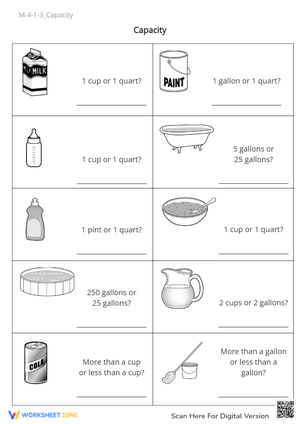
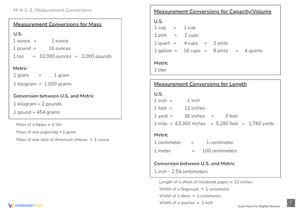
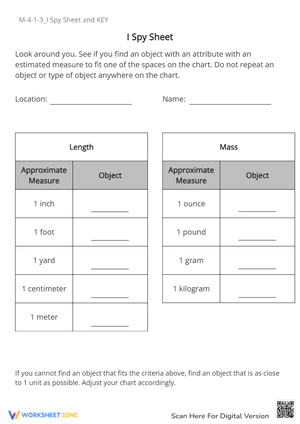
- Identifying appropriate customary units — fluid ounces, cups, pints, quarts, and gallons — for real-world containers ranging from a medicine dropper to a bathtub
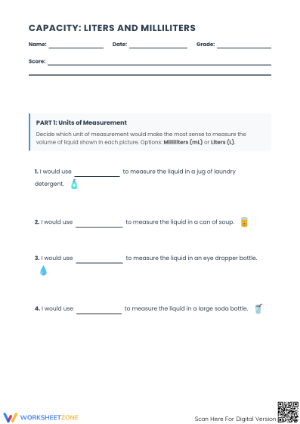
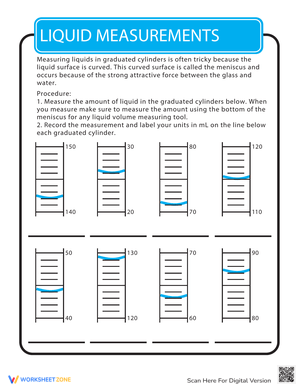
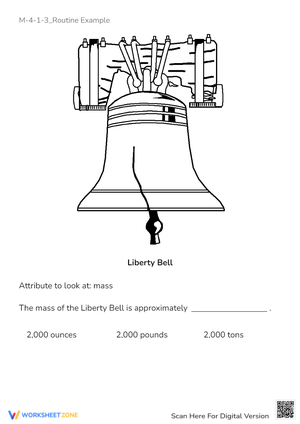
- Recognizing benchmark metric volumes, primarily milliliters and liters, and matching them to familiar objects like water bottles and eyedroppers
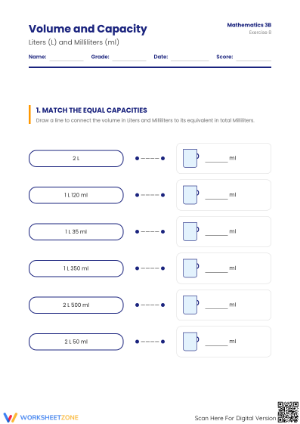
- Completing two-column conversion tables that move from a larger unit to a smaller unit within one system
- Solving single-step and multi-step word problems that require unit conversion before computing an answer
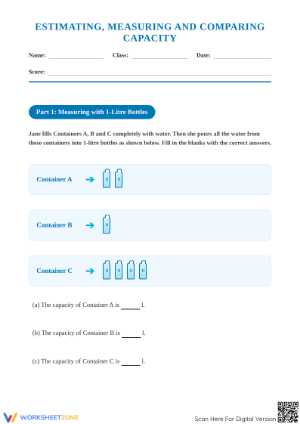
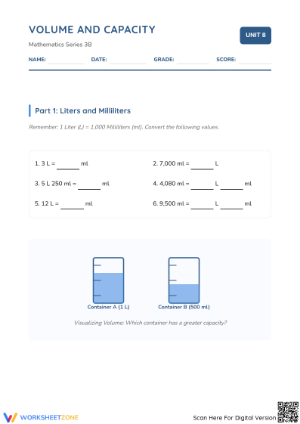
- Estimating and comparing capacity using greater than/less than reasoning between labeled containers
The balance between customary and metric work is deliberate. Students who gain fluency with one system often hit a wall when the other appears on an assessment, and keeping both in rotation throughout the set prevents that gap from developing quietly.
Frequent Student Errors Worth Watching For
The most persistent error in this unit isn't forgetting the conversion factor — it's applying it in the wrong direction. A student who correctly knows that one gallon equals four quarts will still write ÷ 4 when converting gallons to quarts, because dividing feels like "breaking something into parts," which seems conceptually right. The two-column table format makes this error immediately visible: if a student's quart column shows smaller numbers than the gallon column, the contradiction sits right in front of them, and that's a productive moment to press on the reasoning.
A subtler issue appears in metric work. Fourth graders carry strong place-value knowledge by spring, but many write 1 liter = 100 milliliters, reaching for the familiar hundreds relationship rather than the correct 1,000. When a word problem asks for the milliliter equivalent of 3 liters and a student writes 300, the place-value pull is the culprit — not carelessness. Watching for that specific wrong number during independent practice tells you immediately who needs more time at the benchmark-building stage before moving to conversion tables.
How to Work These Worksheets Into Your Week
Begin the unit with a concrete measuring station before any worksheet appears. Let students pour water between a gallon jug, quart containers, and pint cups so the physical relationships exist in memory before the numbers arrive. Then introduce 4th grade measurement and capacity printable worksheets tasks in this sequence: benchmark identification first, conversion tables second, word problems third. This ordering follows a gradual release of cognitive demand — students aren't asked to transfer knowledge to an unfamiliar format until the underlying relationships feel stable.
Exit tickets drawn from the conversion-table worksheets work particularly well in the final ten minutes of a lesson block. Two or three items give you a fast read on whether tomorrow's instruction can advance to word problems or needs another pass through the basic tables. In a math center rotation, these worksheets fit naturally at the written-practice station, where you can review student work alongside what's happening at the hands-on measuring station and spot which students need the two experiences connected for them explicitly.
Adapting the Set for Mixed-Ability Classrooms
For students still consolidating conversion facts, reduce the cognitive load on word-problem worksheets by allowing a reference card — just the five customary unit relationships written out. The goal at that stage is practicing the conversion reasoning, not retrieving facts under pressure. Pull the card once the reasoning process holds up independently.
Students who move through the standard tasks quickly benefit from a different kind of challenge. Ask them to work backward: given a number of cups, build the two-column table themselves before writing the conversion rule it demonstrates. This reversal requires structural thinking that goes well beyond filling in a pre-built table. The 4th grade measurement and capacity printable worksheets tasks that include open-ended comparison problems — which of these three containers holds the most? show your work in two different unit systems — give advanced students meaningful work without requiring separate materials entirely.
Standard Alignment
These 4th grade measurement and capacity printable worksheets resources align to CCSS 4.MD.A.1, which requires students to know the relative sizes of measurement units within one system, record equivalents in two-column tables, and express larger units in terms of smaller units. The standard explicitly names fluid ounces, cups, pints, quarts, gallons, liters, and milliliters as the expected unit vocabulary at this grade. The conversion-table format used across several worksheets directly mirrors the recording structure the standard describes, so students are also practicing the organizational approach they'll encounter on formal assessments. Cross-system conversion — liters to gallons, for instance — is not part of this standard and does not appear in the set.
Frequently Asked Questions
Do these worksheets cover both customary and metric units?
Yes. Some worksheets work exclusively with customary units — fluid ounces through gallons — while others build metric fluency with milliliters and liters. No worksheet in the set asks students to convert between the two systems, which matches the scope of 4.MD.A.1. Cross-system conversion is a middle school expectation.
What's the best way to sequence these alongside hands-on measurement activities?
Use the hands-on station first, worksheets second. Students who have handled a quart container treat "1 quart = 2 pints" as a confirmed physical fact rather than a rule to memorize. Even a brief pouring activity — ten minutes at the start of the first lesson — changes how durably students hold conversion relationships when they're working independently at their desks.
Are the word problems single-step or multi-step?
Both. Earlier word-problem worksheets ask students to perform one conversion and identify the result. Later ones require students to convert first and then add, subtract, or compare — the two-step structure that appears regularly on state math assessments at this grade level.
How do I introduce the "Big G" visual before students use the customary conversion worksheets?
Draw the nested G on the board once as a class. Inside the G (gallon), draw four Qs (quarts). Inside each Q, draw two Ps (pints). Inside each P, draw two Cs (cups). Students can sketch this in the corner of any customary conversion worksheet they're working on. It takes about two minutes to teach and removes the need to memorize the conversion chain as a list of disconnected facts — which is exactly where most errors originate.













 Interactive Worksheet Maker
 Quiz Maker
 Word Search Maker
 Crossword Puzzle Maker
 Word Scramble Generator
 Sentence Scramble Generator
 Handwriting Worksheet Generator
 Name Tracing Generator
 Fill In The Blank Generator