


























Views
Downloads

Printable Decimals to Fractions Worksheet | Grade 4-5 Math
Paste this activity's link or code into your existing LMS (Google Classroom, Canvas, Teams, Schoology, Moodle, etc.).
Students can open and work on the activity right away, with no student login required.
You'll still be able to track student progress and results from your teacher account.
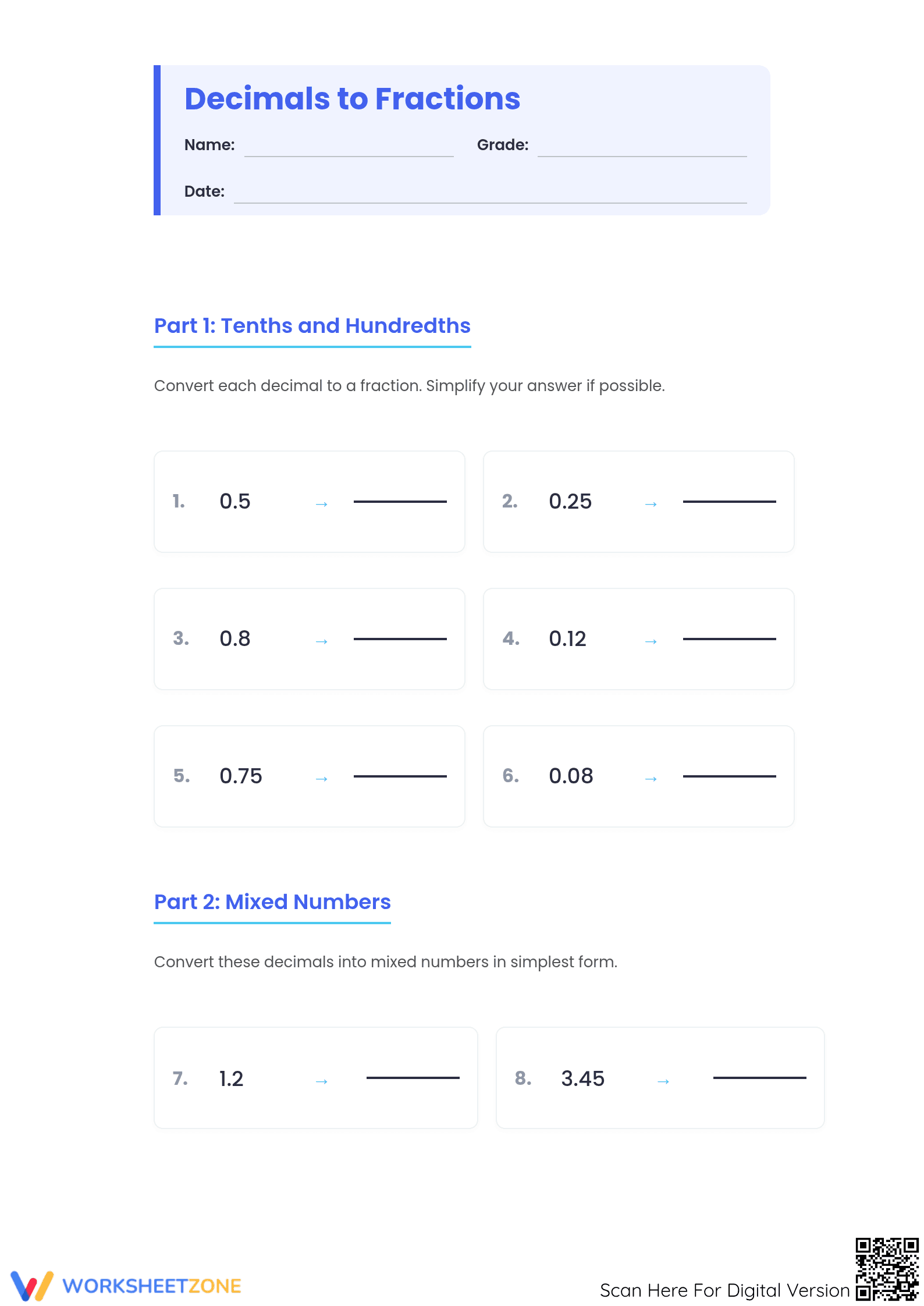
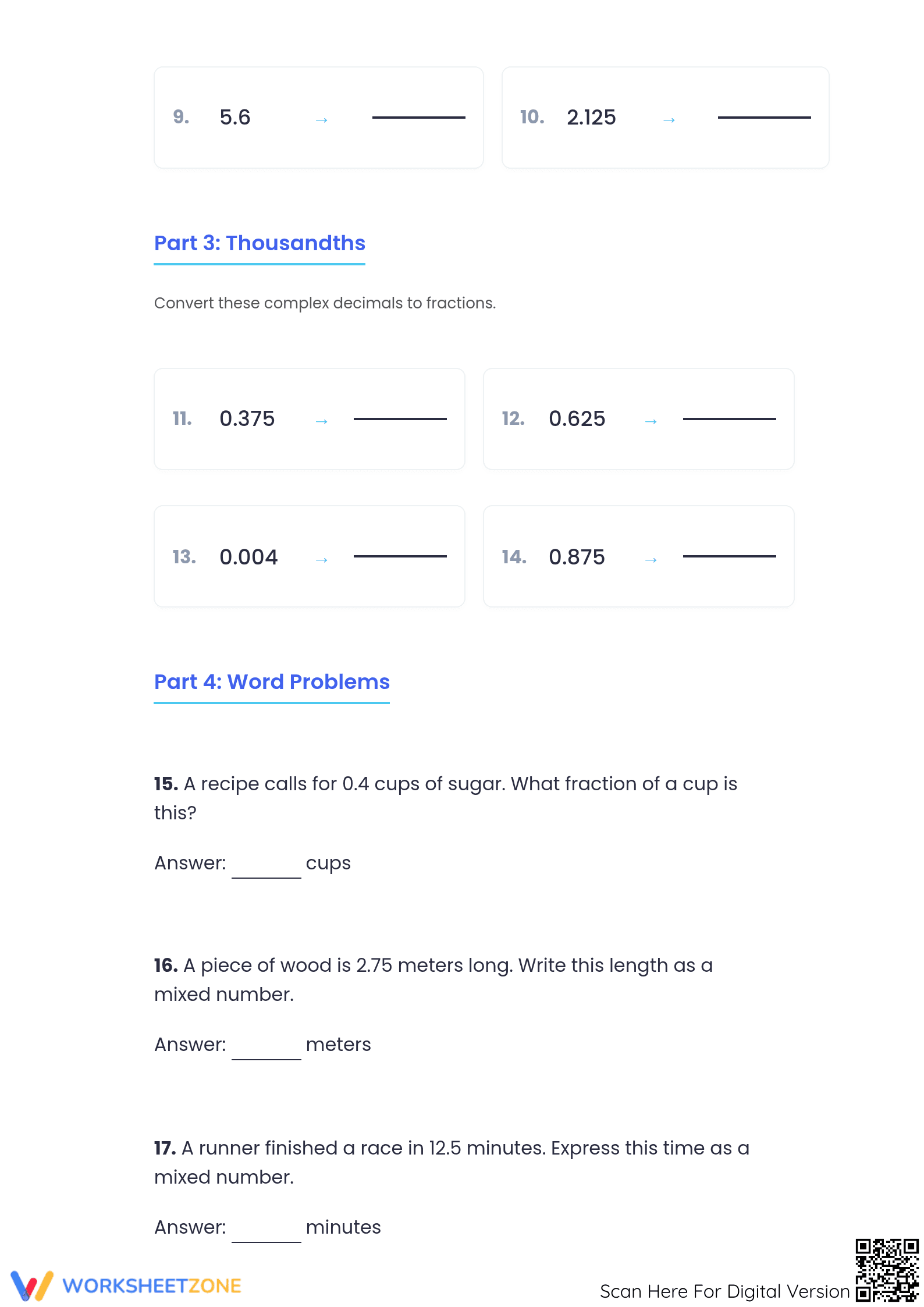
This math worksheet helps students master converting decimals to fractions and mixed numbers. Through 17 structured problems, learners transition from tenths and hundredths to thousandths and word problems. This resource ensures students develop a deep understanding of place value and fraction equivalence, providing essential practice for upper elementary success.
At a Glance
- Grade: 4–7 · Subject: Math · Decimals
- Standard:
CCSS.MATH.CONTENT.4.NF.C.6— Use decimal notation for fractions with denominators 10 or 100- Skill Focus: Decimal to fraction conversion
- Format: 2 pages · 17 problems · Answer key included · PDF
- Best For: Fifth-grade classroom practice or homework
- Time: 20–30 minutes
What's Inside
This two-page PDF features four sections to build confidence. Parts 1 and 2 cover tenths, hundredths, and mixed numbers, including instructions to simplify results. Part 3 introduces thousandths, while Part 4 applies skills to real-world word problems. A full answer key is included to facilitate quick grading and immediate student feedback.
Skill Progression
- Guided practice: The first six problems framework converting simple decimals like 0.5 into fractions, emphasizing the relationship between place value and denominators.
- Supported practice: Students progress to mixed numbers and thousandths (e.g., 2.125), requiring them to apply deeper place value understanding.
- Independent practice: Word problems require students to extract data from a context and represent it as a fraction without scaffolding.
This worksheet follows the gradual-release model, moving from explicit patterns to independent application.
Standards Alignment
This worksheet aligns with `CCSS.MATH.CONTENT.4.NF.C.6`: Use decimal notation for fractions with denominators 10 or 100. It also supports 5th-grade standards by extending place value to thousandths. Both standard codes can be copied directly into lesson plans, IEP goals, or district curriculum mapping tools.
How to Use It
Use this as a formative assessment or a bridge between units. Observe how students handle mixed numbers; struggles here may indicate a need for whole-number place value review. Completion typically takes 20–30 minutes.
Who It's For
Ideal for Grade 4 and 5 students developing numerical fluency. It also serves as a remedial review for Grade 6 and 7 students. Pair with a place value anchor chart for maximum instructional impact.
Mastering the conversion between decimals and fractions is a foundational milestone in upper elementary mathematics. According to NAEP data, students who can fluently navigate between different numerical representations demonstrate significantly higher proficiency in later algebraic reasoning and proportional thinking. This worksheet directly targets the `CCSS.MATH.CONTENT.4.NF.C.6` standard, which emphasizes the conceptual link between decimal notation and base-ten fractions. Research from Fisher & Frey (2014) highlights that structured practice with varied problem types—including mixed numbers, word problems, and multi-digit decimals—reinforces long-term retention of mathematical concepts more effectively than isolated drill. By providing 17 tasks across multiple sections, this resource offers the repetitive but meaningful practice necessary for students to achieve true mastery in decimal-fraction equivalence. The inclusion of word problems ensures that students are not merely memorizing procedures but are applying their knowledge to solve practical, real-world challenges in measurement and time management.


