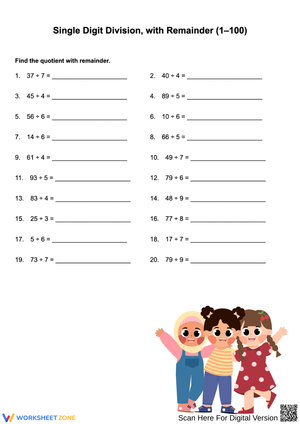
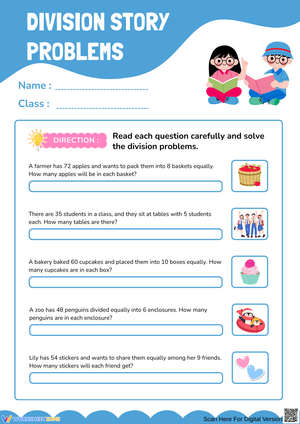
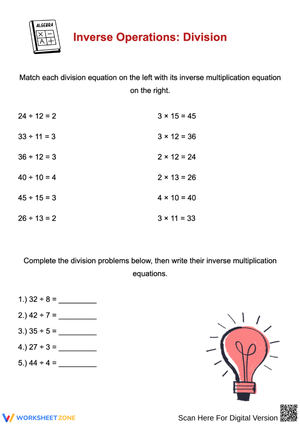
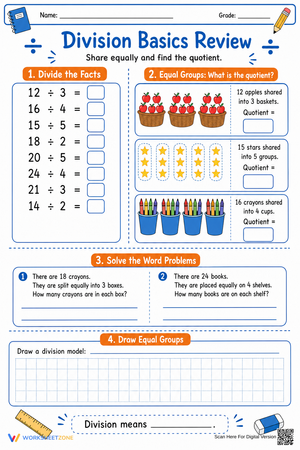
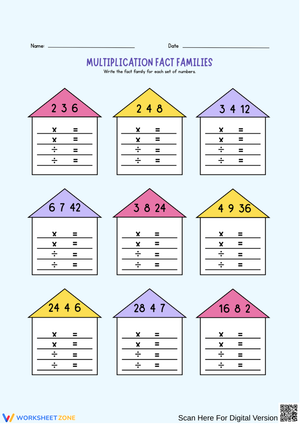
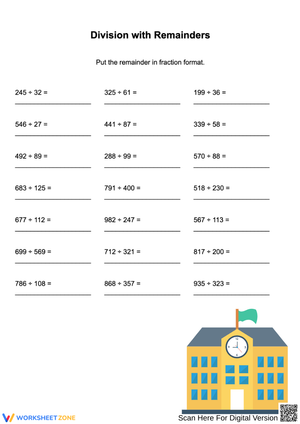
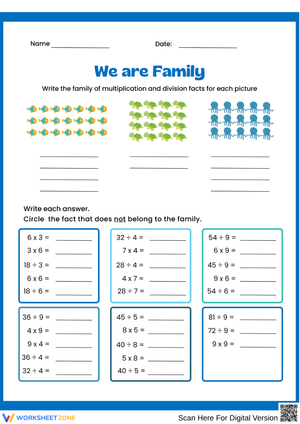
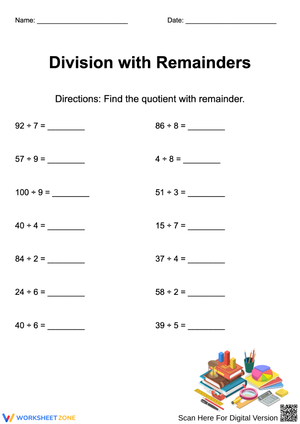
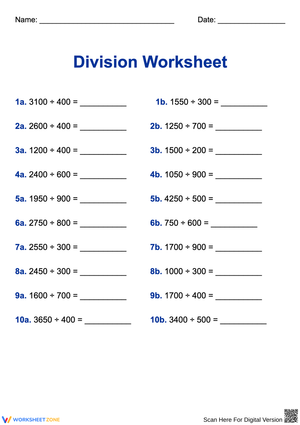
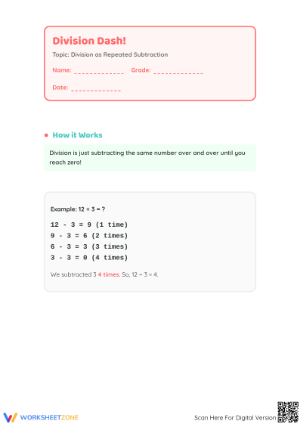
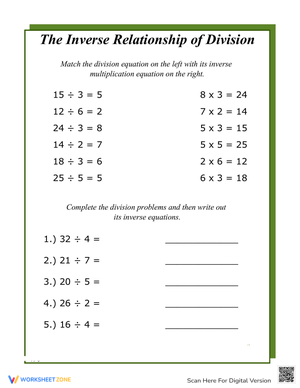
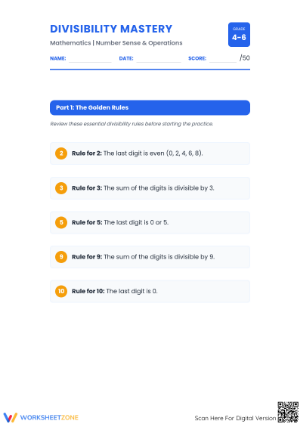
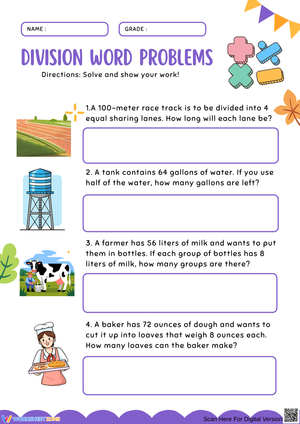
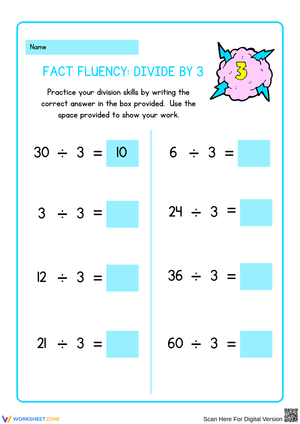
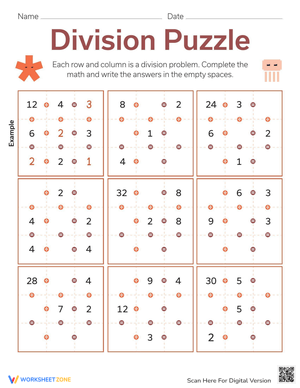
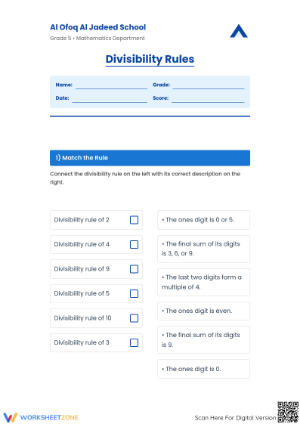
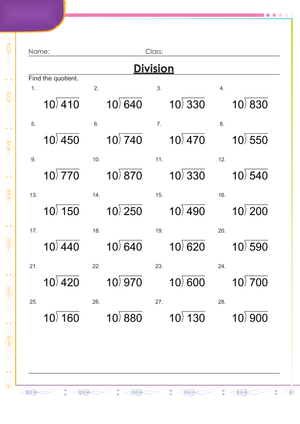
These 4th grade division printable worksheets cover the stretch of instruction from area models and partial quotients all the way through multi-digit long division with remainders — a span that typically runs three to five weeks and produces more genuinely confused faces than almost any other unit at this grade level. Each worksheet targets a specific skill within that progression, so teachers can assign them selectively rather than handing out a generic computation sheet and waiting to see who surfaces. The resources include grid-lined versions for students who lose track of digit placement once problems grow past two steps.
Concepts Covered Across the Set
The worksheets move through several interconnected areas of division, tracking closely with how the skill actually develops from initial understanding to fluent execution.
- Partial quotients: Students subtract friendly multiples of the divisor from the dividend in chunks, recording each partial result before totaling. This method directly supports place value reasoning and gives students a foothold before the standard algorithm is introduced.
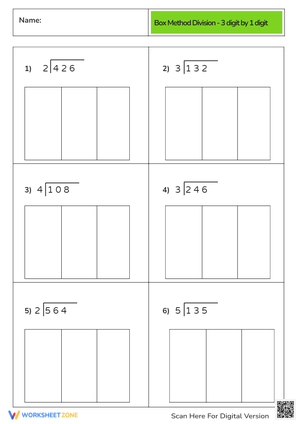
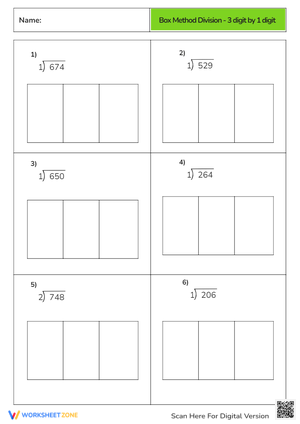
- Area models: Each worksheet in this group frames division as finding an unknown side length of a rectangle. Students partition that rectangle into sections corresponding to hundreds, tens, and ones — making the decomposition of the dividend visible rather than abstract.
- Standard long division algorithm: Students work through four-digit dividends divided by single-digit divisors, with enough structured workspace that alignment doesn't collapse mid-problem.
- Remainder interpretation: Word problems require students to decide whether the remainder gets dropped, rounds the quotient up by one, or is expressed as a fraction. All three scenarios appear explicitly across the set.
- Grid-lined computation practice: Several worksheets print with a fine grid behind the work area, correcting the drift that happens when students write digits on blank paper across a long, multi-step problem.
Errors Students Make — and What They Reveal
The most consistent problem in student work at this stage isn't a multiplication error — it's a place-value error dressed up as one. A student who correctly divides 84 by 4 and writes "21" will often work through 846 ÷ 4 and record the first partial quotient one column to the right of where it belongs, producing a wildly off answer. The student isn't confused about division; they've lost the thread of which digit they're working with. The grid-lined worksheets exist specifically because of this pattern.
Remainder interpretation in word problems is its own category of error, and it's stubbornly persistent. Students who arrive at "5 remainder 3" for a problem about seating 43 students in vans that hold 8 routinely write "5 vans" — the arithmetic is correct, three students are just implicitly left behind. The word problem worksheets push students to write a full sentence answering the question, not just a number, which forces them to confront what the remainder actually means in context rather than treating it as a leftover to ignore.
A third error pattern appears specifically during the transition from partial quotients to the standard algorithm. Students who understand the math perfectly well through partial quotients sometimes abandon their reasoning entirely when the standard format is introduced, treating it as a new procedure with no connection to what they already know. Starting with a side-by-side comparison — both methods solving the same problem simultaneously — reduces this disconnect more effectively than re-teaching either method in isolation.
Standard Alignment
The core standard these resources address is CCSS 4.NBT.B.6: finding whole-number quotients and remainders with up to four-digit dividends and one-digit divisors, using strategies based on place value, the properties of operations, and the relationship between multiplication and division. The standard also requires students to illustrate and explain their work using equations, rectangular arrays, and area models — which is why the area model worksheets aren't supplemental here. They're central to what this standard actually asks students to demonstrate.
The word problem worksheets additionally address CCSS 4.OA.A.3, which asks students to solve multi-step problems using the four operations, interpret remainders in context, and assess the reasonableness of their answers. Teachers documenting standard mastery for both 4.NBT.B.6 and 4.OA.A.3 can pull from different worksheets in the set to gather evidence across both standards without pulling from separate materials.
Putting These Worksheets to Work Across a Division Unit
The sequencing matters more than most teachers expect. Area model worksheets work best in the first week of instruction, before students see the standard algorithm at all. Partial quotients come next — most teachers spend two to three days here before students feel comfortable — and the standard algorithm worksheets land last. Reversing this order and then circling back to models rarely sticks; students who've been shown the "fast" method resist returning to draw rectangles.
One specific tip that reduces friction during long division: before students begin any computation worksheet, have them write the divisor's multiples — one through nine — in the margin. A student dividing by 7 writes 7, 14, 21, 28, 35, 42, 49, 56, 63 across the top of their workspace before touching a single problem. This eliminates the working-memory strain of recalling multiplication facts while simultaneously tracking digit placement and running subtraction — three cognitive demands competing for attention at once. Students who do this move through the worksheet faster and make fewer errors at the multiplication step.
The 4th grade division printable worksheets in the word problem group work well as the last ten minutes of a math block, either as a formative check or a true exit ticket. Answer keys allow for fast turnaround scoring or self-correction projected at the board — both approaches give students immediate feedback before misconceptions settle in overnight.
Meeting Students at Different Points in the Division Progression
Students who haven't consolidated their multiplication facts hit a wall with long division that no amount of algorithm instruction fixes. For those students, the partial quotients worksheets are the right starting point — and staying there longer than feels comfortable is usually the right call. The method lets students use facts they do know (multiples of ten, easy doubles) to make progress, even if they can't yet recall 8 × 7 on demand.
Students on the other end of the range — those who moved past the standard algorithm quickly — get the most out of the remainder-interpretation word problems. These ask them to do more than compute; they have to read carefully, identify what each number represents in context, and write an answer that reflects the actual situation rather than just the quotient. That's a meaningful stretch that doesn't simply mean harder numbers in the same format.
For students with organization difficulties, assigning the 4th grade division printable worksheets that include a printed grid is a small structural change with a noticeable payoff. Digit alignment corrects itself when students can't drift between columns, and students who've been making consistent alignment errors often find the grid worksheets significantly less frustrating than blank work areas. It removes the organizational obstacle without changing the mathematical demand at all.
Frequently Asked Questions
When should I introduce the standard long division algorithm relative to partial quotients?
Wait until students can work through several partial quotients problems with reasonable accuracy — two to three class days is usually the minimum. Students who understand why partial quotients work, that they're subtracting chunks of the dividend, make the transition to the algorithm more smoothly because they can interpret what each step is actually doing rather than following a memorized sequence of moves. The 4th grade division printable worksheets in the partial quotients group include enough workspace and worked-out structure to support that first phase fully before the algorithm enters the picture.
My students solve the division correctly but write the wrong answer to word problems involving remainders. What's happening?
This is one of the most reliable gaps in this unit. Students are performing the arithmetic correctly but detaching from the context of the problem once they have a number. The fix is requiring a written sentence — not just a number — as the final answer. "5 remainder 3" is not an answer to a real-world question about seating students; "The class needs 6 vans" is. The word problem worksheets in the set include answer lines that prompt for a full written response, which holds students accountable for connecting their calculation back to the situation rather than stopping at the quotient.
How do I help the student who keeps misaligning digits no matter how many times I redirect?
Start with the grid-lined worksheets — a printed grid eliminates most alignment errors on its own without any additional instruction. If the problem persists even with grid lines, the student is likely losing track of which operation they're currently performing. Dividing, multiplying, subtracting, and bringing down are four distinct steps cycling in sequence, and the student needs an external anchor. Teaching a simple margin checklist alongside the grid worksheet usually closes the gap. If alignment continues to be an obstacle, returning to partial quotients for a few days builds the underlying place-value understanding that makes alignment meaningful rather than just mechanical.













 Interactive Worksheet Maker
 Quiz Maker
 Word Search Maker
 Crossword Puzzle Maker
 Word Scramble Generator
 Sentence Scramble Generator
 Handwriting Worksheet Generator
 Name Tracing Generator
 Fill In The Blank Generator