


























Views
Downloads



Division Subtraction Worksheet (3 Levels) | Grade 3 Ready
Paste this activity's link or code into your existing LMS (Google Classroom, Canvas, Teams, Schoology, Moodle, etc.).
Students can open and work on the activity right away, with no student login required.
You'll still be able to track student progress and results from your teacher account.
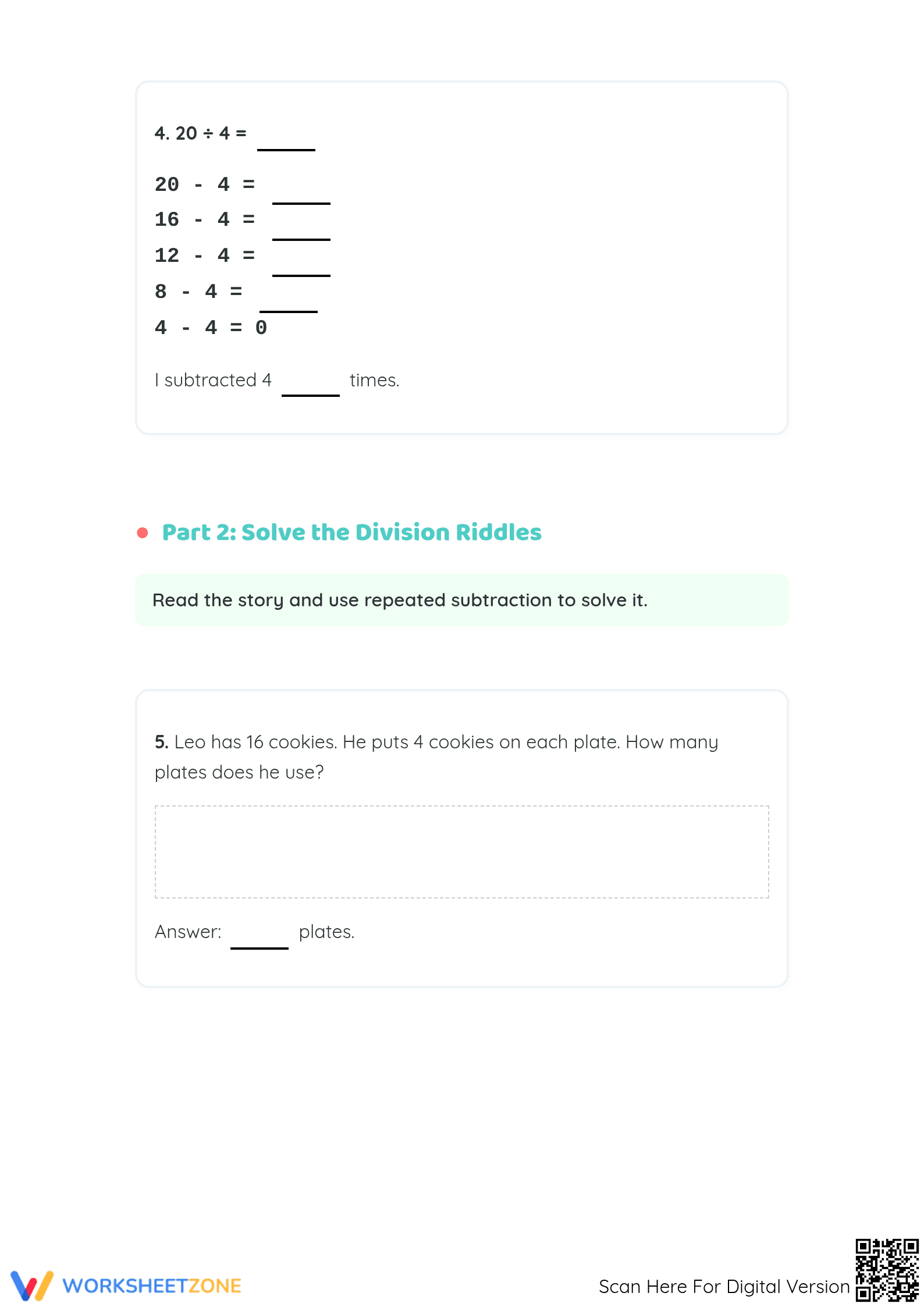
This worksheet provides a clear, structured introduction to division using the repeated subtraction method, suitable for students in grades 2 through 4. It helps learners visualize division by breaking down larger numbers into smaller, equal groups, building a foundational understanding of the relationship between division and subtraction.
At a Glance
- Grade: 2–4 · Subject: Math
- Standard:
CCSS.MATH.CONTENT.3.OA.A.2— Interpret whole-number quotients of whole numbers.- Skill Focus: Division as Repeated Subtraction
- Format: 5 pages · 20 problems · Answer key included · PDF
- Best For: Differentiated practice, concept introduction, small groups
- Time: 20–30 minutes
What's Inside
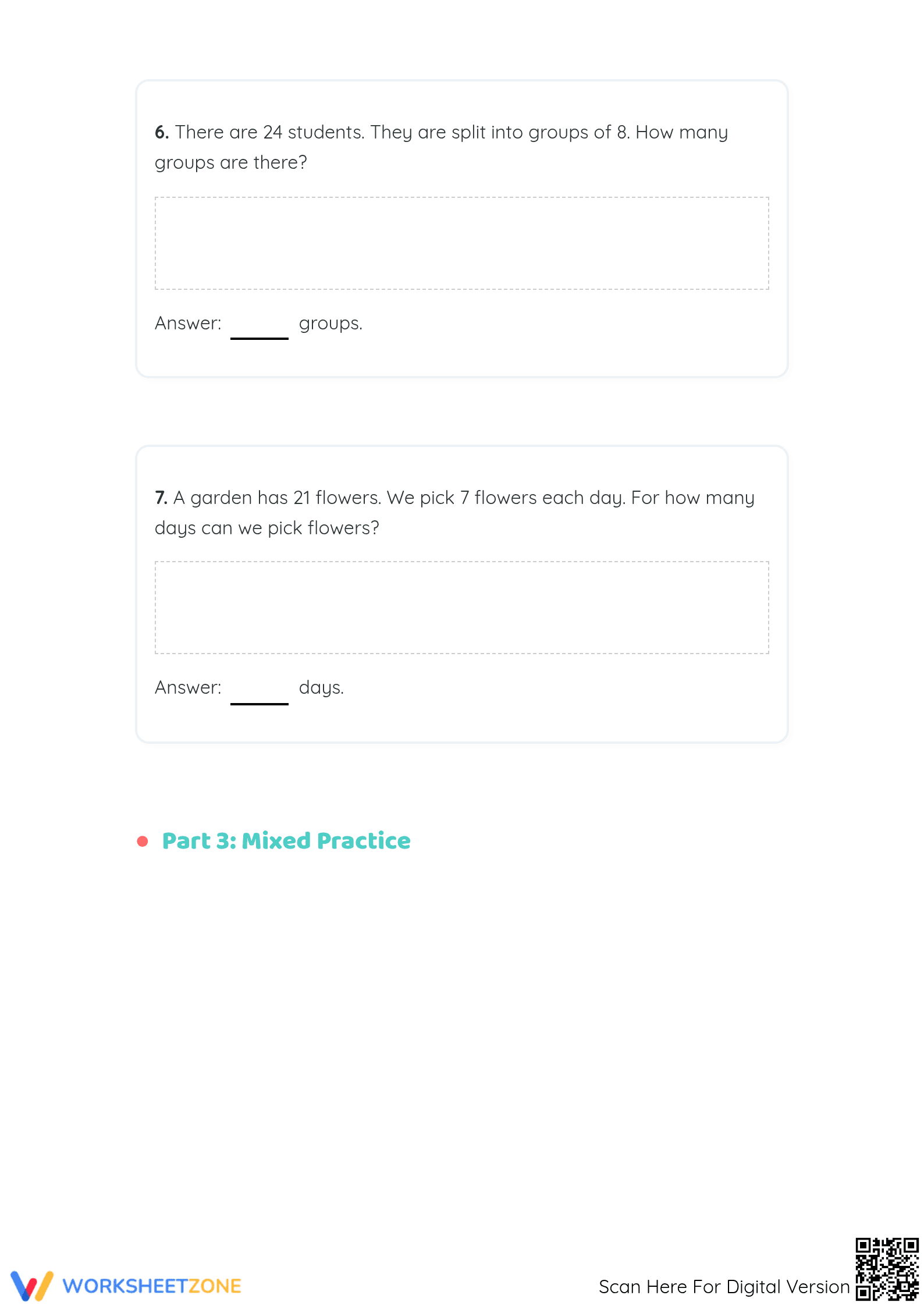
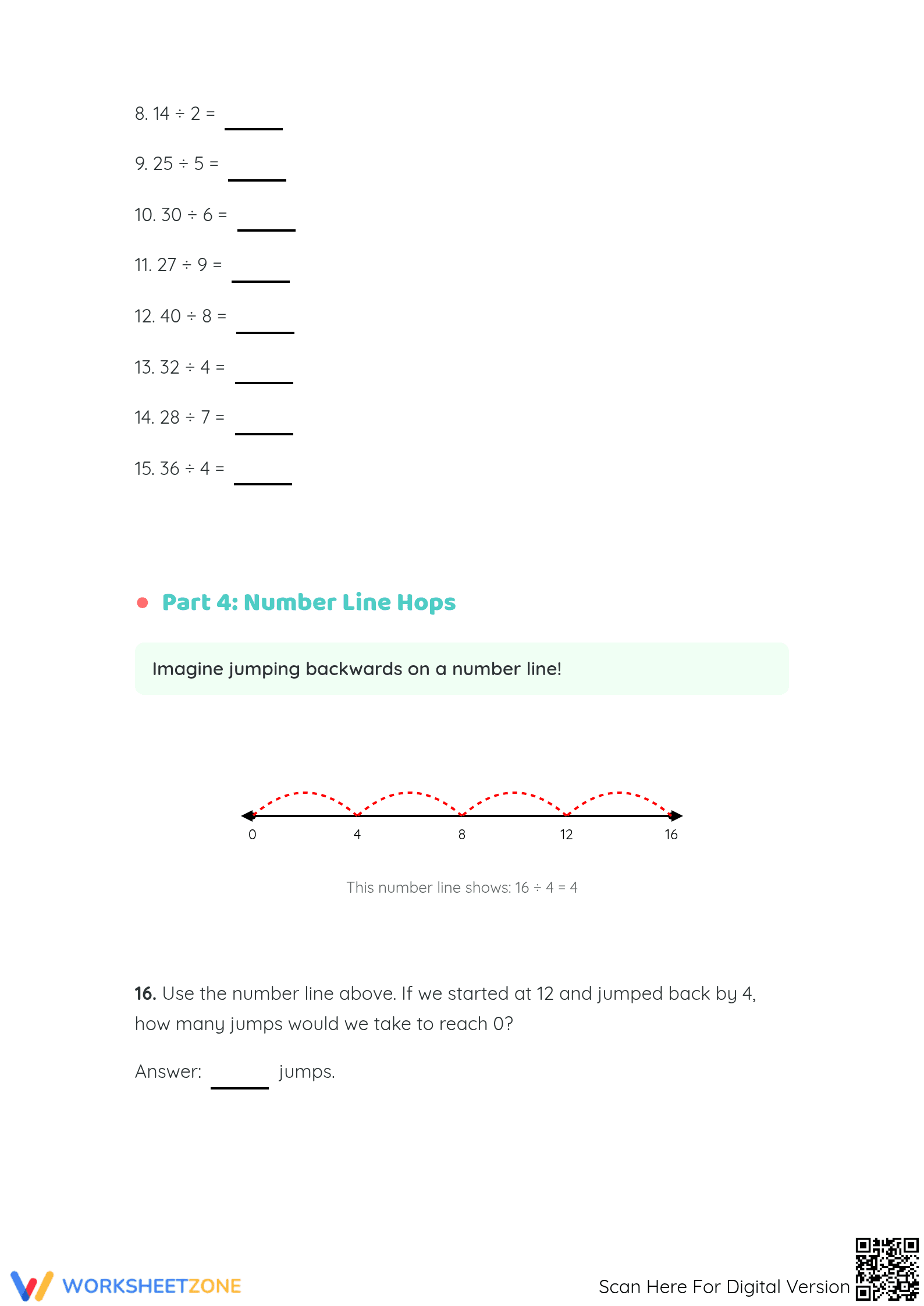
This resource includes a 5-page worksheet with a total of 20 division problems. Each problem is framed as a repeated subtraction task, with number lines provided for initial problems to scaffold the concept. A complete, page-by-page answer key is included for easy grading or self-correction by students.
Level Descriptions
The worksheet is structured to support a range of learners across second, third, and fourth grade with built-in differentiation.
- Below Grade (Grade 2): The first pages use smaller numbers (dividends under 20) and include number lines to provide strong visual support for the repeated subtraction process.
- On Grade (Grade 3): Problems progress to larger two-digit dividends, requiring students to perform more subtraction steps and solidify their understanding in line with third-grade expectations.
- Above Grade (Grade 4): The final pages challenge students with more complex problems, preparing them for multi-digit division and reinforcing the efficiency of the division algorithm.
All three levels are included in this single download, allowing teachers to assign different pages based on individual student needs.
Standards Alignment
This worksheet is directly aligned with the Common Core State Standard CCSS.MATH.CONTENT.3.OA.A.2, which requires students to "Interpret whole-number quotients of whole numbers." It also supports the development of skills for CCSS.MATH.CONTENT.2.OA.C.4 by using addition to find the total number of objects arranged in rectangular arrays, which is conceptually related. Both standard codes can be copied directly into lesson plans, IEP goals, or district curriculum mapping tools.
How to Use It
This worksheet is ideal for use after an initial direct instruction lesson on the concept of division. Use it as a formative assessment to check for understanding before moving to more abstract division strategies. For a small group activity, have students work in pairs to explain their subtraction steps to one another. Expect most students to complete their assigned section within 20-30 minutes.
Who It's For
This resource is designed for elementary students in grades 2, 3, and 4 who are learning division for the first time or need reinforcement on the concept. The leveled approach makes it suitable for inclusive classrooms with diverse learners. It pairs well with a hands-on activity using manipulatives to physically act out the repeated subtraction process.
This worksheet reinforces a foundational approach to division aligned with standard CCSS.MATH.CONTENT.3.OA.A.2, which focuses on interpreting whole-number quotients. By having students use repeated subtraction, it connects division to a more familiar operation, a strategy supported by extensive research on building mathematical fluency. As Fisher & Frey (2014) note, procedural fluency must be built upon conceptual understanding. This worksheet provides the structured practice necessary for students to grasp the concept of division as equal partitioning before they are asked to memorize abstract facts. The progression from visual models with number lines to more abstract problems with larger numbers provides the scaffolding needed to move students toward proficiency. The 20 problems offer sufficient practice to identify and address common misconceptions, a key factor highlighted in the NAEP framework for effective mathematics instruction.


