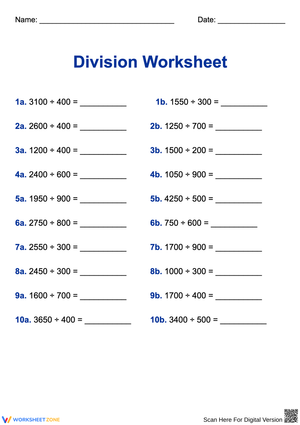
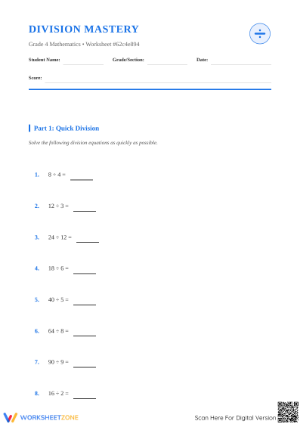
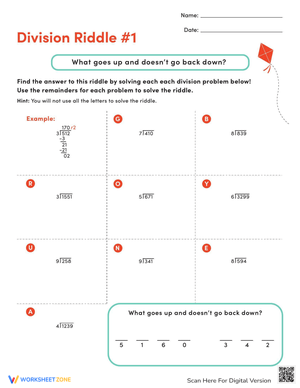
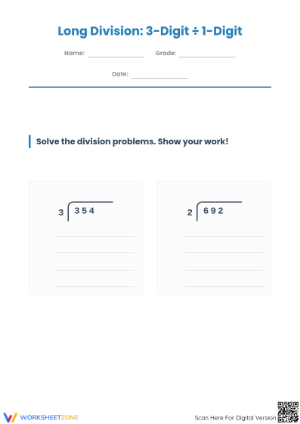
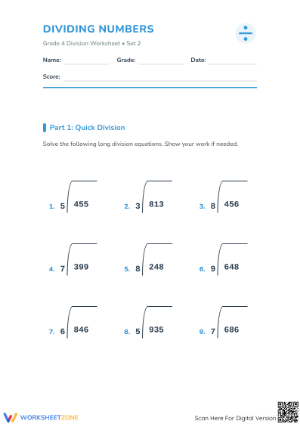
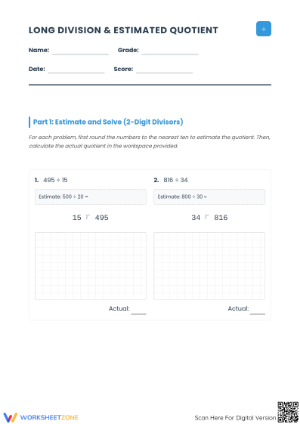
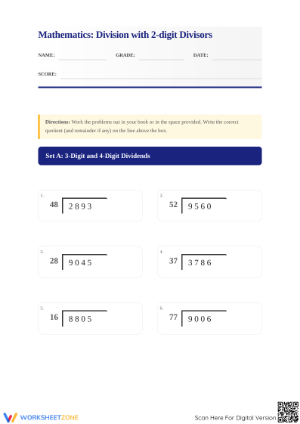
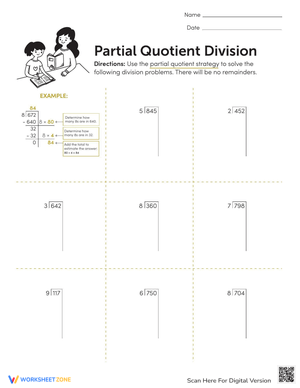
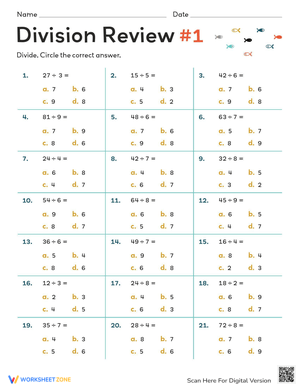
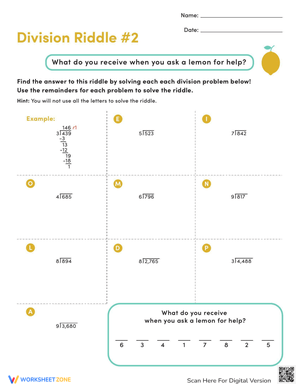
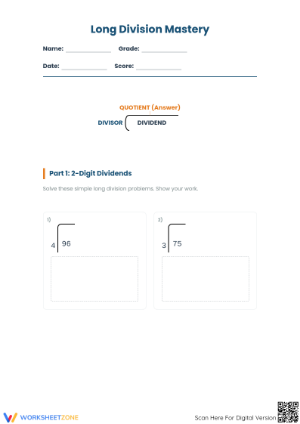
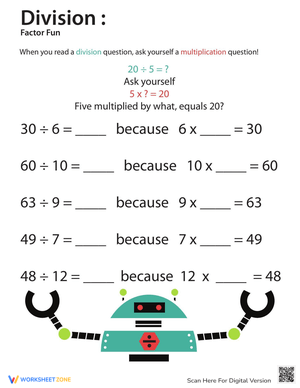
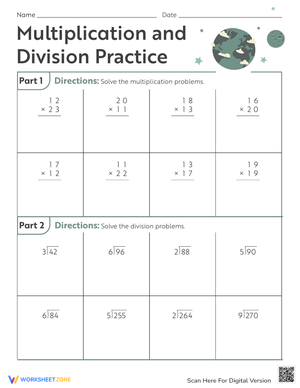
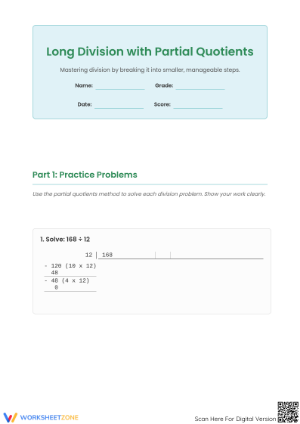
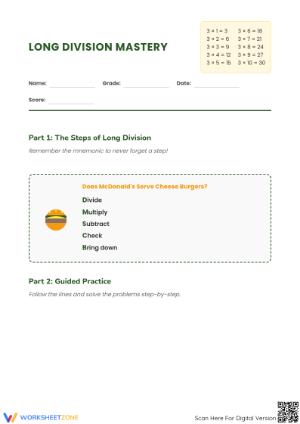
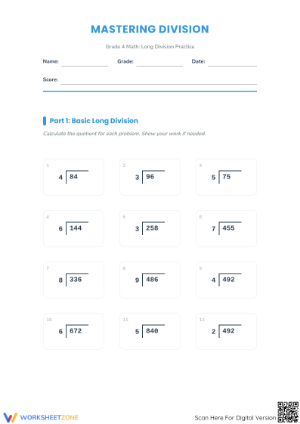
These long division pdf worksheets for 4th grade move students through the full range of what the grade level demands — two-digit dividends up through four-digit problems with remainders — with each worksheet focused on a specific problem type rather than mixing formats at random. Teachers get a ready-to-use set that drops into guided practice, independent work, or a targeted small-group session without requiring any prep beyond printing.
The Specific Skills Each Worksheet Builds
The set works through long division systematically, starting where students need the clearest support and progressing toward the full standard expectation. Skill areas across the worksheets include:
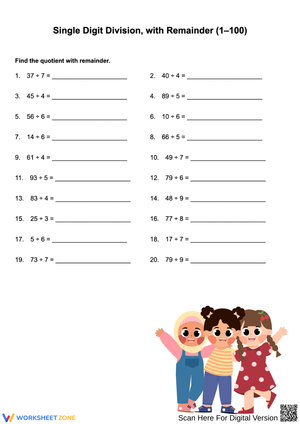
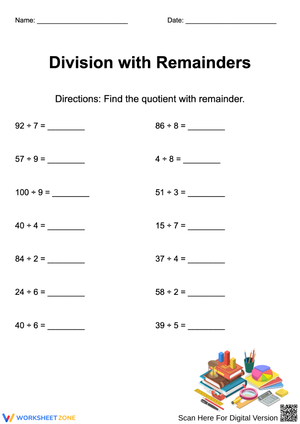
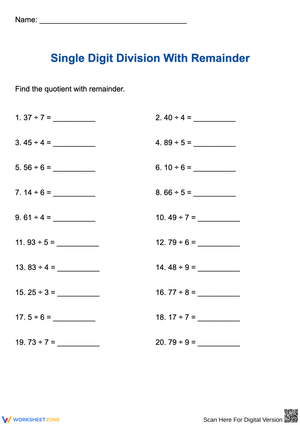
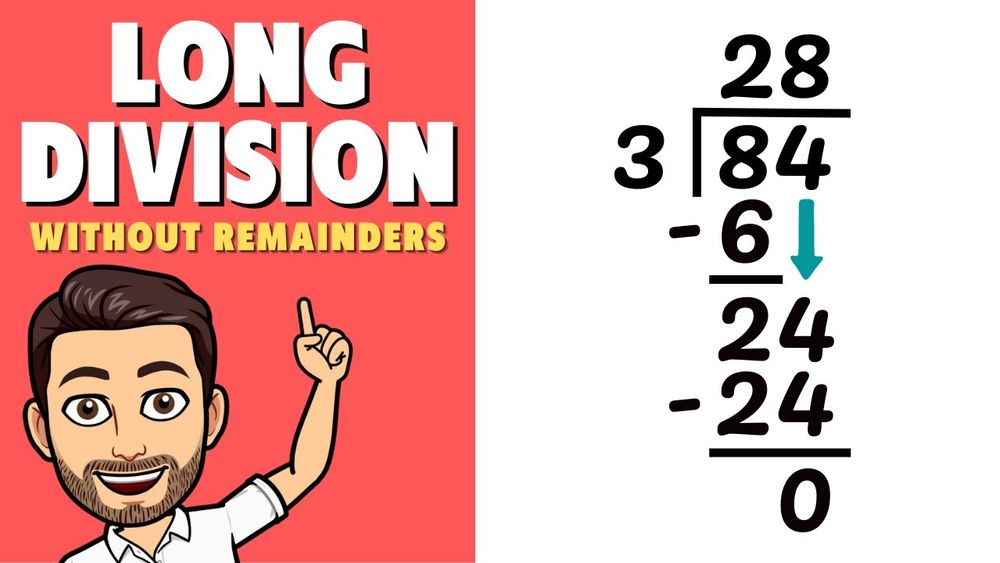
- 2-digit ÷ 1-digit problems — the entry point for students just learning the Divide, Multiply, Subtract, Bring Down sequence
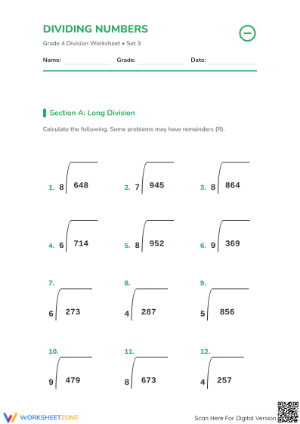
- 3-digit ÷ 1-digit problems — the level where most fourth graders spend the bulk of their practice time as they internalize the algorithm
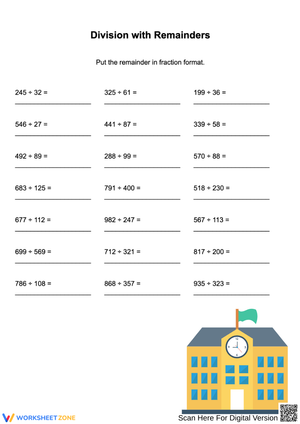
- 4-digit ÷ 1-digit problems — the ceiling of the fourth grade standard, requiring students to sustain three or four complete DMSB cycles without losing their place
- No-remainder problems — lets students focus on procedure before introducing the complication of a leftover value
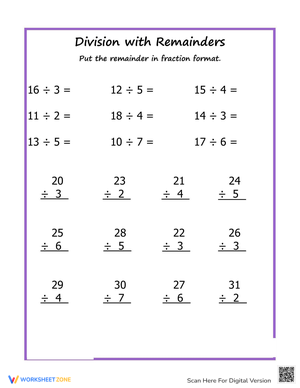
- Remainder problems — develops the understanding that a remainder must always be less than the divisor
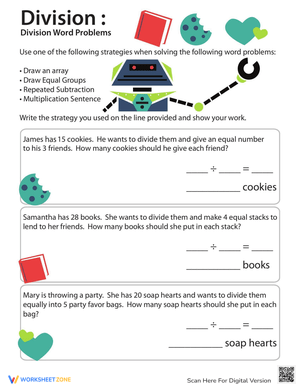
- Word problems — asks students to decide when division applies and interpret what a remainder means in context
Worksheets that include a printed DMSB reference at the top — Divide, Multiply, Subtract, Bring Down — reduce the time students spend searching their notes mid-problem and help them develop a reliable internal checklist over repeated sessions. Over a two-week unit, that reference becomes something most students stop needing.
Student Mistakes Worth Catching Early
Most long division errors in fourth grade trace back to two sources: weak multiplication fact recall and column misalignment. When a student can't retrieve 7 × 8 instantly, they stall at the multiply step, and the extra mental effort bleeds into the subtract step — producing subtraction errors that have nothing to do with their understanding of division. A two-minute fact warm-up before distributing any worksheet in this set measurably reduces that cascade. It's a small investment with a noticeable return.
Alignment errors deserve their own attention. A student may execute every DMSB step correctly but place the quotient digit one column to the left, producing an answer off by a factor of ten. This is especially common when students work on unlined paper. Worksheets with pre-drawn digit boxes eliminate the problem structurally — the boxes don't make the math easier, they remove a visual-spatial obstacle that otherwise causes correct reasoning to produce wrong answers.
Two additional patterns appear consistently in student work: forgetting to bring down the next digit after subtracting, and leaving a remainder larger than the divisor. That second error signals the student's initial quotient-digit estimate was too small. A brief class discussion — "How do you know when your quotient digit is too big or too small?" — surfaces this reasoning in a way that silent practice alone never quite does.
Fitting These Worksheets Into Your Instructional Week
Used across multiple points in a unit, long division pdf worksheets for 4th grade serve a different instructional function at each stage rather than functioning only as an end-of-lesson assignment. During initial instruction, project one of the two-digit dividend worksheets and work through three problems as a class — narrating each DMSB step aloud — before releasing students to finish independently. That gradual release structure matters more for long division than for most other fourth grade math topics because the algorithm has four distinct steps students can recite but still stumble executing in sequence.
For the eight minutes before students pack up at the end of a math block, two problems pulled from the current worksheet level function as a quick formative check. What you see tells you exactly where to start the next day. Math centers work well too: a no-remainder station alongside a remainder station lets students self-select based on confidence, and what you observe during that time informs your small-group pull-out the following day.
Answer keys make homework self-checking viable. When students compare their work to a key, circle errors, and attempt corrections before turning in the worksheet, they do a small amount of their own error analysis — a habit worth building in fourth grade, when students are old enough to begin monitoring their own work but still need structure to do it.
Standard Alignment
This set targets CCSS 4.NBT.B.6, which requires fourth graders to find whole-number quotients and remainders with up to four-digit dividends and one-digit divisors. In classroom terms, this standard typically enters the curriculum in the second quarter of fourth grade, after students have consolidated multiplication fluency and place value work from the first quarter. The progression built into the worksheets — two-digit dividends to four-digit dividends, no remainders before remainders — mirrors the sequencing most teachers follow when introducing the standard algorithm for the first time.
Adjusting the Set for a Range of Learners
The long division pdf worksheets for 4th grade span enough difficulty that the same set serves students at different readiness levels without requiring separate materials. Students still shaky on multiplication facts work best with the two-digit dividend worksheets, where the DMSB cycle is short enough to complete before they lose their place. Students who have the algorithm internalized can move directly to four-digit problems with remainders, where the challenge shifts from learning the procedure to maintaining accuracy across four or five cycles in a row.
For students who freeze when they see a multi-step algorithm laid out in front of them, reducing the task — asking them to complete only the divide and multiply rows of each problem before checking in — gives them a foothold without rewriting the worksheet. On the other end, students who finish early can verify every answer by multiplying the quotient by the divisor and adding the remainder; that inverse-operation check extends the work meaningfully without adding new problems to grade.
English language learners working through the word problem worksheets benefit from having the question stem read aloud before they begin. The arithmetic itself rarely creates the barrier — the language surrounding the division context does.
Frequently Asked Questions
What long division skills should a fourth grader have by the end of the year?
By the close of fourth grade, students should divide up to four-digit dividends by one-digit divisors using the standard algorithm, both with and without remainders. They should also be able to verify their work by multiplying the quotient by the divisor and adding any remainder to confirm they recover the original dividend.
Do students need multiplication facts memorized before starting long division?
Full memorization is not a strict prerequisite, but gaps slow the algorithm considerably. When a student has to count up to find 6 × 7 inside a four-step problem, they frequently lose their place in the DMSB sequence. A quick fact fluency check before beginning the unit helps identify which students will need extra support at the multiply step.
Why do some worksheets in the set include pre-drawn digit boxes?
Digit boxes give each quotient digit a fixed column, which prevents the most common non-procedural error in fourth grade long division: placing a correct digit in the wrong column. Students can execute every step correctly and still write an answer off by a factor of ten when alignment goes wrong. The boxes remove that opportunity.
How is long division different from short division, and why does fourth grade use the longer form?
Short division condenses the algorithm by keeping intermediate calculations mental rather than written — faster for practiced students, but invisible to anyone trying to check the work. Long division makes every step explicit, which is exactly why fourth grade instruction uses it. When a student makes an error, you can see precisely where the reasoning broke down. That visibility is the point.
Are these worksheets appropriate for students working above grade level?
The long division pdf worksheets for 4th grade reach the four-digit dividend ceiling set by 4.NBT.B.6, which is as far as the set goes. Students working above that level can extend each worksheet by verifying answers using inverse operations or by writing their own word problems around the calculations — neither of which requires additional materials.













 Interactive Worksheet Maker
 Quiz Maker
 Word Search Maker
 Crossword Puzzle Maker
 Word Scramble Generator
 Sentence Scramble Generator
 Handwriting Worksheet Generator
 Name Tracing Generator
 Fill In The Blank Generator