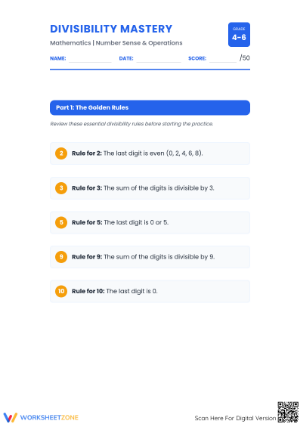
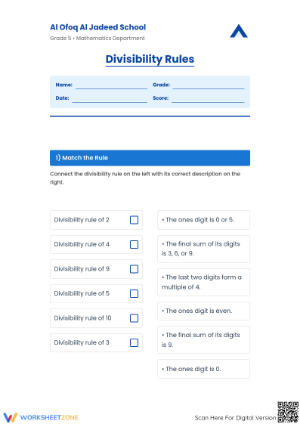
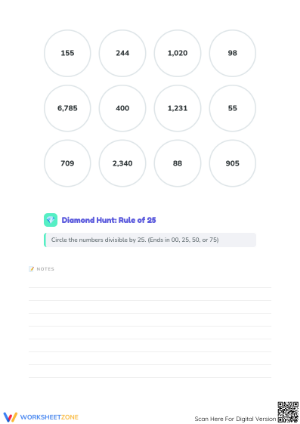
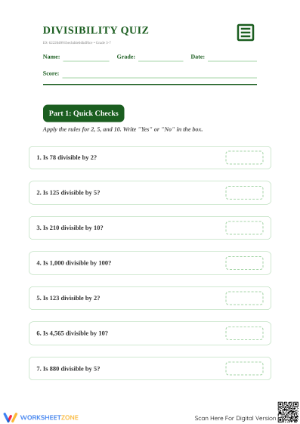
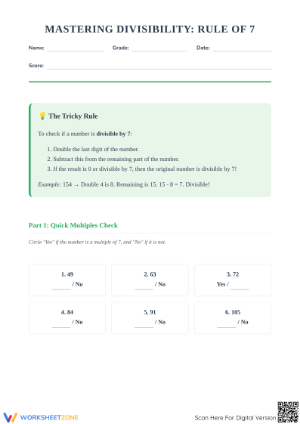
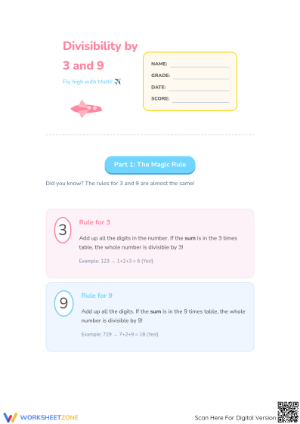
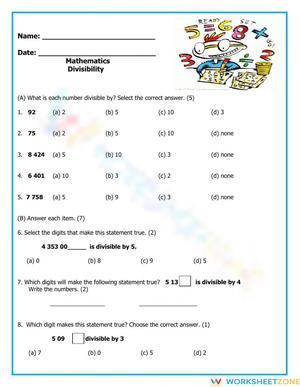
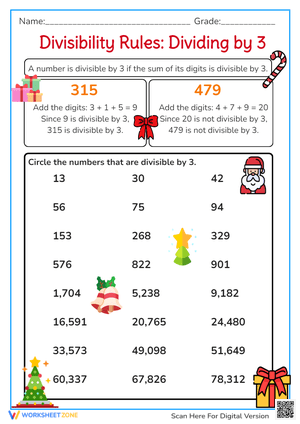
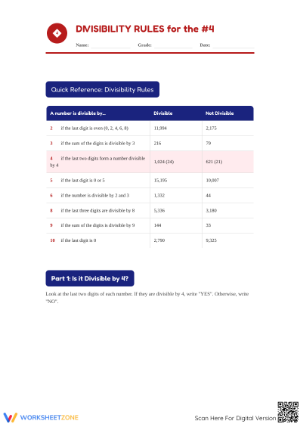
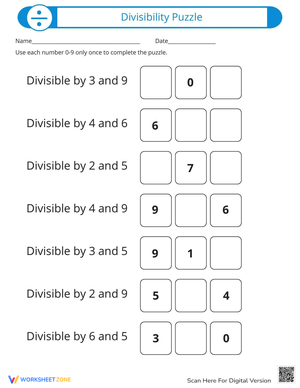
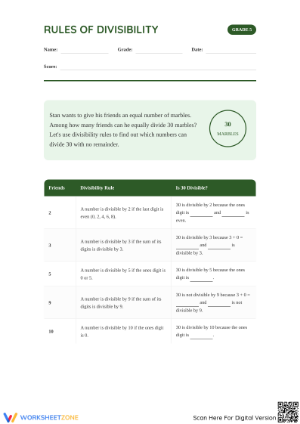
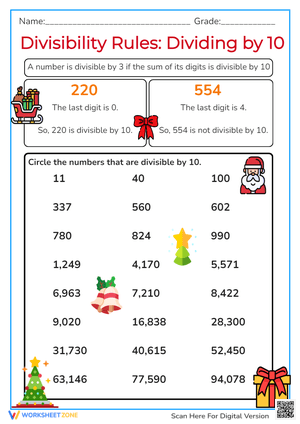
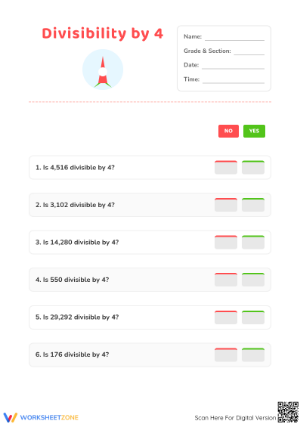
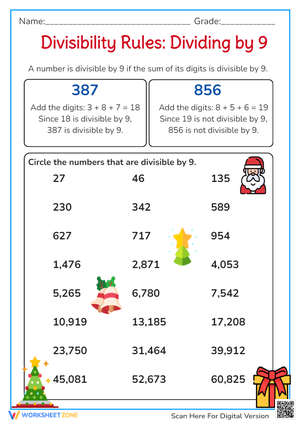
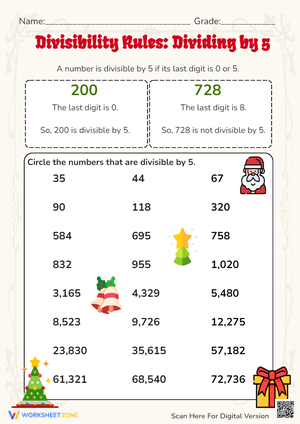
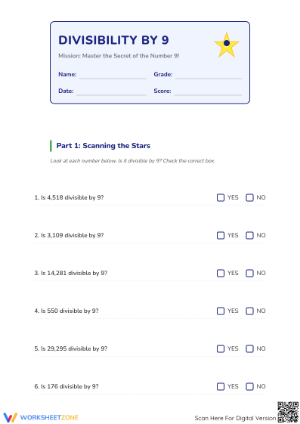
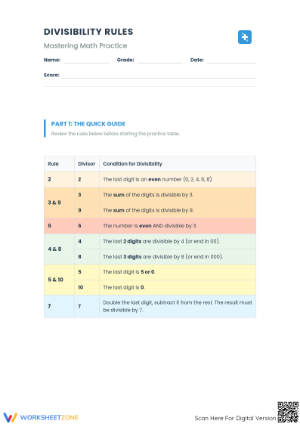
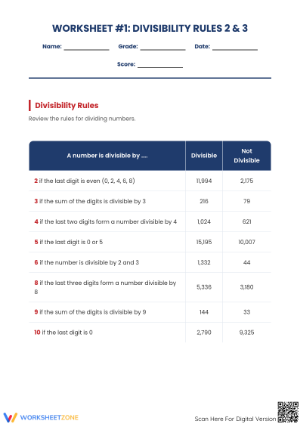
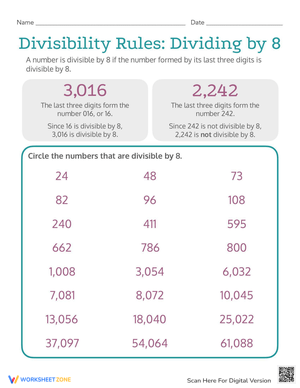
These divisibility rules worksheets for 4th grade give teachers print-ready practice for one of the more pattern-rich parts of fourth-grade number work — deciding whether a whole number divides evenly by 2, 3, 5, 6, 9, or 10 without grinding through long division each time. The set covers both last-digit rules and digit-sum rules, includes number-sorting tasks and short justification prompts, and comes with answer support for fast independent-practice grading.
Error Patterns Teachers Should Know Before Assigning These Worksheets
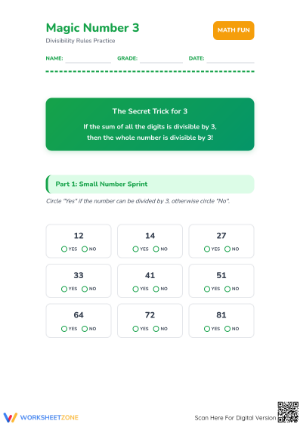
The most reliable predictor of confusion is the shift from last-digit rules to digit-sum rules. Students who move confidently through divisibility by 2, 5, and 10 — checking only the final digit — will carry that same habit into the rule for 3. A student who sees 72 will look at the 2, decide it is too small to help, and mark the number as not divisible by 3. The digit sum is 9, and 72 is in fact divisible by 3, but the student never checked there. That error shows up consistently enough that it is worth addressing directly before any worksheet on the rule for 3 — not after students have already marked a full column wrong.
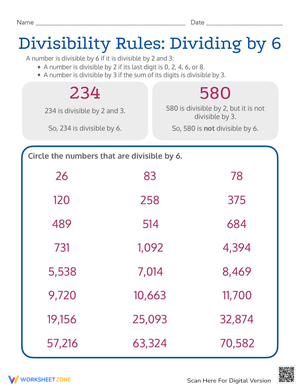
A second pattern surfaces with the rule for 6. Students learn correctly that even numbers are divisible by 2, and many stop there. They confirm a number is even and circle it as divisible by 6 without checking the rule for 3. The number 34 is even, but 3 plus 4 equals 7, which is not divisible by 3, so 34 fails the test for 6. Students who understand each rule in isolation still miss compound rules because they are not used to applying two checks before committing to an answer.
For three-digit numbers, digit addition itself becomes a source of error. A student adding the digits of 135 will sometimes group the last two digits together — treating it as 1 plus 35 rather than 1 plus 3 plus 5. Catching that during a center activity, before students work far into a worksheet, saves time and clarifies the procedure early.
Skills Covered Across the Set
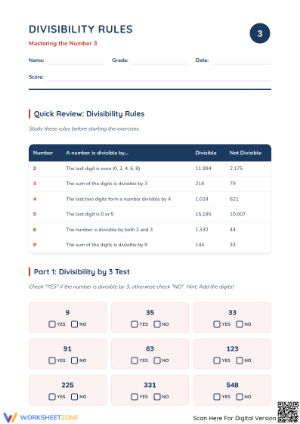
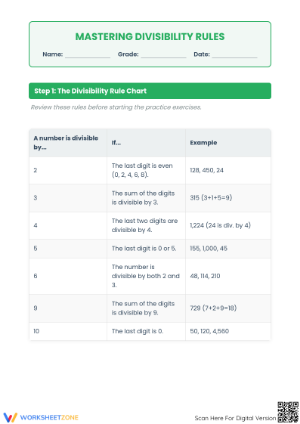
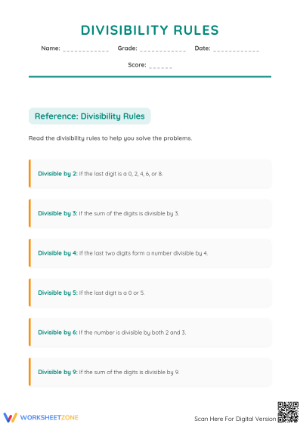
The earlier worksheets focus on divisibility by 2, 5, and 10 — the three rules that depend on the last digit only. Students underline the final digit, apply the rule, and record their answer. That focused format is intentional: the goal is fluency with the checking process, not memorization of a reference table.
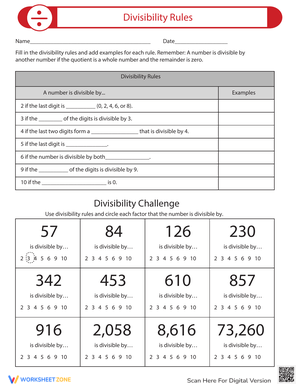
Later worksheets introduce the digit-sum rules for 3 and 9, then the compound rule for 6. Tasks across the set include:
- Sorting numbers into "divisible" and "not divisible" columns for a single rule
- Applying multiple rules to the same number and listing all that apply
- Writing one-sentence justifications — "I know 45 is divisible by 9 because 4 plus 5 equals 9"
- Identifying errors in sample student work, which prompts close reasoning without introducing new computation
- Generating numbers that satisfy a given rule — an extension task that reaches students who are ready for more
The justification prompts are not decorative. When students write out why a rule applies, the reasoning that was implicit becomes visible — both for the student and for the teacher reviewing the stack.
Working These Worksheets Into the Math Block
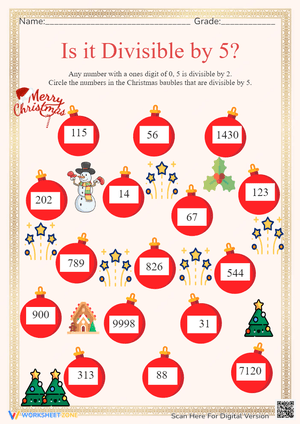
The cleanest entry point is a four-to-six number warm-up during the first five minutes of math, before the lesson opens. Write three numbers on the board, ask which are divisible by 5, give students two minutes to mark and discuss. Done consistently across a week, that brief routine builds automaticity faster than one longer practice session.
Math center rotations work well for divisibility rules worksheets for 4th grade when each worksheet is paired with a set of number cards. One student draws a card, both partners decide which rules apply, then they record. The conversation before they write is often more instructive than the written answer itself.
For small-group intervention, restrict practice to one rule per session and keep numbers in the two-digit range. Students who are still uncertain about the rule for 3 do not need mixed-rule practice — they need the digit-sum procedure to become routine before anything else is layered on top.
Exit tickets fit naturally here because most items take less than two minutes to complete. Pull three items — one last-digit rule, one digit-sum rule, one compound rule — and you have a fast formative read on where the class actually stands before tomorrow's lesson.
Standard Alignment
These worksheets align with CCSS 4.OA.B.4, which asks fourth graders to find all factor pairs for whole numbers in the range 1 to 100 and to recognize that a whole number is a multiple of each of its factors. Divisibility rules are the checking tool that makes factor-finding efficient. When a student confirms that 48 is divisible by 2, 3, and 6, they are identifying three of 48's factors — the divisibility work and the factor work are the same mathematical act. Assigning divisibility practice in the weeks before a factor-and-multiple unit means students arrive at that unit with a working method already in place, which reduces procedural confusion when the focus shifts to listing complete factor pairs.
Adjusting These Worksheets for a Range of Learners
Divisibility rules worksheets for 4th grade adapt well across ability levels because the rule structure stays constant while number complexity and task demands can shift independently. A student who needs more support gets two-digit numbers and one rule per worksheet. A student working at grade level handles three-digit numbers and mixed-rule sorting within the same set. A student ready for extension works with four-digit numbers, applies rules for 3, 6, and 9, and writes a justification for every answer rather than selected items only.
For students who find the digit-sum rules persistently difficult, writing out the digit addition horizontally before summing helps — it separates the "find the digit sum" step from the "apply the rule" step. That small procedural change reduces the working-memory load enough that most students can handle the process independently after a session or two without needing a different worksheet altogether.
Frequently Asked Questions
Which rules should Grade 4 students learn first?
Start with 2, 5, and 10. They require only a check of the last digit, connect to even-odd reasoning and place value students already know, and give students early success before the digit-sum rules introduce a more demanding procedure. Rules for 3, 9, and 6 work best as a second phase, after students apply the first three without hesitation.
Do these worksheets include answer keys?
Yes. Each worksheet comes with answer support formatted to match the student worksheet layout, which cuts checking time when you are moving between groups during a center rotation or reviewing after independent practice.
How do these worksheets connect to factor and multiple work?
The connection is direct. Knowing that a number is divisible by 3 is the same as confirming that 3 is one of its factors. The divisibility rules worksheets for 4th grade in this set are worth assigning in the weeks just before a factor-and-multiple unit — students arrive with a checking method already practiced, which means less procedural backtracking when they begin listing complete factor pairs.
Can I use these worksheets for students who have already mastered rules for 2, 5, and 10?
Yes. Move those students directly to the worksheets covering rules for 3, 9, and 6, and assign the justification prompts. Asking them to write an explanation for each answer, or to generate numbers that satisfy two rules simultaneously, extends the cognitive demand without requiring a separate resource.













 Interactive Worksheet Maker
 Quiz Maker
 Word Search Maker
 Crossword Puzzle Maker
 Word Scramble Generator
 Sentence Scramble Generator
 Handwriting Worksheet Generator
 Name Tracing Generator
 Fill In The Blank Generator