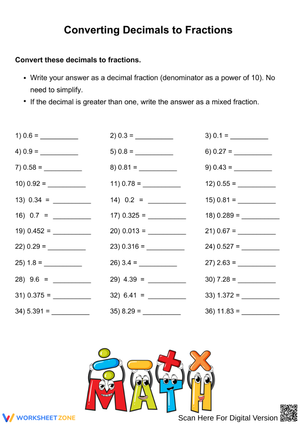
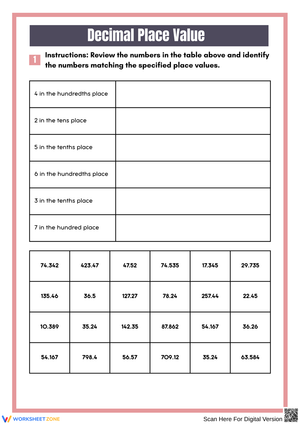
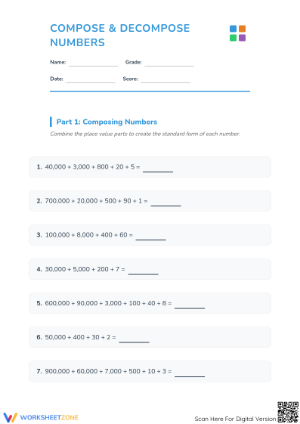
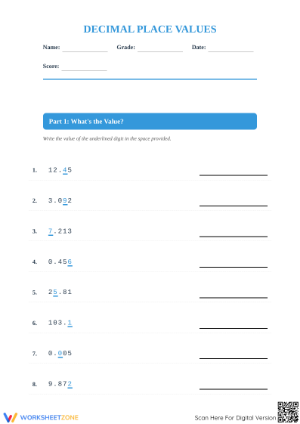
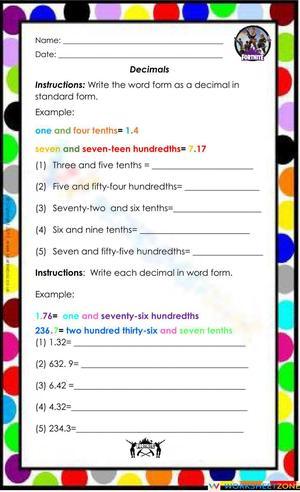
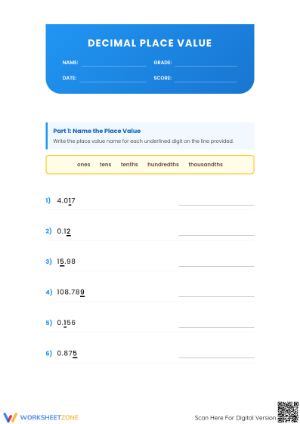
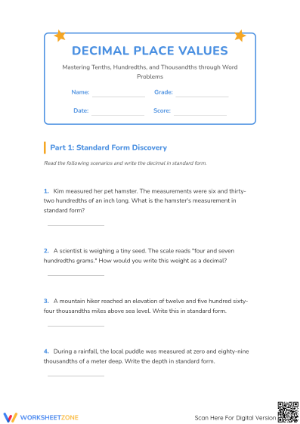
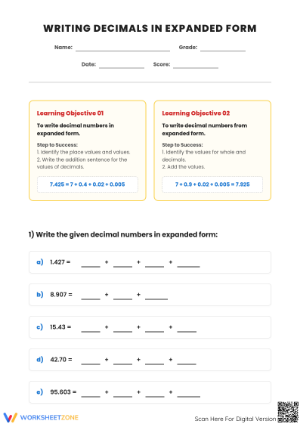
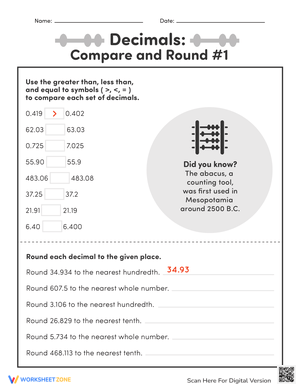
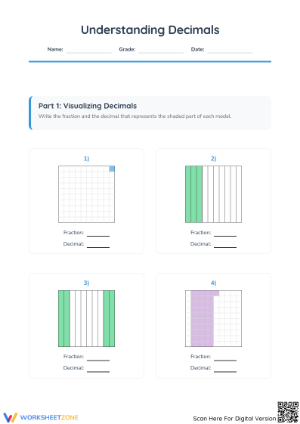
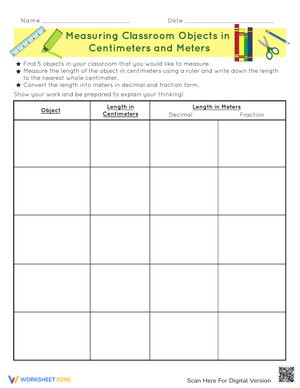
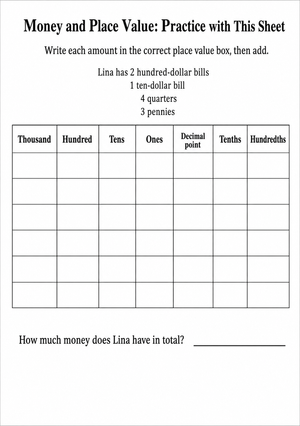
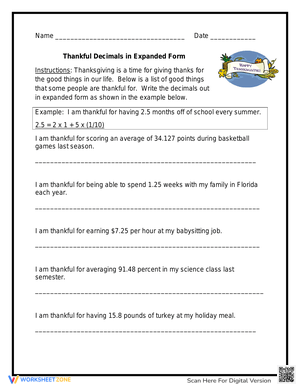
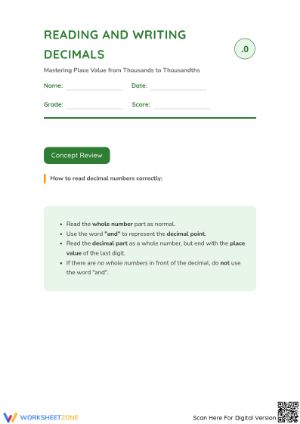
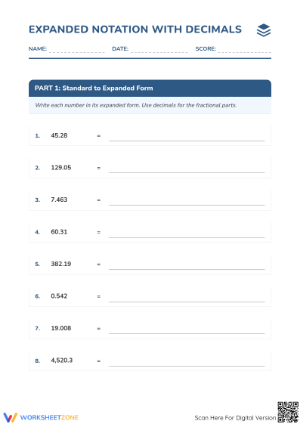
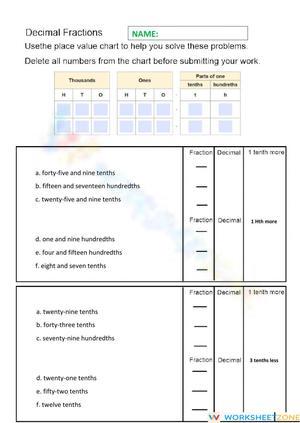
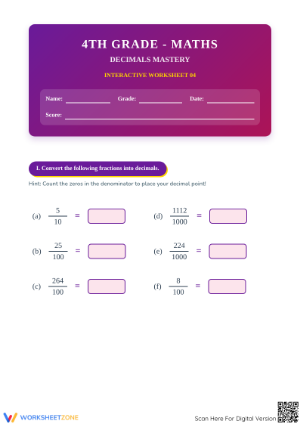
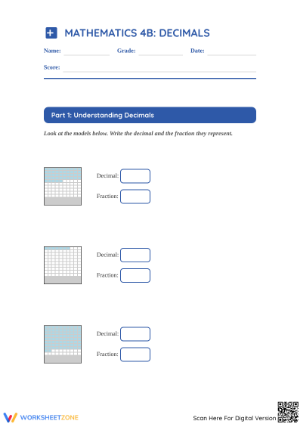
Decimal place value worksheets give teachers a low-prep way to build that second system deliberately, one representation at a time, instead of hoping it forms on its own during a fractions unit. This matters because decimal notation is not simply a rewritten fraction. A student can correctly compute 3/10 plus 2/10 and still stumble the moment those same values are written as 0.3 and 0.2. Worksheets built specifically around place value close that gap by asking students to move between fraction form, decimal form, word form, and a visual model for the same quantity, often within a single page.
Aligned Standard With 4th Grade Decimal Place Value Worksheets
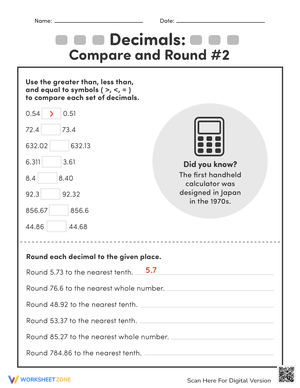
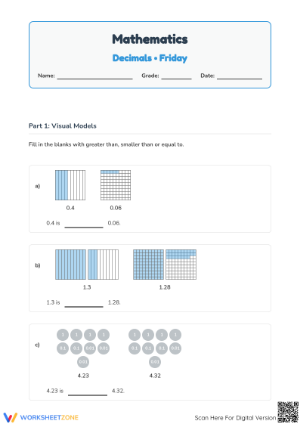
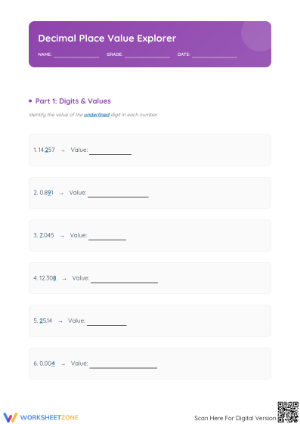
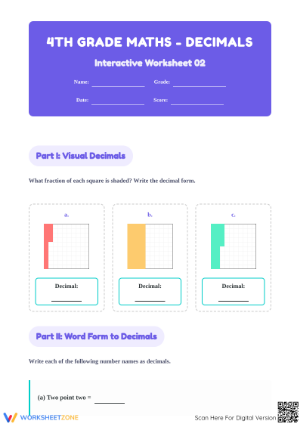
Two standards anchor most 4th grade decimal work. CCSS 4.NF.C.6 asks students to use decimal notation for fractions with denominators of 10 or 100, so a student should be able to rewrite 62/100 as 0.62 and locate that value on a number line. CCSS 4.NF.C.7 goes a step further, asking students to compare two decimals to hundredths by reasoning about their size and recording the comparison with greater than, equal to, or less than symbols. A well-designed worksheet sequence does not jump straight to comparison. It builds the notation skill first, checks that students can read and write decimals accurately, and only then layers in comparison tasks.
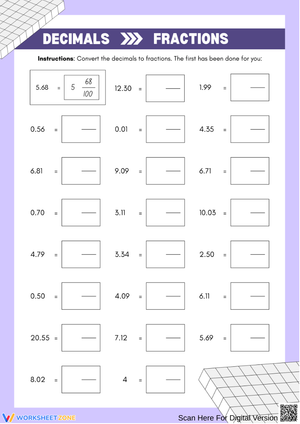
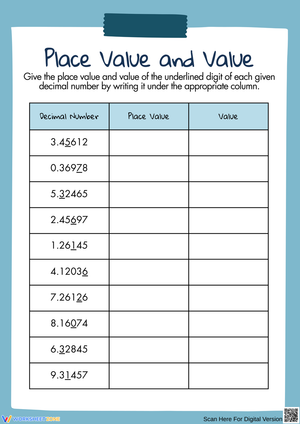
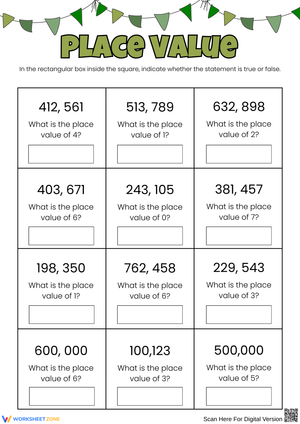
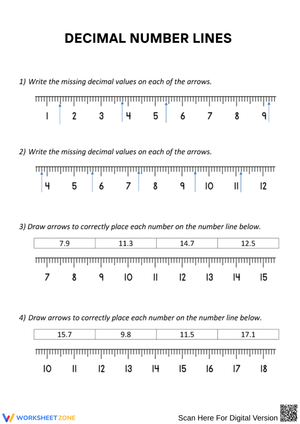
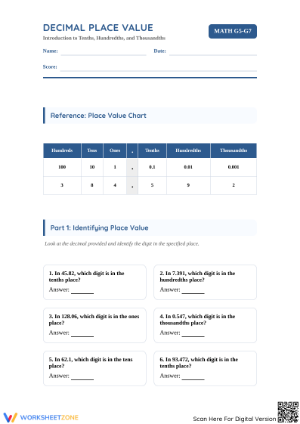
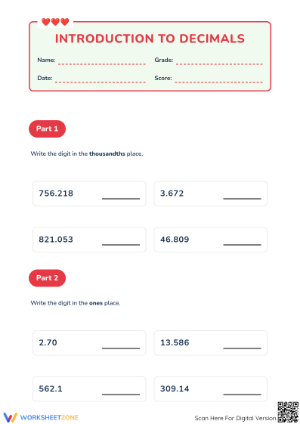
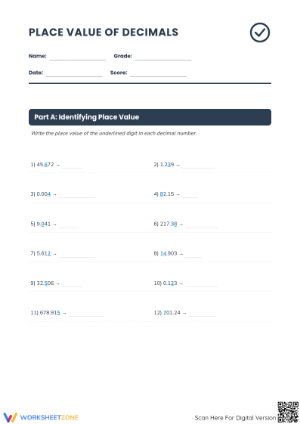
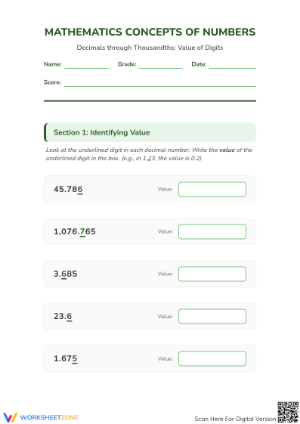
Worksheets aligned to these two standards typically include number-line placement tasks, fraction-to-decimal conversion rows, and word-form matching, so a single practice set can serve as both instruction support and a quick check of where a student sits in the standard's progression.
The Tenths Versus Hundredths Misconception
The most persistent error in this unit is a size misconception carried over from whole numbers. Because a hundred is larger than a ten, many students assume a hundredth must be larger than a tenth, when the opposite is true: a hundredth is a smaller piece of the same whole. This single misunderstanding can undo weeks of otherwise solid comparison practice, because a student applying it will consistently reverse greater than and less than judgments on any problem that pairs a tenth with a hundredth.
Classroom-tested resources on this topic report that a large share of comparison errors in the 0.3 versus 0.29 style of problem trace back to this exact reversal rather than to a computation mistake, which means reteaching the algorithm rarely fixes the error on its own; the fix has to happen at the level of what a tenth and a hundredth actually represent.
According to Common Core State Standards for Grade 4 Number and Operations-Fractions, students must use decimal notation for fractions with denominators of 10 or 100, then compare two decimals to hundredths using greater than, equal to, or less than symbols, but only when both decimals refer to the same whole.
Teacher Tips
When a decimal place value worksheet is going to double as a diagnostic tool, ask students to read at least one answer out loud or write the word form next to the numeral. A student who reads 0.75 as seventy-five instead of seventy-five hundredths is showing a gap between symbolic fluency and place value understanding that a purely written answer key will not reveal. For small-group intervention, pull four or five items from the comparison stage only, since that is where the tenths and hundredths misconception surfaces most clearly. For whole-class review, a mixed worksheet touching all four sequence stages works well as a warm-up or an exit ticket, giving a fast read on which stage needs another day of instruction before moving on to adding and subtracting decimals, where misaligned decimal points become the next common error source.
Frequently Asked Questions
1. What decimal place value skills should 4th graders master by CCSS standards
Students should be able to use decimal notation for fractions with denominators of 10 or 100 and compare two decimals to hundredths using greater than, equal to, or less than symbols, always reasoning about the same whole.
2. How do you teach the difference between tenths and hundredths without visual models
It is difficult to do reliably. Most teachers find that even a brief return to grids or number lines resolves confusion faster than verbal explanation alone, since the size difference is easiest to grasp visually.
3. What are the most common decimal place value mistakes 4th graders make
The two most frequent errors are assuming hundredths are larger than tenths, and misreading decimals aloud in a way that does not match their place value, such as saying seventy-five instead of seventy-five hundredths.
4. How can decimal place value worksheets be used for intervention groups versus whole-class review
For intervention, narrow the worksheet to the comparison stage where the tenths and hundredths misconception shows up most. For whole-class review, use a mixed worksheet spanning all four sequence stages as a quick diagnostic.
5. How do decimal worksheets connect to comparing decimals using greater than and less than symbols
Comparison worksheets should come after students can already identify place value and convert between fractions, grids, and decimal notation, since comparison reasoning depends on that earlier notation fluency being solid.













 Interactive Worksheet Maker
 Quiz Maker
 Word Search Maker
 Crossword Puzzle Maker
 Word Scramble Generator
 Sentence Scramble Generator
 Handwriting Worksheet Generator
 Name Tracing Generator
 Fill In The Blank Generator