


























Views
Downloads


Grade 4 Decimal Practice Worksheet | Printable Math
Paste this activity's link or code into your existing LMS (Google Classroom, Canvas, Teams, Schoology, Moodle, etc.).
Students can open and work on the activity right away, with no student login required.
You'll still be able to track student progress and results from your teacher account.
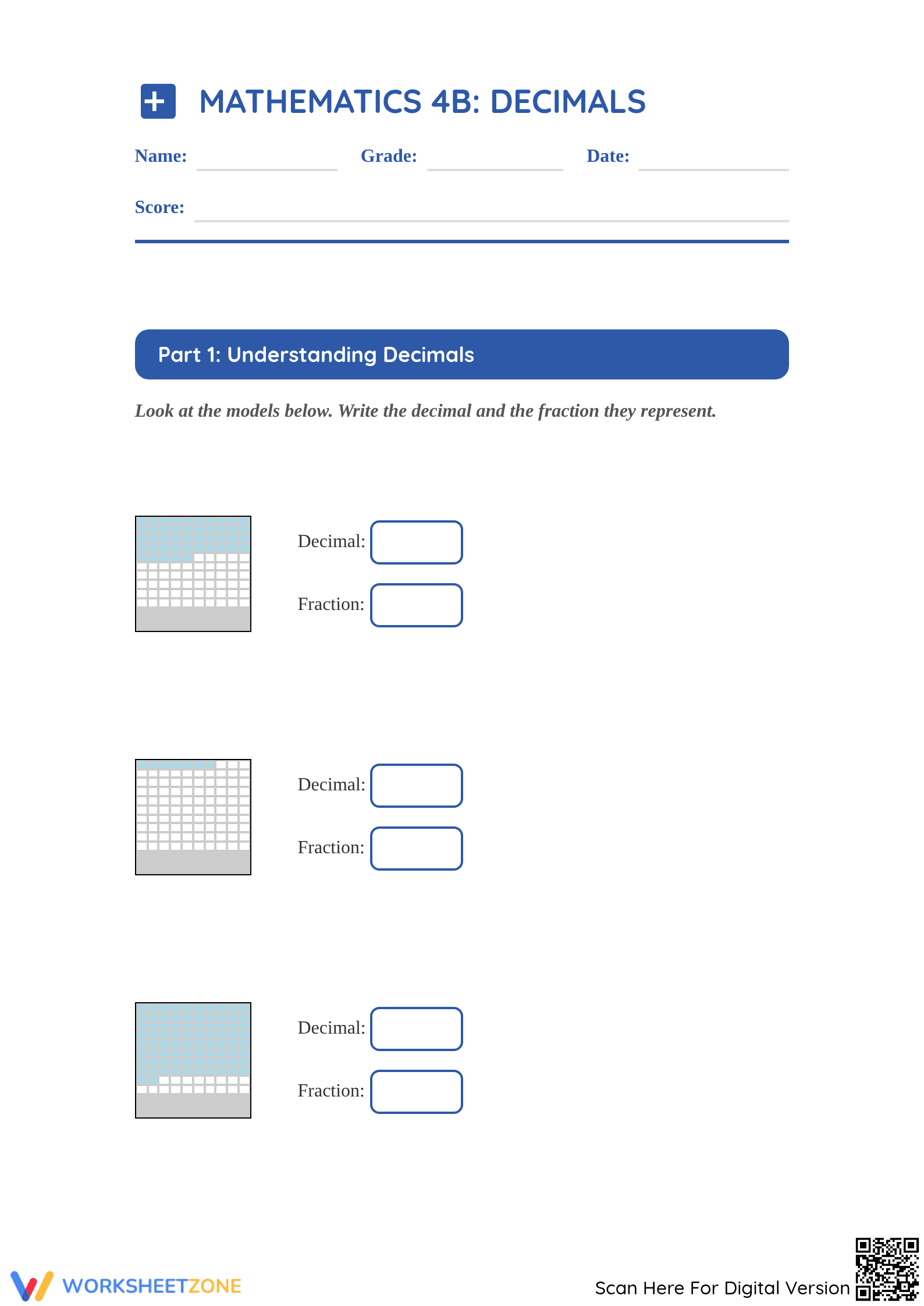
Mastering the concept of decimals begins with a concrete understanding of tenths. This four-page worksheet offers visual scaffolding and practice to internalize decimal notation. Using multiple representations, students translate between shaded grids, number lines, and place value charts for procedural fluency in Grade 4 decimal standards.
At a Glance
- Grade: 4 · Subject: Math
- Standard:
CCSS.MATH.CONTENT.4.NF.C.6— Use decimal notation for fractions with denominators 10 or 100- Skill Focus: Decimal Tenths & Models
- Format: 4 pages · 34 problems · Answer key included · PDF
- Best For: Independent practice after decimal introduction
- Time: 25–40 minutes
What's Inside: This resource contains four distinct pages designed to build decimal number sense. It includes visual grid models (bar models), labeled number lines, a place value chart for ones and tenths, and fraction-to-decimal conversion tables. A complete answer key is provided to facilitate quick grading or student self-correction, making it ideal for both classroom use and homework assignments.
Skill Progression
- Guided Practice: Students begin by identifying shaded tenths in 10-part bar models and matching them to their decimal equivalents, reinforcing the concept that decimals represent parts of a whole (10 tasks).
- Supported Practice: Learners map decimal values onto labeled number lines and record them in a place value chart, bridging the gap between visual area models and linear numeric relationships (12 tasks).
- Independent Practice: The final section requires students to convert fractions with a denominator of 10 into decimals and word forms without visual aids, demonstrating mastery of abstract notation (12 tasks).
This sequence follows a gradual-release model, moving from concrete visual representations to symbolic abstract reasoning.
Standards Alignment
This worksheet is strictly aligned to CCSS.MATH.CONTENT.4.NF.C.6: "Use decimal notation for fractions with denominators 10 or 100; for example, rewrite 0.62 as 62/100; locate 0.62 on a number line diagram." It also supports 4.NF.C.5 by reinforcing the base-ten relationship of fractional denominators. Both standard codes can be copied directly into lesson plans, IEP goals, or district curriculum mapping tools.
How to Use It
This worksheet is best utilized during the independent practice phase of a lesson on decimal introduction. After providing direct instruction on place value, distribute the first two pages to ensure students can connect visual models to notation. Use the number line section as a formative assessment point; observe if students correctly place decimals between whole numbers. The estimated completion time is 35 minutes, though it can be split across two sessions.
Who It's For
This resource is designed for Grade 4 students but serves as an excellent review for Grade 5 learners who require reinforcement of decimal place value. It is particularly effective for visual learners who benefit from seeing tenths as physical segments. Pair this worksheet with base-ten blocks or a tenths anchor chart to provide a multi-sensory learning experience for students who are new to rational numbers.
Aligned with CCSS.MATH.CONTENT.4.NF.C.6, this worksheet helps students master decimal notation for fractions, a key step in rational number reasoning. Research, including the RAND AIRS 2024 report, highlights that using multiple visual representations like the grid models and number lines in this 34-task worksheet enhances retention of place value concepts. It provides structured practice in identifying tenths, converting fractions, and placing values on a number line, supporting numeric fluency (NAEP). The scaffolded approach, moving from concrete visual bars to abstract place value charts, ensures learners internalize tenths and decimal notation, aligning with evidence-based practices that reduce cognitive load.


