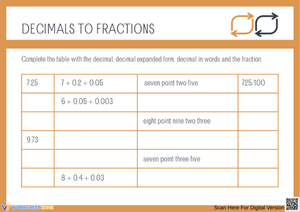
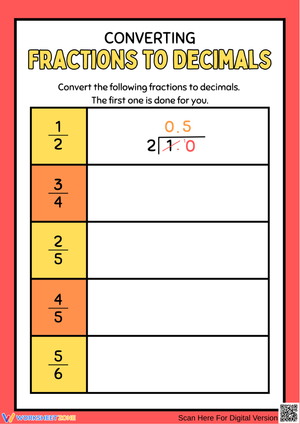
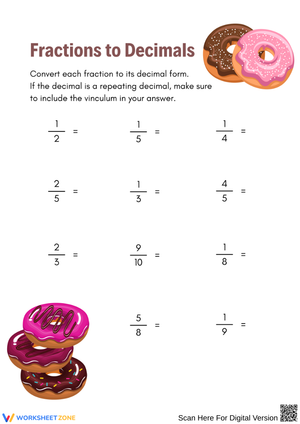
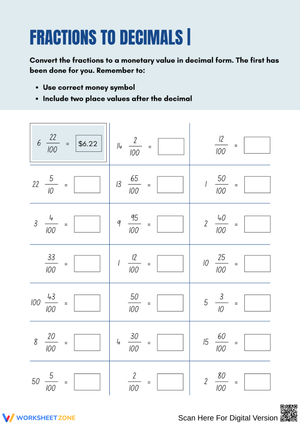
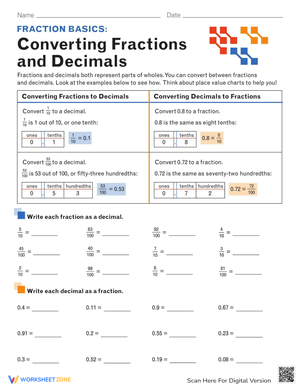
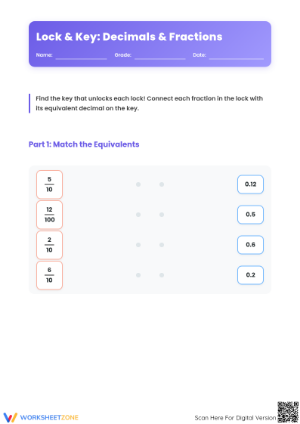
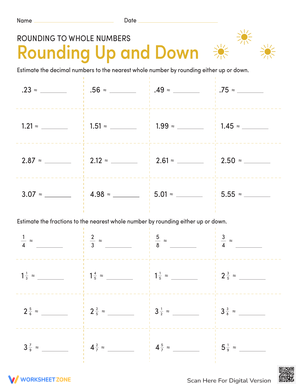
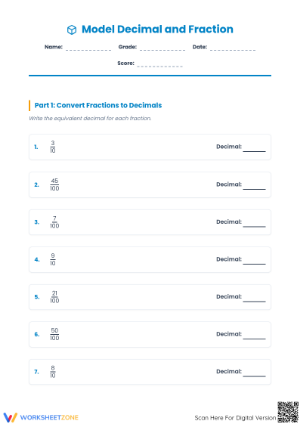
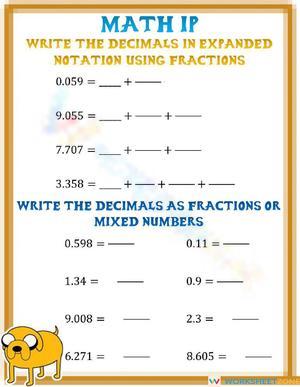
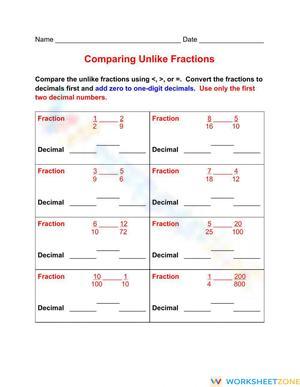
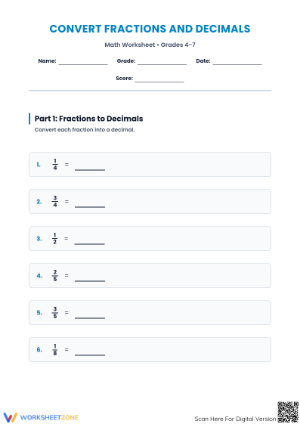
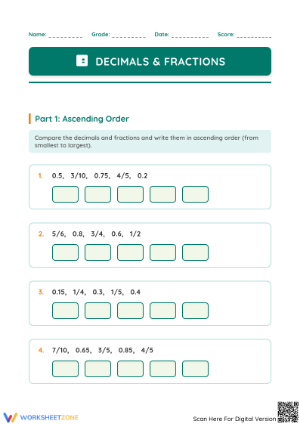
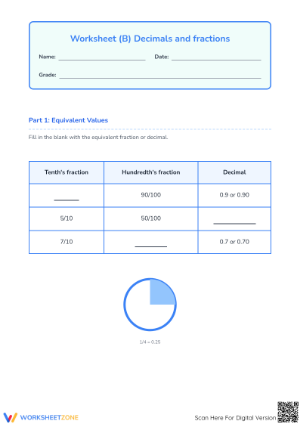
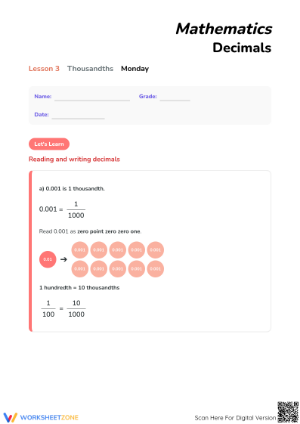
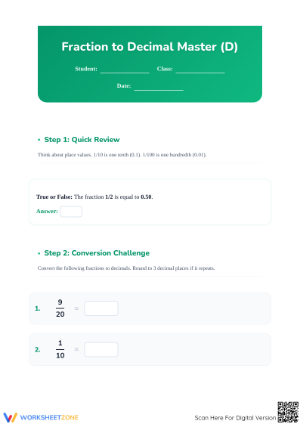
These 4th grade converting decimals and fractions printable worksheets give teachers a focused set of resources for the two place-value concepts at the center of the Grade 4 number standard: tenths and hundredths. Each worksheet targets a distinct skill—reading shaded 10x10 grids, writing decimal notation for given fractions, placing equivalent values on a number line, and applying those conversions in metric measurement problems. The set moves from concrete visual work to abstract symbolic conversion without losing the connection between the two.
Skills Each Worksheet Builds
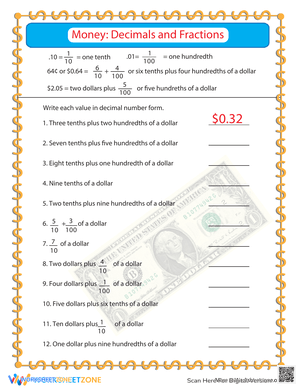
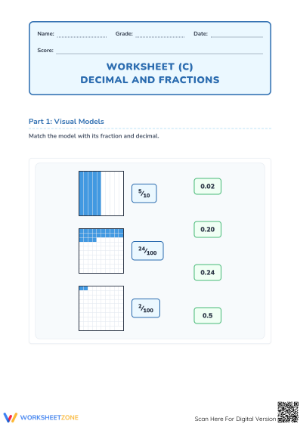
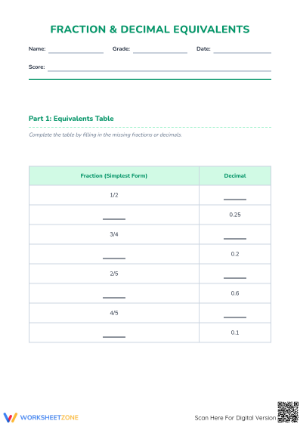
The work runs across three main skill areas. First, students practice reading and writing tenths: given a fraction like 7/10, they write the decimal equivalent; given 0.3, they write the fraction. Second, the hundredths work asks students to recognize that 6/10 and 60/100 name the same quantity—which is the prerequisite for understanding why 0.6 and 0.60 are equivalent. Third, students combine both place values to convert numbers like 43/100 to 0.43 and match those forms to shaded grid representations.
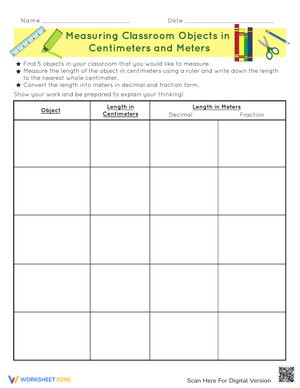
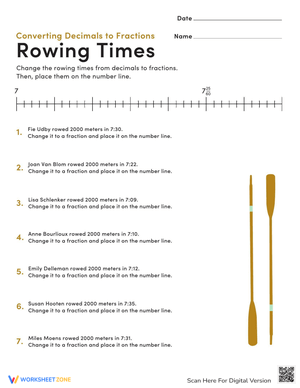
Several worksheets include measurement contexts: expressing a centimeter measurement as a decimal fraction of a meter, or working with milliliters and liters. These aren't decorative word problems—they show students where decimal-fraction conversion appears outside the number line. The 4th grade converting decimals and fractions printable worksheets in this set also include a card-sort format where students group fraction cards, decimal cards, and shaded grid images into equivalent sets, which pushes them to think about the quantity rather than just pattern-match notation.
Errors Students Make With Regularity—and How to Watch for Them
The placeholder zero is the biggest recurring problem. Students who have no trouble reading 7/10 as 0.7 will confidently write 5/100 as 0.5 instead of 0.05. The reasoning makes internal sense to them: there's only one significant digit, so why would two decimal places be needed? Until students connect the number of zeros in the denominator to the number of decimal places required, this error persists. The 10x10 grid makes the contrast visible—0.5 covers 50 small squares (five full columns), while 0.05 covers only 5 squares. That visual difference does what a verbal explanation alone rarely accomplishes.
The second common error is treating 0.4 and 0.40 as unequal. Students frequently argue that 0.40 is "bigger" because it has more digits—the same overgeneralization that leads younger students to think 12 is greater than 9. Returning to the grid (4 shaded columns vs. 40 individually shaded squares) is usually the fastest correction. A third error worth anticipating: students who correctly convert 6/10 to 0.6 will then write 6/100 as 0.6 as well, because they're pattern-matching the numerator rather than attending to the denominator. A brief comparison exercise where students place 6/10 and 6/100 side-by-side on a number line tends to break that habit.
Fitting These Worksheets Into Your Planning Week
The most reliable placement is in the first 10 minutes of a math block after the initial concept lesson, not as homework. Students who work on decimal-fraction conversion at home without immediate feedback will reinforce their own errors—especially the placeholder zero confusion. Using each worksheet as a structured warm-up on the day after whole-class instruction keeps the teacher in the room when misconceptions surface.
The card-sort worksheet works especially well for partner work mid-unit, after students have practiced tenths and hundredths separately. A pair of students sorting fraction, decimal, and grid cards generates audible disagreement when one partner reads 0.06 and the other reaches for the 6/10 card—and that disagreement is where the real learning happens. Friday review blocks also work well for the measurement-context worksheets, since by the end of the week students have enough symbolic fluency to focus on the applied reasoning rather than getting stuck on notation.
For classes using a math workshop model, the more procedural conversion worksheets (fraction to decimal, decimal to fraction, no visuals) function well as independent center tasks once students have had at least two guided lessons. Saving the grid-shading worksheets for teacher-led small groups gives the teacher a real-time view of whether a student understands the magnitude relationship or is simply executing a memorized procedure.
Standard Alignment
These worksheets address CCSS 4.NF.C.6: "Use decimal notation for fractions with denominators 10 or 100." This standard sits inside the Number and Operations—Fractions domain and is typically introduced in the second half of the school year, after students have built fluency with fraction equivalence (4.NF.A.1) and comparison (4.NF.A.2). That sequence matters: students who haven't yet grasped that 1/2 = 2/4 = 5/10 will struggle to see why 30/100 and 3/10 name the same decimal. The measurement context in several worksheets also touches 4.MD.A.2, which asks students to solve word problems involving distances and liquid volumes—skills that require comfort with decimal notation when working in metric units.
Adjusting the Work for Mixed-Ability Math Classes
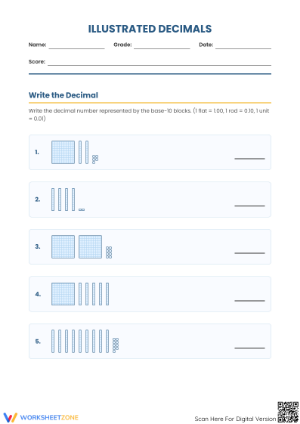
For students still working on the tenths concept, pull back from the hundredths worksheets and pair the tenths-only exercises with base-ten blocks: the flat represents one whole, the rod represents one tenth. That hands-on layer slows things down in a useful way—students who rush to write decimal notation without understanding magnitude benefit from building numbers physically before recording them symbolically.
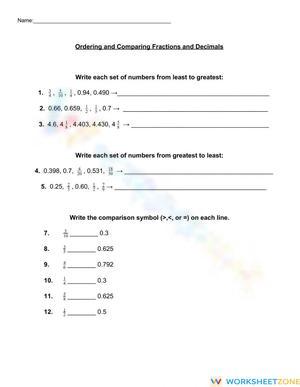
Students who have already mastered tenths and hundredths conversions can move into comparison and ordering tasks: given a mixed set of fractions and decimals, arrange them from least to greatest. This extends the standard without leaving the Grade 4 scope. Some students at this level are also ready to work through why 1/2 converts to 0.5—finding the equivalent fraction step (1/2 = 5/10) first connects back to 4.NF.A.1 and keeps the reasoning grounded rather than introducing a calculator shortcut that bypasses understanding entirely.
For students who work confidently with symbols but freeze when shown an area model, the 4th grade converting decimals and fractions printable worksheets that use number lines instead of 10x10 grids often reduce that friction. Number lines tend to feel less visually busy, and students with strong number-sense intuition can often place a value correctly on a line even when an area model produces confusion.
Frequently Asked Questions
Do these worksheets include visual models, or are they purely symbolic?
Both. Several worksheets use 10x10 grids and number line diagrams as the primary question format—students shade grids to match a given fraction or decimal, or mark equivalent values on a number line. Other worksheets in the set are purely symbolic: write the decimal for 47/100, write the fraction for 0.8. Teachers who want students to move from concrete to abstract work can sequence the two types in that order within the same unit.
At what point in a unit should I introduce these worksheets?
Start with the visual worksheets after the first one or two whole-class lessons on tenths. Students need at least one exposure to the place value language—"seven tenths," not "zero point seven"—before symbolic practice makes sense. The purely symbolic worksheets work best once students can read a shaded grid correctly, usually by the third or fourth lesson. Introducing abstract notation before students have built a mental image of what 0.07 represents tends to produce rule-following without understanding, which breaks down quickly on anything other than a straightforward conversion question.
How do these worksheets address the equivalence between 0.6 and 0.60?
The 4th grade converting decimals and fractions printable worksheets in this set address the 0.6/0.60 relationship directly, using side-by-side grid comparisons where both representations are shaded to show identical coverage. Students also write both forms from a single shaded model, which makes the equivalence a conclusion they reach rather than a rule they're handed. This is worth deliberate attention because the connection between tenths and hundredths notation appears on most Grade 4 assessments, and students who have only memorized the procedure without seeing the underlying relationship tend to misapply it under slightly different conditions.













 Interactive Worksheet Maker
 Quiz Maker
 Word Search Maker
 Crossword Puzzle Maker
 Word Scramble Generator
 Sentence Scramble Generator
 Handwriting Worksheet Generator
 Name Tracing Generator
 Fill In The Blank Generator