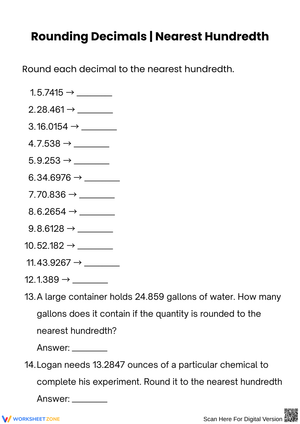
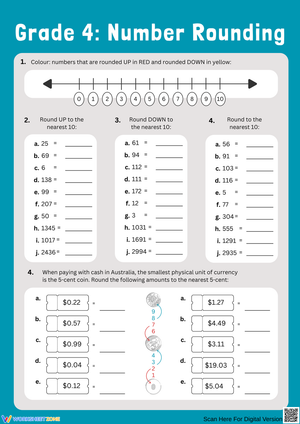
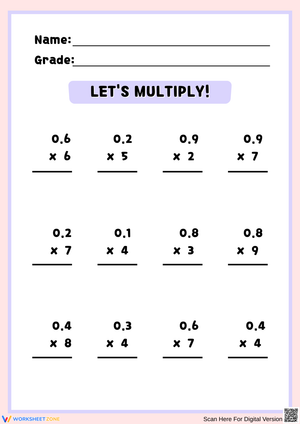
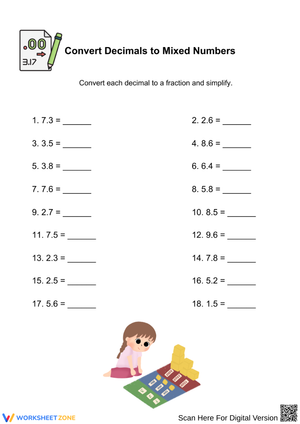
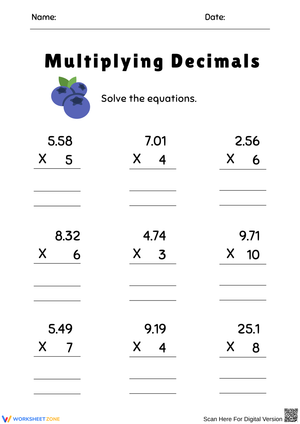
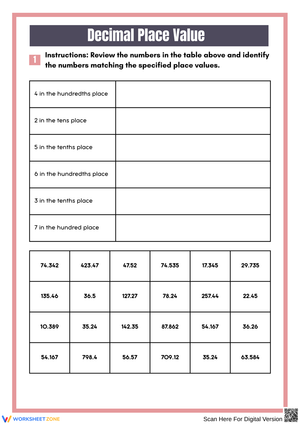
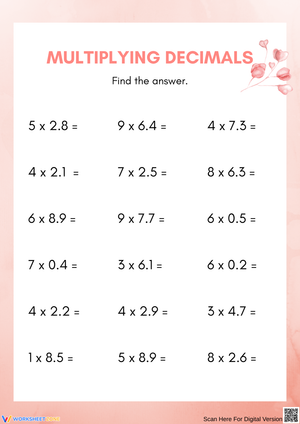
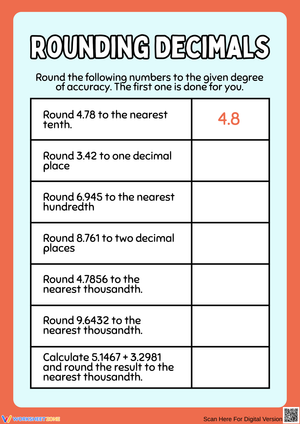
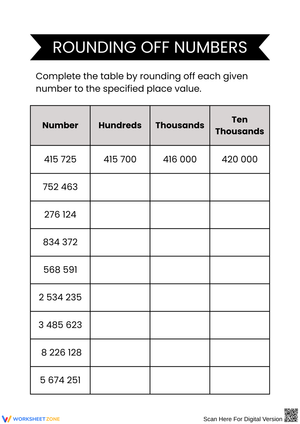
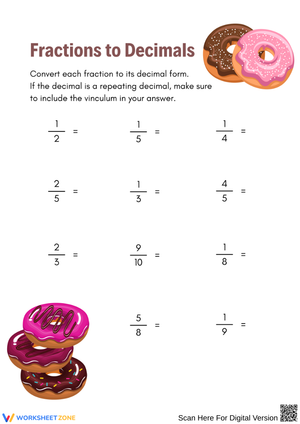
These 4th grade decimals worksheets resources address the complete range of skills Grade 4 students need before decimal work feels settled: reading and writing notation to hundredths, converting between fractions and decimals, and comparing and ordering decimal values using place value reasoning. Each worksheet focuses on one skill rather than bundling too many concepts at once — a structure that matters when students are encountering decimal notation for the very first time. Teachers get print-ready practice that drops into warm-ups, independent work time, or small-group review without extra preparation.
What Each Worksheet Targets
The set addresses four skill areas that build on each other across a decimal unit:
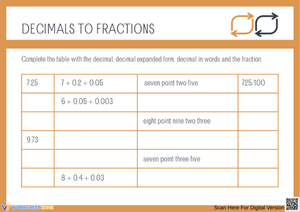
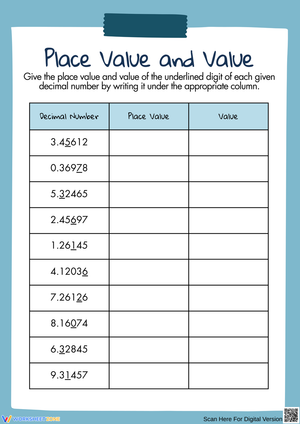
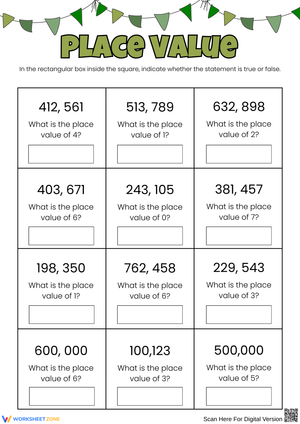
- Reading and writing decimals to hundredths — Students write decimal notation from word form, identify place value position, and connect the written form to fractional language (four tenths, seven hundredths).
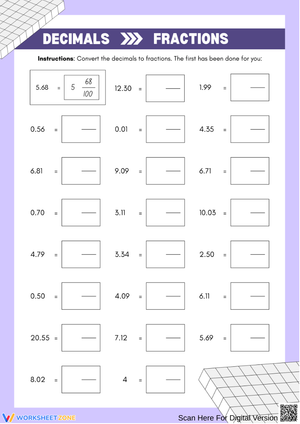
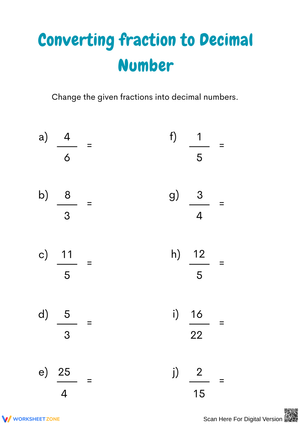
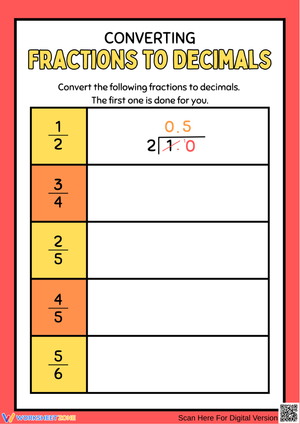
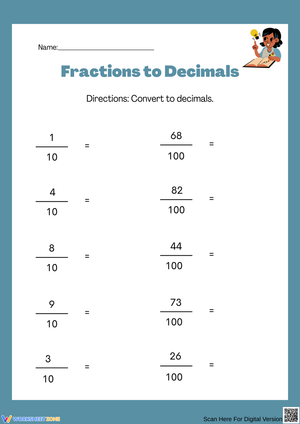
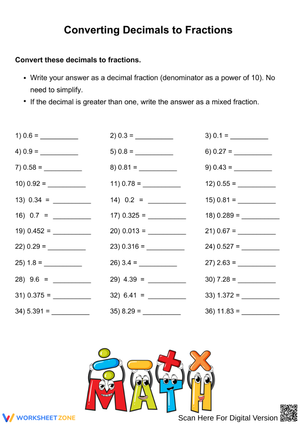
- Fraction-to-decimal conversion — Practice moves from straightforward cases like 7/10 = 0.7 to the harder step of finding equivalent fractions first: rewriting 7/10 as 70/100 before writing 0.70. The sequencing matters because students who skip the equivalent fraction step tend to produce errors on hundredths conversions.
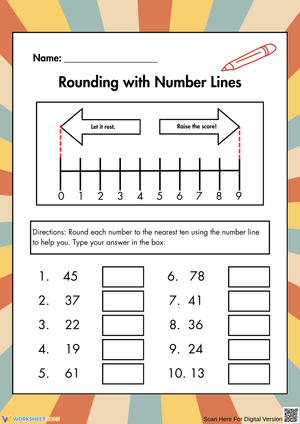
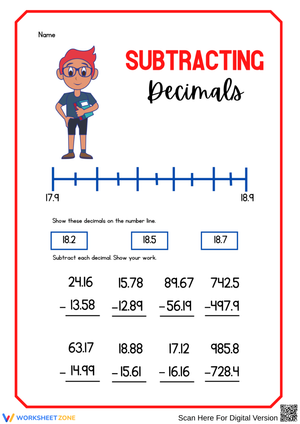
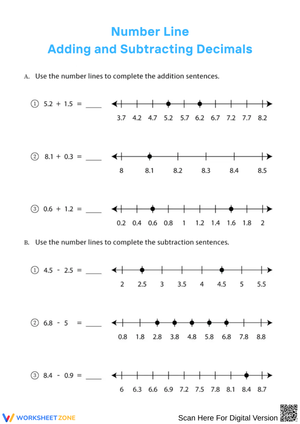
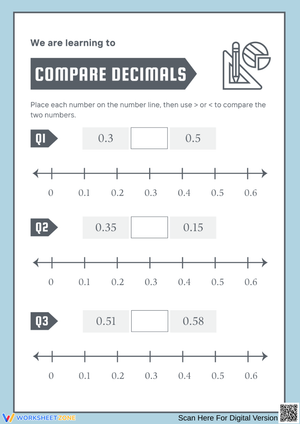
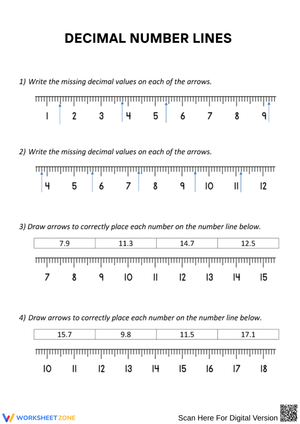
- Visual model work — These worksheets use 10x10 grids and number lines as the primary format. Students shade grids to match decimal values, mark labeled points on number lines, and match visual representations to written notation — rather than only manipulating symbols.
- Comparing and ordering — Students record comparisons using the words greater than, less than, and equal to, then arrange sets of three to five decimals from least to greatest. Tasks mix tenths-only values (0.3) with hundredths values (0.07, 0.34) so students must reason about place value rather than match notation format.
Mistakes Students Make That Teachers Need to Catch Early
The most persistent error in this unit is the comparison reversal: students conclude that 0.45 is greater than 0.5 because 45 is greater than 5. This is not carelessness — it is a structural misreading of how place value works across the decimal point. Asking a student to shade both values on a 10x10 grid (45 squares versus 50 squares) usually makes the error visible in a way that a circled wrong answer on paper does not. When students see the shaded areas side by side, the conversation shifts from "I made a mistake" to "I can see why 0.5 is larger," which is a more instructive place to teach from.
A second error that moves under the radar: students who read 3.4 aloud as "three point four" often treat the digits before and after the decimal as disconnected whole numbers. The fix is to insist on "three and four tenths" during any read-aloud practice. That language keeps the fractional meaning in the room. Requiring students to say it before they write the fraction equivalent reduces transcription errors on conversion tasks measurably.
Conversion also produces one specific slip worth watching for. When asked to rewrite 3/10 with a denominator of 100, some students write 3/100. They scale the denominator by 10 but forget to scale the numerator. In written work this looks like 3/10 = 0.03 — plausible enough to get skipped during a fast scan of papers. A brief class exercise where students check their conversions by shading a grid catches this before it becomes a habit.
Fitting These Worksheets Into Your Decimal Unit
The most reliable lesson sequence for this topic is concrete before symbolic. The worksheets that include a 10x10 grid model alongside a notation task let teachers direct students to complete the shading first, then write the decimal — keeping the visual and the symbol connected rather than introduced separately. When students cannot immediately explain why 0.4 and 0.40 are equal, a return to the shaded grid resolves the question faster than re-explaining verbally. These 4th grade decimals worksheets resources are sequenced with that concrete-to-symbolic arc in mind, so teachers can move through them in order or pull individual worksheets to match where students currently are.
For pacing, the notation and conversion worksheets work well as independent practice during the main lesson. The comparison worksheets make stronger warm-up material once the initial notation unit wraps up — posting two decimals and asking students to record and justify their answer on the worksheet before whole-class discussion ensures every student commits to a position first. Money contexts are a reliable bridge when students stall on abstract comparisons: a student uncertain about 0.5 versus 0.45 often resolves the question immediately when it becomes $0.50 versus $0.45.
Standard Alignment
These worksheets address two standards within the Number and Operations: Fractions domain of the Common Core State Standards. 4.NF.C.6 requires students to use decimal notation for fractions with denominators of 10 or 100 — rewriting 62/100 as 0.62 and locating it on a number line, for example. The notation and conversion worksheets are the primary vehicle for this standard. 4.NF.C.7 requires students to compare two decimals to hundredths by reasoning about size, recognize that comparisons are valid only when both decimals refer to the same whole, and record results using inequality language. The comparison and ordering worksheets address that standard directly. Both standards sit at a specific instructional seam: students arrive in Grade 4 with experience in equivalent fractions from 4.NF.A.1, and they will need decimal operations in Grade 5 (5.NBT.B.7). These two standards are the conceptual bridge between those phases, which is why building genuine understanding matters more than speed at this stage.
Supporting Different Learners Across the Same Unit
Students who need more time building number sense do better starting with tenths-only worksheets before hundredths are introduced. Reducing the place value complexity while students are still getting comfortable with notation itself is not simplifying the math — it is a sensible progression that prevents the notation from overwhelming the concept. A printed number line from 0 to 1, marked at every tenth, gives those students a reliable reference during comparison tasks without requiring them to construct one from scratch each time.
For students ready to move further, the 4th grade decimals worksheets set includes ordering tasks that mix decimal and fraction notation within the same problem — asking students to arrange 0.6, 3/10, 0.45, and 7/100 from least to greatest. That format pushes students to convert before comparing rather than working with uniform decimal notation throughout, and it surfaces whether students genuinely understand that 3/10 and 0.3 represent the same value or simply look similar. One honest limitation worth knowing: the written explanation prompts in several comparison worksheets ("explain how you know which is larger") create friction for students who have the math right but struggle with written expression. Accepting a drawn number line or a verbal explanation as an equivalent response assesses the actual standard without layering a writing task on top of a math task.
Frequently Asked Questions
What Common Core standards do these worksheets cover?
The set addresses 4.NF.C.6 (using decimal notation for fractions with denominators of 10 or 100) and 4.NF.C.7 (comparing decimals to hundredths by reasoning about size and recording comparisons with inequality language). Both fall within the Number and Operations: Fractions domain in Grade 4.
Are the worksheets appropriate for students who are just beginning decimal instruction?
Yes. The introductory worksheets work with tenths only and use grid and number line formats as the primary activity — students shade, mark, and label before they do any purely symbolic work. More complex conversion and comparison worksheets are better reserved for after students have built basic notation fluency. The 4th grade decimals worksheets resources move from simpler to more demanding tasks, so teachers can pull individual worksheets to match where their class currently is rather than working through the set in strict order.
How do I address the misconception that 0.45 is greater than 0.5?
Address it directly rather than just marking the answer wrong. Ask the student to shade 0.45 and 0.5 on separate 10x10 grids, then compare the shaded areas. The visual makes it difficult to maintain the misconception. Following that with a number line where both values are plotted adds a second representation confirming the same conclusion. Most students correct their written comparison once they have seen both models — and they are far less likely to repeat the error on the next worksheet.
Can these worksheets serve as test preparation?
Decimal comparison and fraction-to-decimal conversion appear on state assessments aligned to Common Core. The task formats in these worksheets — recording comparisons with inequality language, plotting values on number lines, converting between fractions and decimals — match what students encounter on those tests. Using the worksheets as review two to three weeks before an assessment works better than the night before, because the spacing gives time to identify and correct the place value misconceptions these tasks reliably surface.













 Interactive Worksheet Maker
 Quiz Maker
 Word Search Maker
 Crossword Puzzle Maker
 Word Scramble Generator
 Sentence Scramble Generator
 Handwriting Worksheet Generator
 Name Tracing Generator
 Fill In The Blank Generator