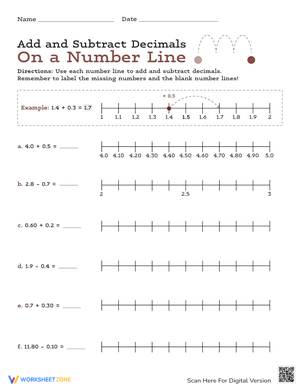
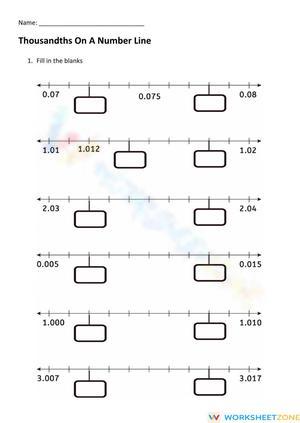
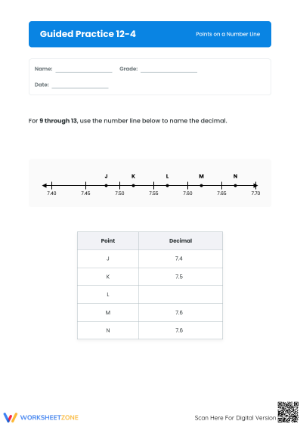
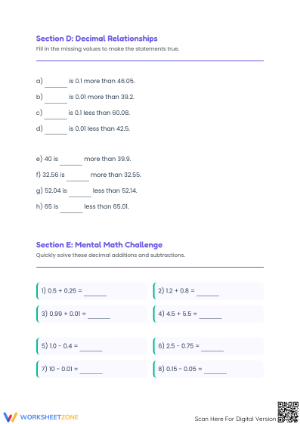
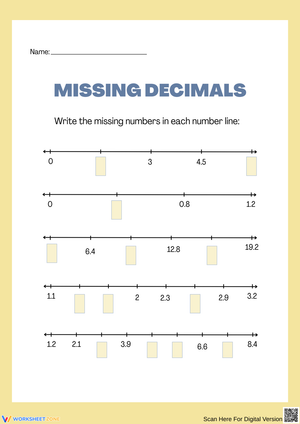
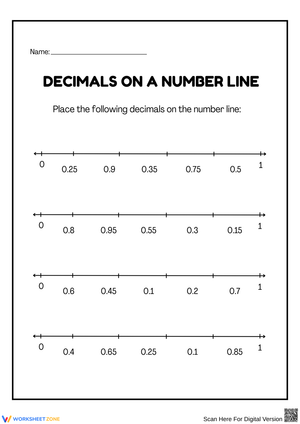
These decimals on the number line pdf worksheets for 4th grade place number sense practice where it belongs — on a continuous model that shows students how far apart decimal values actually are, not just which digit occupies which column. The set covers tenths and hundredths, giving teachers a ready sequence from initial placement tasks through comparison and ordering work.
What Each Worksheet Targets
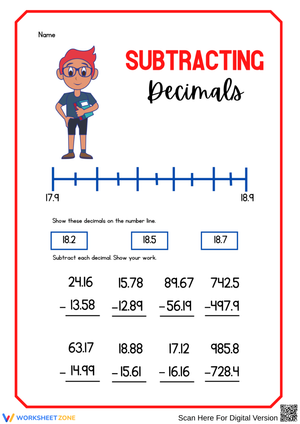
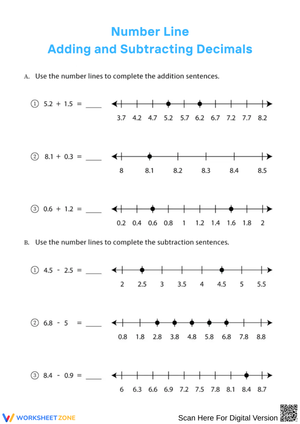
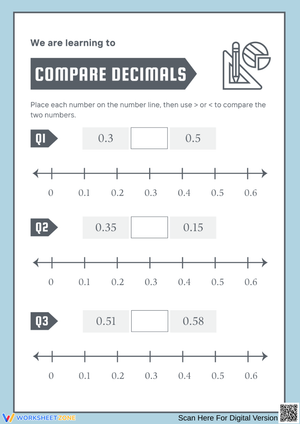
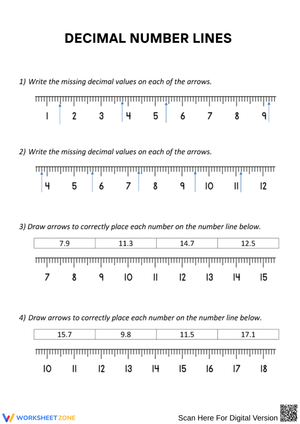
The set moves through three interconnected skills. Students first practice reading a number line divided into ten equal intervals between whole numbers, identifying values at marked points and labeling missing tenths. The hundredths worksheets then introduce a zoomed-in segment — the stretch between two adjacent tenths like 0.1 and 0.2, subdivided into ten smaller intervals — so students can locate values like 0.13 or 0.07 with precision. Comparison worksheets, which appear in both the tenths and hundredths groups, ask students to plot two or three decimals on the same line and record an inequality statement based on their positions.
A smaller group of worksheets connects decimal notation to fraction equivalents. Students mark a point on the line, then write both the fraction and the decimal name for that location. This side-by-side labeling makes clear that 3/10 and 0.3 are two names for one position — not two separate numbers — which matters for students who have only ever seen the fraction-to-decimal conversion as a memorized rule rather than a spatial relationship.
Frequent Student Errors These Worksheets Help You Catch
The most persistent error in this unit appears during comparison tasks. A student who correctly reads 0.7 off a tenths number line will often, on the same worksheet, mark 0.35 as greater than 0.4 because "35 is bigger than 4." The number line corrects this directly: when both values are plotted, 0.4 sits visibly to the right of 0.35. But the correction sticks only when students explain the relationship after plotting — not just circle an answer and move on.
Interval miscounting is the second error worth anticipating. When a number line runs from 0 to 2 and students must place 1.6, many count from 0 rather than anchoring at 1 first. They arrive in the right general region but land on 1.5 or 1.7 and don't notice the error. Requiring students to mark the nearest whole-number boundaries before counting intervals catches this before it becomes automatic.
Standard Alignment
CCSS.Math.Content.4.NF.C.6 requires students to use decimal notation for fractions with denominators of 10 and 100. In practice, this standard plays out in two instructional phases: first, students learn to convert 7/10 to 0.7; then they need to place and compare those values. The worksheets in this set address the second phase — the placement and comparison work that proves understanding goes beyond notation. Teachers also targeting 4.NF.C.7, which asks students to compare two decimals to hundredths using symbols and justify the comparison, will find the comparison worksheets directly usable for that standard as well.
How to Build These Worksheets Into Your Lesson Plans
The tenths worksheets work well as Monday warm-ups after a weekend gap — five minutes locating points on a pre-labeled line pulls students back to the correct scale before new instruction starts. The hundredths worksheets take meaningfully longer and belong in the main lesson block. Plan for students to need at least 12 to 15 minutes with the zoomed-in number line the first time they encounter it; rushing that initial exposure produces exactly the interval-counting errors described above.
Exit tickets are where this set earns its keep. Cut a number line strip from one worksheet, write a single decimal on the board, and ask students to mark and label it before they leave. That takes under three minutes and tells you exactly who is ready for comparison work the next day. Comparison worksheets, by contrast, work better as partner tasks — two students talking through why 0.6 is greater than 0.58 before writing the inequality builds more durable understanding than silent independent work on the same problem.
These decimals on the number line pdf worksheets for 4th grade also hold up well in math center rotations when laminated. Students use dry-erase markers to plot values, then wipe and rotate. The hundredths worksheets are detailed enough that reprinting them repeatedly gets costly, so keeping a laminated class set for center use is a practical call.
Adjusting the Set for Different Student Levels
The decimals on the number line pdf worksheets for 4th grade include number lines that span only 0 to 1, which is where students who are still shaky on whole-number placement should begin. Extending the range beyond 1 before a student has stable interval-counting adds confusion rather than challenge. For these students, the fraction-decimal labeling task provides a second access point — they anchor at the fraction first, then write the decimal, rather than working purely from decimal notation.
Students who move through tenths quickly can use the hundredths worksheets differently: give them an unmarked number line between two consecutive tenths and ask them to build their own scale, decide how many intervals to draw, and then locate a value the teacher writes on the board. This reverses the usual task — from locating a value on a pre-divided line to constructing the line from scratch — which is a meaningfully harder cognitive demand.
One honest limitation worth naming: the comparison format on these worksheets frustrates students who freeze when given an open number line with no pre-marked intervals. Those students need a fully labeled line before moving to the open-format comparison tasks, and that intermediate step requires additional structured support the set alone doesn't provide.
Frequently Asked Questions
Which worksheets should come first — tenths or hundredths?
Start with tenths, on number lines that span 0 to 1 only. Students need to feel confident counting ten intervals before they encounter the finer subdivisions in the hundredths work. Moving to hundredths before that fluency is solid produces interval errors that are hard to undo once they're automatic.
How do I address students who confuse 0.10 and 0.1?
The worksheets that combine fraction and decimal labeling at the same point handle this directly. When a student marks the first interval on a tenths line and writes both "1/10" and "0.1" at that location, then adds "0.10" as an equivalent form, the equivalence becomes something they've seen and written — not just a rule they've been told. Follow up by asking them to plot both 0.10 and 0.1 on the same line and confirm they mark the same point.
Can these worksheets serve as test prep for state assessments?
Most state assessments aligned to the Common Core include items where students compare or order decimals, and number line placement appears across multiple item types. The decimals on the number line pdf worksheets for 4th grade in this set match that format closely — the comparison tasks in particular, where students plot two values and write an inequality, mirror the two-step reasoning most assessment items require.
Is this set appropriate for 5th graders who missed the concept in 4th grade?
Yes. The tenths worksheets are accessible enough for 5th-grade remediation without feeling like primary-grade material. The open-format hundredths comparison tasks remain appropriate for 5th grade because they require reasoning about magnitude and scale, not simple procedural recall.













 Interactive Worksheet Maker
 Quiz Maker
 Word Search Maker
 Crossword Puzzle Maker
 Word Scramble Generator
 Sentence Scramble Generator
 Handwriting Worksheet Generator
 Name Tracing Generator
 Fill In The Blank Generator