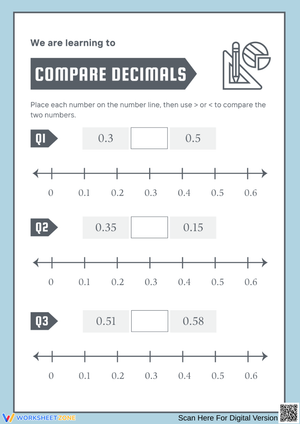
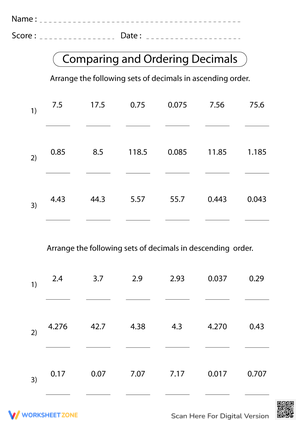
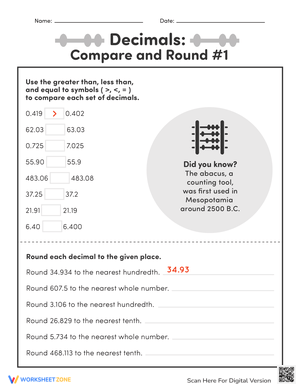
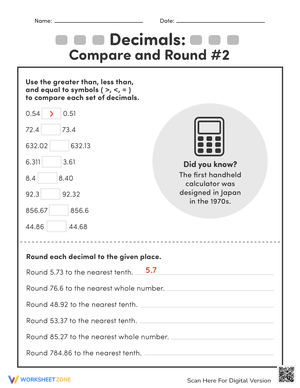
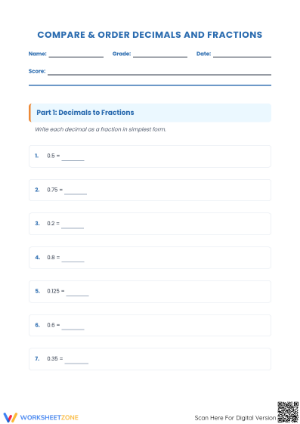
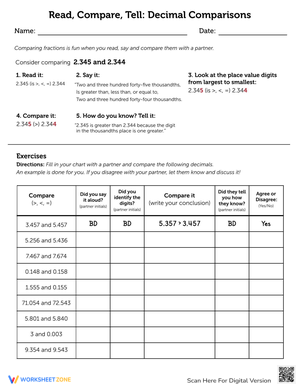
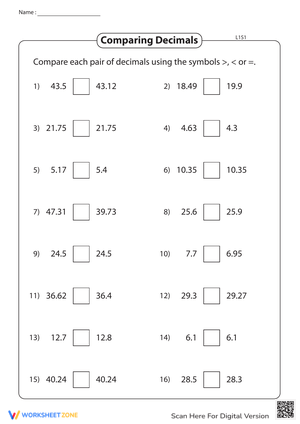
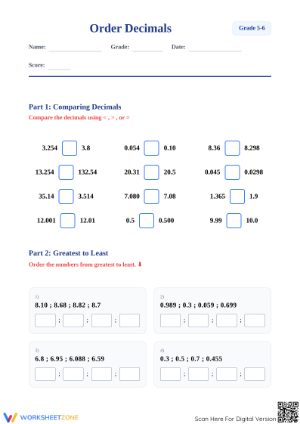
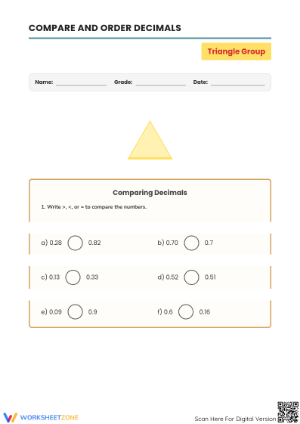
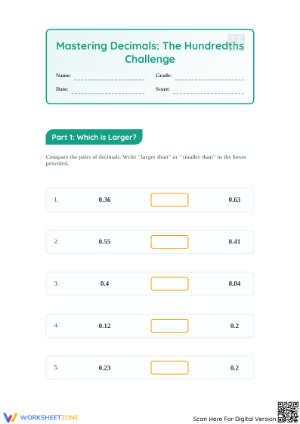
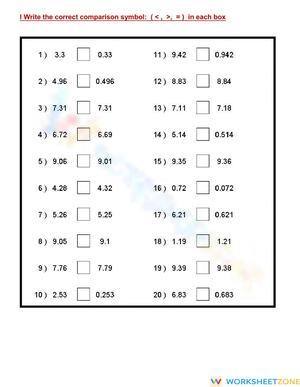
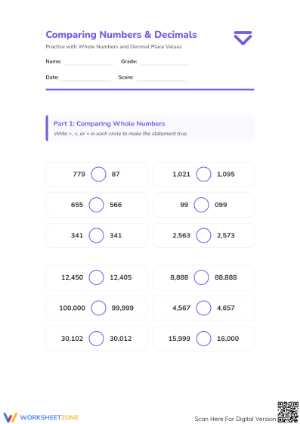
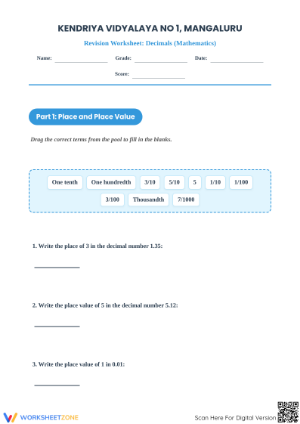
These comparing decimals pdf worksheets for 4th grade address the exact moment when a student's whole-number reasoning starts working against them. A child who has spent two years learning that more digits means a bigger number will read 0.09 and 0.2, pick 0.09, and be genuinely confused by the correction. The set gives teachers the combination of visual models and abstract place value problems needed to interrupt that pattern before it settles in.
Skills Each Worksheet Builds
The core work across the set covers five distinct tasks:
- left-to-right digit comparison in the ones, tenths, and hundredths places
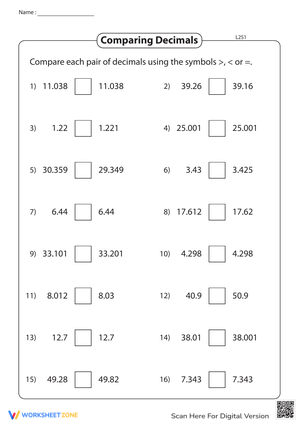
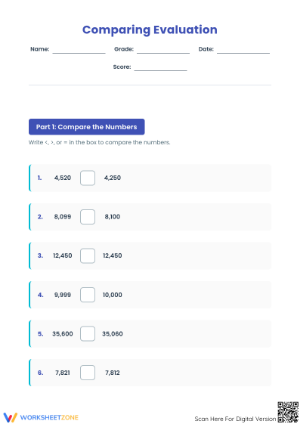
- marking comparisons with less than, greater than, and equal to symbols
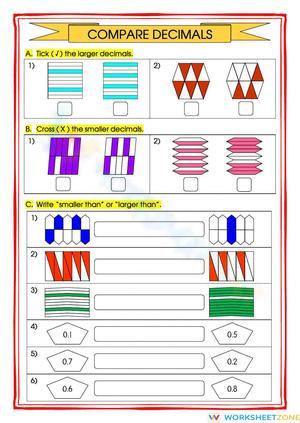
- shading 10×10 grids to show the relationship between tenths and hundredths
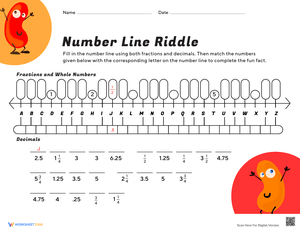
- plotting decimals on number lines between 0 and 1
- applying placeholder zeros to compare decimals of different lengths
The set also returns repeatedly to equivalent decimals. Students who move through 0.3 versus 0.8 without hesitation frequently stall on whether 0.5 and 0.50 represent the same value. Recognizing that five tenths equals fifty hundredths is not obvious at this grade, and several worksheets treat it as a skill requiring its own dedicated practice rather than a quick aside during the main lesson.
Frequent Errors Worth Watching For and Addressing Before They Harden
The dominant mistake is "longer is larger" transfer. Students see 0.15 and 0.2, read fifteen and two, and select 0.15 with full confidence. The error makes complete sense given two years of whole-number work — no one told them the rule had an expiration date. It persists longest when instruction stays in symbolic notation. A grid showing two full rows versus one row and five squares is often the first representation that genuinely dislodges the misconception, because the difference in area is impossible to argue with.
A second error gets overlooked more often: decimal point misalignment. Some students stack 4.2 and 0.42 in a column, align the digits from the right rather than anchoring the decimal points, and end up comparing 4 ones to 0 ones. They record an answer and move on without ever touching the tenths or hundredths. A worksheet that requires students to draw a vertical line through both decimal points before comparing turns that alignment into an explicit step rather than an assumed one.
Fitting These Worksheets Into Your Instructional Week
The grid-shading worksheets belong early in the unit — during or right after a mini-lesson, when students are forming initial understanding rather than retrieving practiced knowledge. Shading requires students to commit to a visual claim before they write a symbol, which slows impulsive answers and gives you something concrete to address when you circulate. These comparing decimals pdf worksheets for 4th grade fit efficiently into the 10–12 minutes directly after direct instruction, while the concepts are still active.
Save the abstract symbol-only worksheets for retrieval practice later in the week. Thursday or Friday, when the goal shifts from formation to consolidation, is the natural slot. For small-group instruction, pairing a worksheet with base-ten blocks adds a tactile layer: students build both decimals physically, compare the quantities, record the symbol, then verify their written answer against what they constructed. That concrete-to-abstract sequence is especially useful for students who struggle with the visual-spatial demand of reading a 10×10 grid without physical referents alongside it.
Standard Alignment
CCSS Math 4.NF.C.7 requires students to compare two decimals to the hundredths place by reasoning about their size and to record results using the less than, greater than, and equal to symbols. What often gets underemphasized in planning is the standard's built-in constraint: comparisons are valid only when both decimals refer to the same whole. These comparing decimals pdf worksheets for 4th grade hold to that requirement by using consistent visual units — the same complete 10×10 grid, the same 0-to-1 number line segment — so students are never inadvertently comparing parts of different-sized objects. That constraint is not a procedural footnote; it is the conceptual foundation the standard rests on, and it surfaces again when students reach fraction comparison in 5th grade.
Adjusting the Worksheets for a Range of Learners
Students still consolidating place value benefit from restricting early work to tenths only and using a printed place value chart to line up digits. The grid worksheets are the natural entry point here: the difference between three shaded columns and seven shaded columns is unmistakable before a student can reliably name the places. Once they can say "three tenths is less than seven tenths" without prompting, hundredths problems with placeholder-zero support become workable.
Students who clear the standard problems quickly gain more from being asked to name a decimal between two given values — for example, identifying any decimal that falls between 0.6 and 0.7. That task demands a mental model of the number line that simple symbol comparison doesn't require, and it reveals whether a student's proficiency rests on genuine number sense or on a memorized left-to-right procedure. Either finding is useful to have before the unit ends rather than a year later.
Frequently Asked Questions
Why do students keep choosing the decimal with more digits as the larger value?
They are applying the most reliable pattern they know from whole-number work, and they haven't yet seen evidence that it fails. These comparing decimals pdf worksheets for 4th grade pair grid shading with symbol problems so the error becomes visible rather than just marked wrong. When a student shades 0.09 — nine small squares — next to 0.2 — two full columns — the visual mismatch between what they predicted and what they see is often enough to shift thinking in a way that correction alone doesn't.
Is the placeholder-zero technique worth teaching explicitly, or does it become a crutch?
It becomes a crutch only when students use it without knowing why it works. The zero is useful because it converts a tenths-versus-hundredths comparison into hundredths-versus-hundredths — structurally the same operation as comparing whole numbers. Teach the reasoning explicitly once, and the technique supports understanding rather than replacing it. Most students stop writing the zeros within a week or two once the equivalence clicks, which is exactly the right outcome.
How much verbal explanation should students produce alongside their written comparisons?
More than feels comfortable to most teachers. When a student reads "0.4 is greater than 0.38" aloud as "four tenths is greater than thirty-eight hundredths," they are naming the place values rather than repeating a memorized phrase. That naming step exposes students who guessed correctly for the wrong reason — which is more common in this unit than it appears. Five minutes of partner talk after a worksheet catches more of those cases than five additional silent problems.













 Interactive Worksheet Maker
 Quiz Maker
 Word Search Maker
 Crossword Puzzle Maker
 Word Scramble Generator
 Sentence Scramble Generator
 Handwriting Worksheet Generator
 Name Tracing Generator
 Fill In The Blank Generator