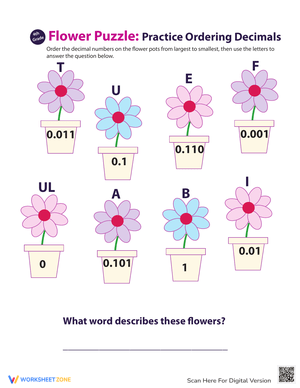
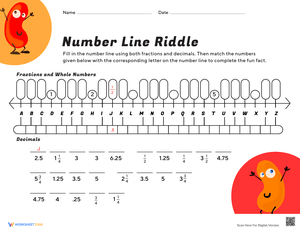
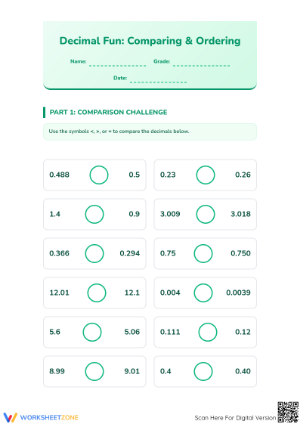
These 4th grade ordering decimals printable worksheets resources give teachers a focused set of standalone practice tools built for a very specific problem: the moment a student applies solid whole-number logic to decimals and lands on the wrong answer with complete confidence. Each worksheet targets a distinct skill in the tenths-and-hundredths range, so the set can be assigned selectively based on where individual students are stalling.
Errors Students Make With Decimal Ordering — and Why They Make Them
The dominant error pattern is the "longer is larger" assumption. Students who correctly know that 456 is greater than 5 apply the same digit-counting logic to decimals and conclude that 0.456 is greater than 0.5. This is not a careless mistake — it is a direct transfer of a rule that worked reliably for years. The fix is not re-explanation alone; it is repeated exposure to counterexamples, particularly comparisons where the shorter decimal is the larger value. When teachers run 4th grade ordering decimals printable worksheets sets alongside this kind of targeted instruction, the deliberate pairing of tenths-versus-hundredths comparisons in multiple formats accelerates the point at which students stop defaulting to digit-counting.
A second pattern shows up whenever zeros appear in the tenths place. Students encountering 0.05 and 0.5 in the same problem often treat them as close in value — both "have a 5 in them" — or even rank 0.05 higher because it visually appears to have more going on. The money model addresses this directly: 0.5 is fifty cents; 0.05 is five cents. When students hold two quarters in one hand and a nickel in the other, the place value difference is no longer abstract. That physical anchor is worth building in before the worksheet, not after the error has appeared repeatedly on paper.
Skills Covered Across the Set
The worksheets address the following, each isolated to its own practice context so teachers can assign by skill rather than by sequence:
- Comparing two decimals by reading place by place from left to right — tenths first, then hundredths
- Rewriting decimals with placeholder zeros before ordering (converting 0.6 to 0.60 before comparing it to 0.58, for instance)
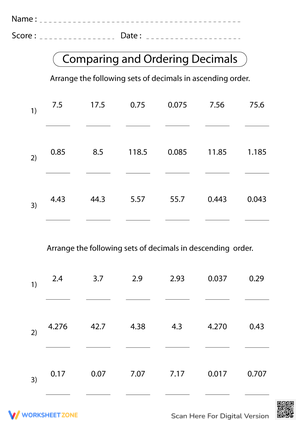
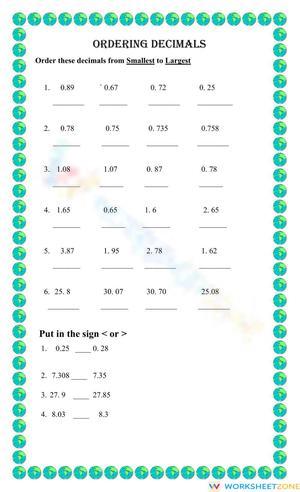
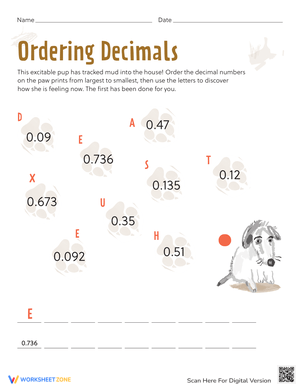
- Arranging sets of three to six decimals from least to greatest and greatest to least
- Plotting decimal values on pre-marked number lines, including positions between labeled tenths
- Identifying the equivalent fraction form — 3/10 for 0.3, 45/100 for 0.45 — and ranking the results in order
- Spotting and correcting errors in a pre-ordered decimal sequence
That last format tends to be more revealing than straightforward ordering tasks. A student who can explain why 0.3, 0.45, 0.4 is sequenced incorrectly understands place value in a way that someone who simply re-sorts the list may not.
Standard Alignment
The core standard is 4.NF.C.7, which asks students to compare two decimals to hundredths by reasoning about their size and to record comparisons using greater than, less than, or equal to symbols. The standard also requires students to recognize that comparisons are valid only when both values refer to the same whole — a detail that becomes instructionally important when worksheets include measurement or money contexts. Worksheets that pair fraction and decimal ordering connect additionally to 4.NF.C.6, which addresses notation for fractions with denominators of 10 and 100. In most fourth-grade math programs, these two standards land in the same two-to-three week cluster, and the worksheets in this set support both without requiring separate planning.
Fitting These Worksheets Into Your Weekly Instruction
Exit tickets are the most efficient use of the comparison-only worksheets. Three or four items at the end of a lesson take under five minutes to complete and under two minutes to scan — and they tell teachers exactly which students need another day on tenths-only comparisons before moving to hundredths problems.
During small-group rotations, the number line placement worksheets work well for independent work while the teacher pulls a group for direct instruction. Each worksheet runs roughly fifteen minutes at a steady pace, which fits a standard rotation block without the awkward early-finisher problem. The fraction-decimal ordering worksheets work better as a partnered task during that same structure, since talking through equivalences tends to surface reasoning that silent work hides.
One activity worth building around the number line worksheet: distribute the decimal value cards to individual students and have the class arrange themselves in a line at the front of the room from least to greatest. When two students disagree about their relative positions, the ensuing argument — which number goes first, and why — makes misconceptions audible and gives the whole class something concrete to discuss. It takes about eight minutes and surfaces more useful diagnostic information than reviewing the same content on a projected slide. The 4th grade ordering decimals printable worksheets resources in this set include enough variation across skill types that teachers can rotate which worksheet feeds into this kind of whole-class follow-up without repeating the same format twice in a row.
Differentiating Across Readiness Levels
Students who are still unsteady with basic place value benefit most from the tenths-only comparison worksheets before any hundredths work is introduced. Pairing those tasks with a physical model — specifically dimes and pennies — gives students a concrete reference. Two dimes is 0.20; nineteen pennies is 0.19. Students who can demonstrate that comparison with coins before writing it on paper are far less likely to revert to digit-counting under pressure. Moving too quickly to the abstract comparison format, before students have a reliable mental model, tends to produce correct answers through pattern-matching rather than through actual reasoning about value.
Students who have solid tenths-and-hundredths comparison are ready for the worksheets that include whole numbers alongside decimals in the same ordering set — comparing 1.3, 1.25, and 2.04 requires the same place-by-place strategy but adds a layer of decision-making that extends the thinking. The spot-the-error worksheets work especially well for students who need a challenge, since they require written justification rather than just a correctly ordered list. That kind of explanatory writing also prepares students for constructed-response items on fourth-grade state assessments in most states.
The 4th grade ordering decimals printable worksheets set covers enough range across skill types and difficulty levels that teachers in mixed-readiness classrooms can make targeted assignments without building separate materials from scratch.
Frequently Asked Questions
Why do students keep assuming that a longer decimal is automatically greater than a shorter one?
Because that rule worked for whole numbers. Students who correctly know that 348 is greater than 57 apply digit-counting directly to decimals and land on the wrong answer. Explanation alone rarely fixes it — what works is repeated comparison of tenths-and-hundredths pairs where the shorter decimal is the larger value, combined with the placeholder zero strategy. Once students rewrite 0.5 as 0.50 and compare it to 0.48 as hundredths, the visual evidence overrides the old rule in a way that a verbal correction does not.
When should I introduce the placeholder zero strategy?
After students can correctly identify what the tenths and hundredths places represent. Introducing it before that foundation is in place turns it into a memorized step rather than a reasoning tool — students add zeros without understanding why the values stay the same. Once a student understands that 0.6 and 0.60 name the same point on a number line, the strategy makes sense rather than just appearing to work by coincidence.
How does decimal ordering connect to the fraction work students finished earlier in fourth grade?
Standards 4.NF.C.6 and 4.NF.C.7 are explicitly linked. A student who understands that 0.3 means 3/10 and 0.30 means 30/100 can use fraction comparison skills when ordering decimals — finding a common denominator of 100 gives a second pathway to the same answer. Asking students to rewrite a decimal as a fraction before ordering it reinforces both standards at once and gives students who are struggling with the decimal process an alternative route when place-by-place comparison alone is not clicking.













 Interactive Worksheet Maker
 Quiz Maker
 Word Search Maker
 Crossword Puzzle Maker
 Word Scramble Generator
 Sentence Scramble Generator
 Handwriting Worksheet Generator
 Name Tracing Generator
 Fill In The Blank Generator