




























Views
Downloads

Printable Decimals and Fractions Worksheet | Grade 4 Math

Paste this activity's link or code into your existing LMS (Google Classroom, Canvas, Teams, Schoology, Moodle, etc.).
Students can open and work on the activity right away, with no student login required.
You'll still be able to track student progress and results from your teacher account.
This comprehensive math worksheet helps students master the relationship between decimals and fractions through engaging matching tasks, data tables, and real-world word problems. Students practice identifying equivalent values for tenths and hundredths, building the conceptual foundation necessary for advanced rational number operations. This printable resource ensures learners can confidently transition between fractional and decimal notations.
At a Glance
- Grade: 4 · Subject: Math
- Standard:
CCSS.MATH.CONTENT.4.NF.C.6— Use decimal notation for fractions with denominators 10 or 100- Skill Focus: Equivalent Decimals and Fractions
- Format: 3 pages · 18 problems · Answer key included · PDF
- Best For: Independent practice or formative assessment
- Time: 20–30 minutes
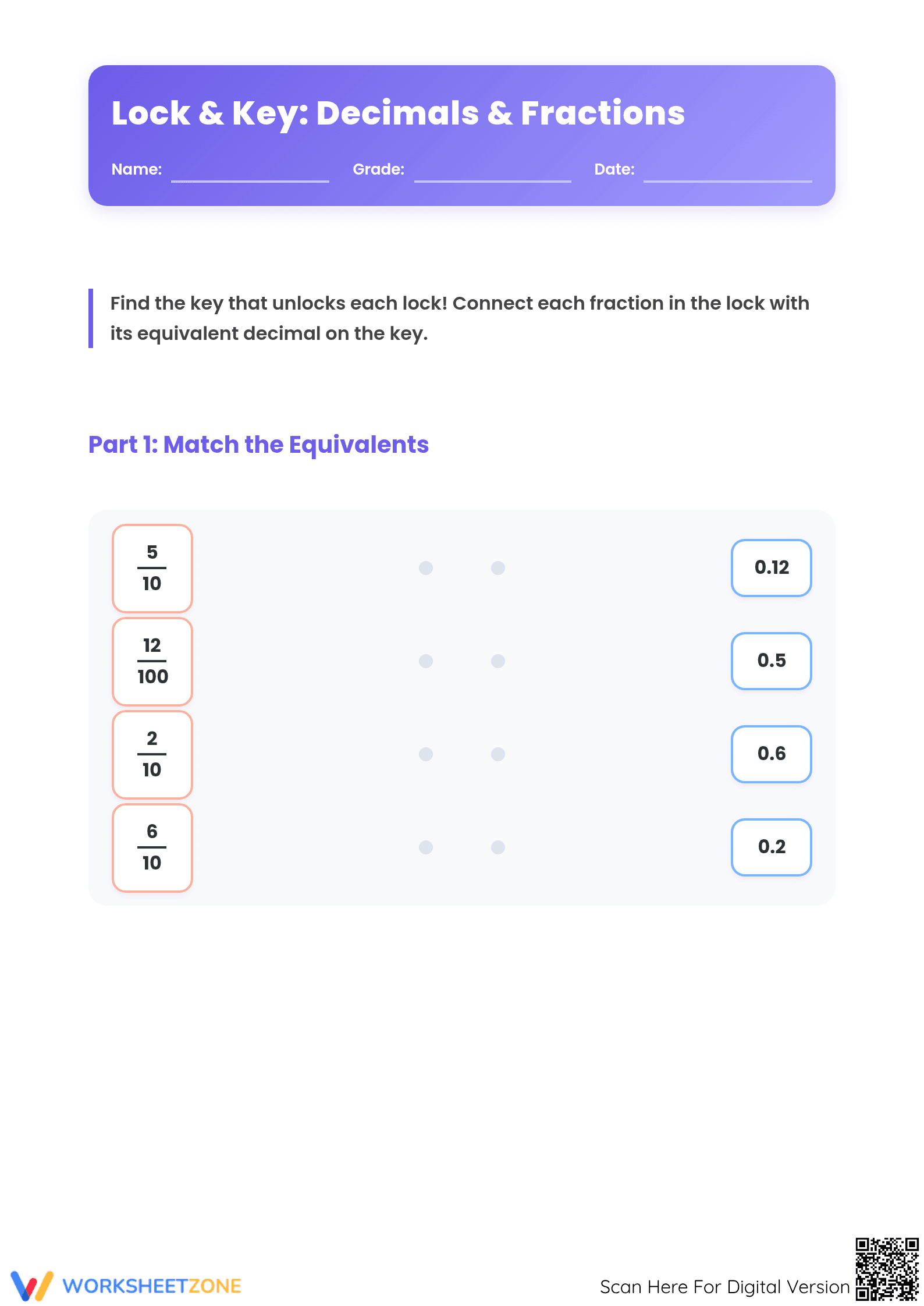
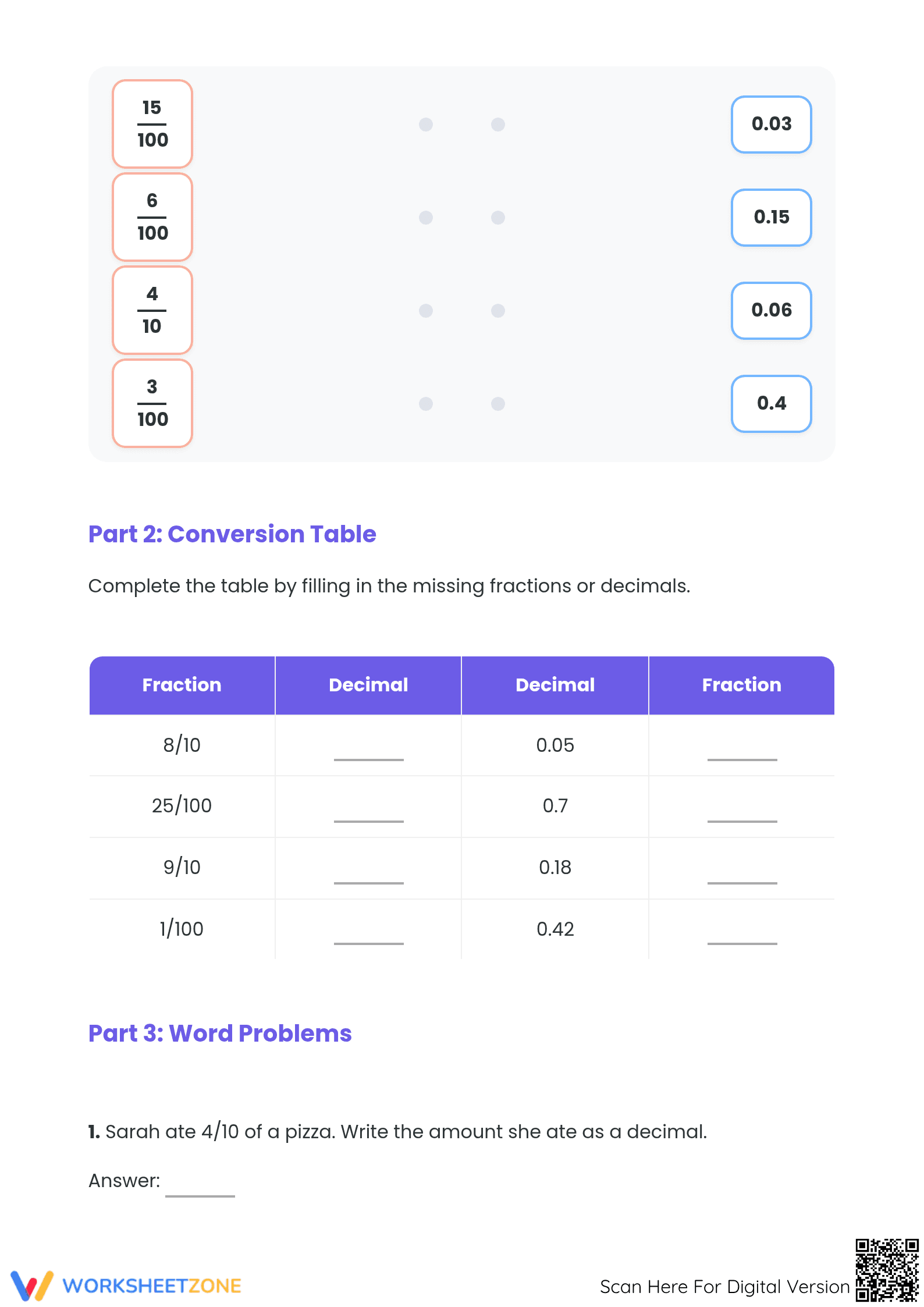
This three-page PDF includes 18 distinct tasks organized into three sections: "Match the Equivalents," a "Conversion Table," and "Word Problems." The layout features clear visual prompts, including lock-and-key matching icons and structured tables, to support student focus. A complete answer key is provided for immediate feedback or teacher-led grading, making it an efficient tool for any classroom setting.
Skill Progression
- Guided Matching: 8 pairs where students connect visual "lock" fractions to "key" decimals, reinforcing basic recognition of tenths and hundredths across two pages.
- Supported Table Work: 8 conversion entries that require students to translate between forms using a provided table structure, bridging the gap between matching and generation.
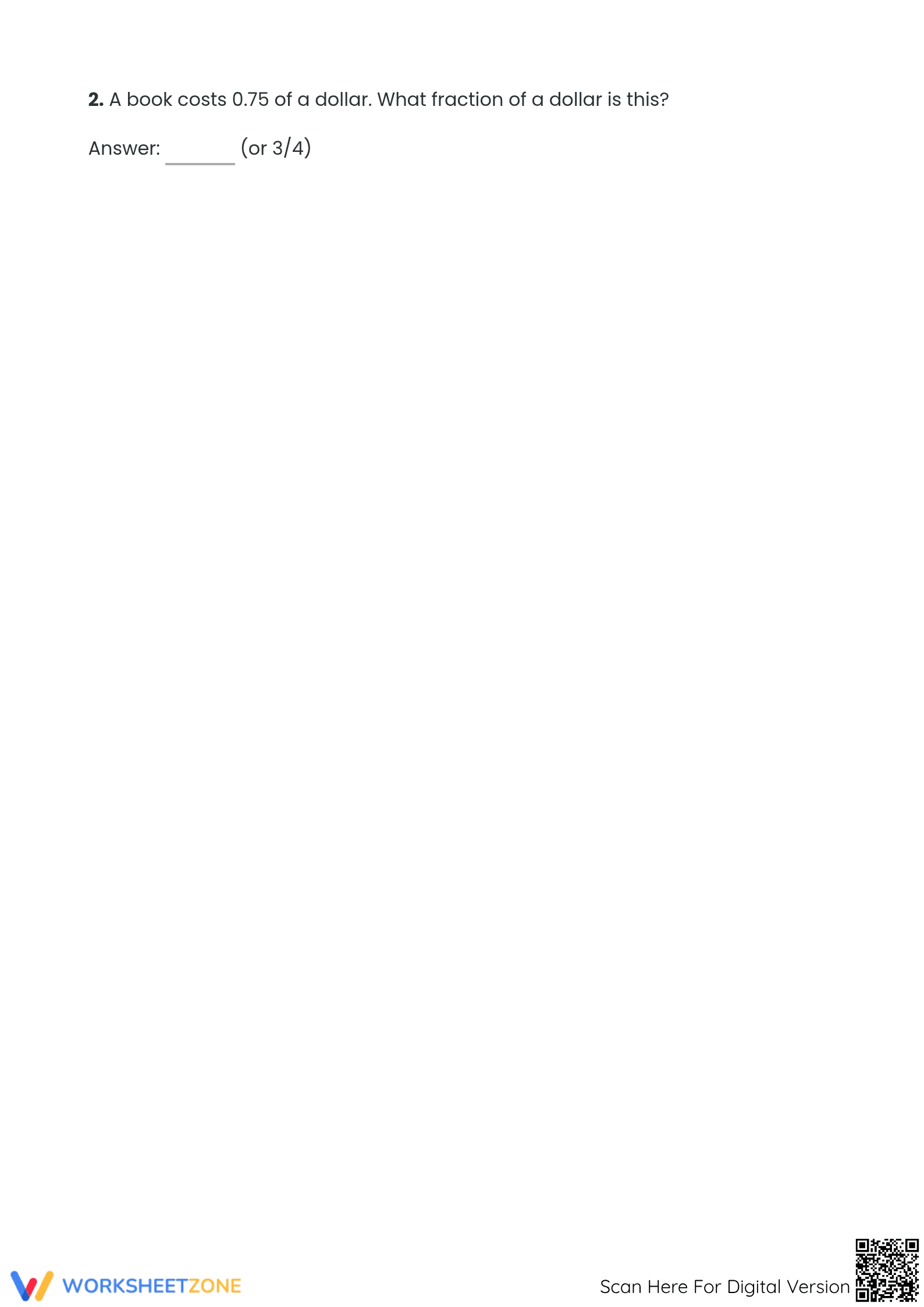
- Independent Application: 2 word problems requiring students to extract data from a scenario and write the correct decimal or fractional equivalent.
This sequence follows a gradual-release model, moving from simple recognition to active generation and contextual application.
Standards Alignment
The primary focus of this worksheet is CCSS.MATH.CONTENT.4.NF.C.6, which requires students to use decimal notation for fractions with denominators 10 or 100. By matching fractions like 8/10 to 0.8 and 25/100 to 0.25, students demonstrate mastery of the base-ten system. Both standard codes can be copied directly into lesson plans, IEP goals, or district curriculum mapping tools.
How to Use It
Use this worksheet as a mid-unit formative assessment to check for student misconceptions regarding place value. During instruction, observe if students struggle more with hundredths versus tenths; this provides a clear data point for small-group intervention. Most students will complete the full three-page set in approximately 25 minutes, making it ideal for a "Work on Math" station or a homework assignment.
Who It's For
This resource is designed for Grade 4 general education students, though it serves as an excellent challenge for Grade 3 advanced learners or a necessary intervention for Grade 5 students needing place value review. It pairs naturally with base-ten blocks or a decimal place value anchor chart to provide concrete support during the abstract matching phase.
According to the RAND AIRS 2024 analysis of elementary mathematics instruction, the ability to fluidly translate between representations of rational numbers is a key predictor of success in middle school algebra. This worksheet targets CCSS.MATH.CONTENT.4.NF.C.6 by requiring students to identify equivalent tenths and hundredths across 18 structured problems. By utilizing a multi-modal approach—incorporating visual matching, tabular organization, and contextual word problems—the resource aligns with evidence-based practices for mathematical fluency. Fisher & Frey (2014) emphasize that such scaffolds support the gradual release of responsibility, allowing students to move from rote recognition to independent application. The inclusion of a formal answer key facilitates immediate self-correction, a strategy proven to reduce the fossilization of mathematical errors. Educators can use these tasks to verify that students understand the positional value of digits in the decimal system, ensuring a robust transition from fractional parts to base-ten decimal notation.


