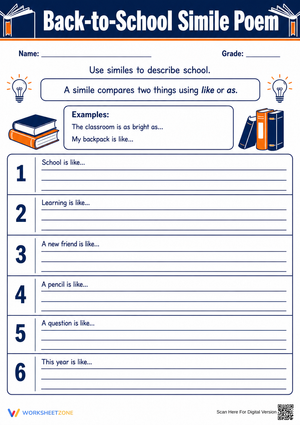
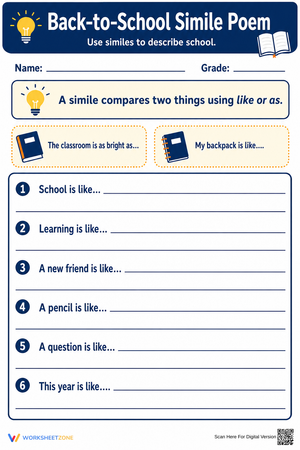
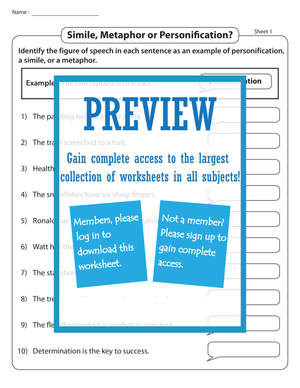
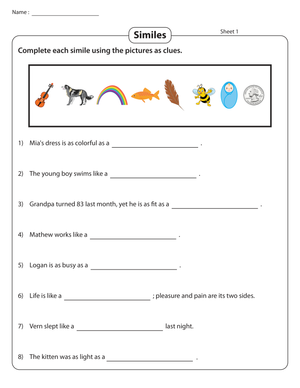
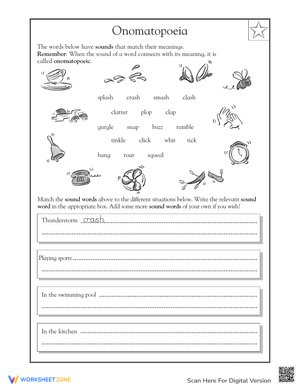
These figurative language worksheets for 4th grade target the specific literary devices CCSS L.4.5 expects students to interpret — not just name — by the end of the year: similes, metaphors, idioms, adages, proverbs, personification, and hyperbole. The set moves students through identification tasks, meaning-in-context questions, and short writing responses, so teachers have exercises for every phase of instruction from first introduction through review. Each worksheet works as a standalone activity, which makes them easy to slot into a unit at whatever point fits the class.
Skills Across the Set
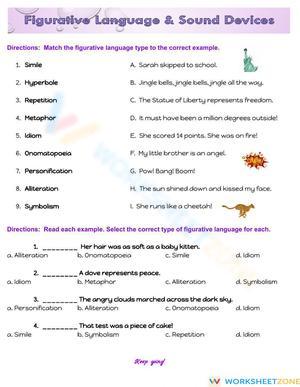
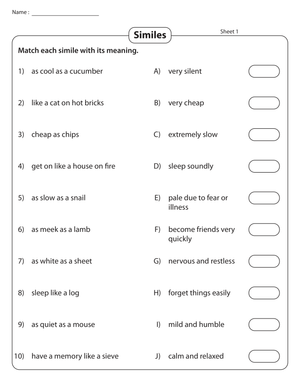
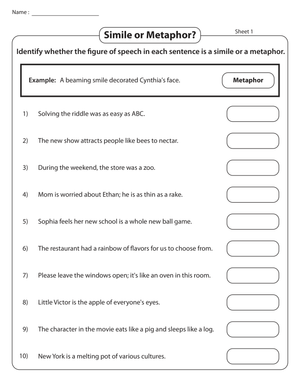
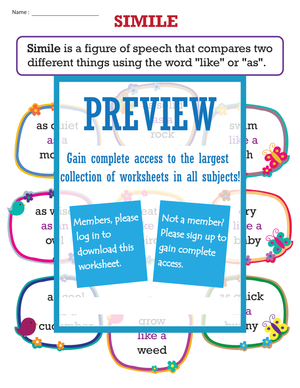
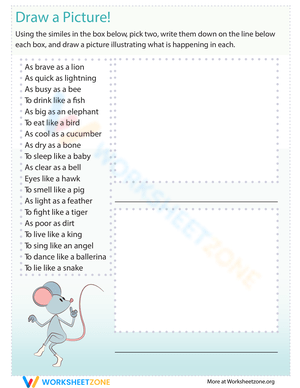
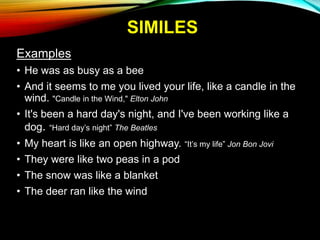
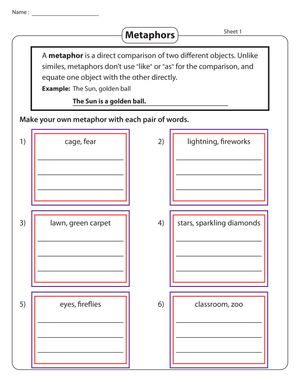
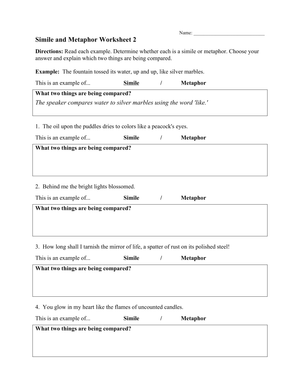
The simile and metaphor worksheets ask students to do more than circle and label — they ask students to explain what the comparison means within the specific sentence in front of them. That shift matters at fourth grade, where L.4.5 moves the expectation from recognition to interpretation. Metaphor worksheets also include tasks where students rewrite a given simile as a metaphor and vice versa, which forces attention to the grammatical difference between the two devices rather than just the comparison they both make.
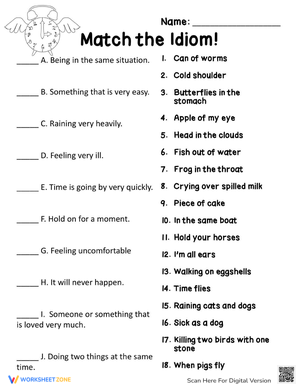
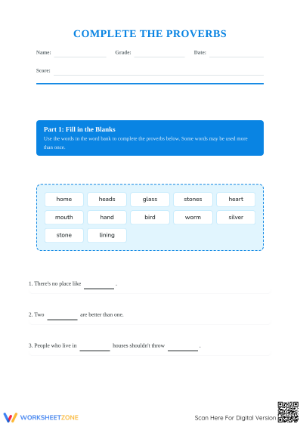
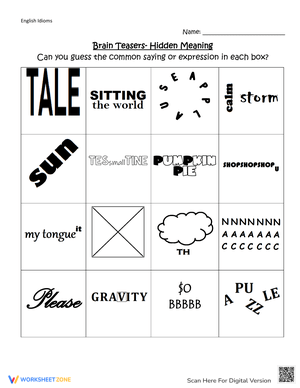
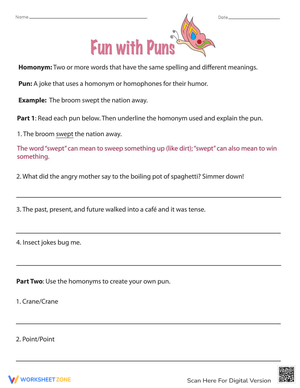
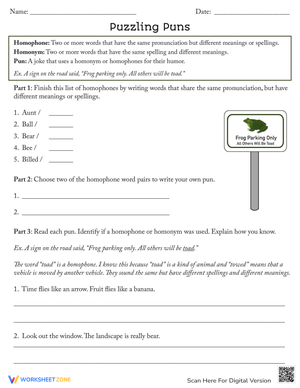
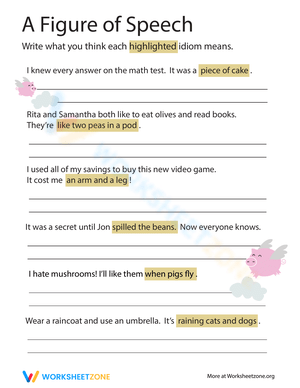
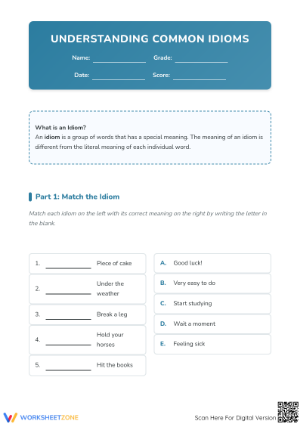
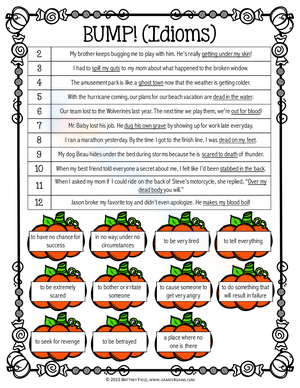
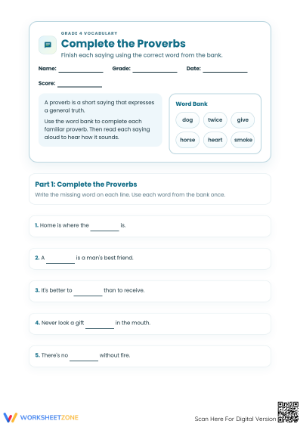
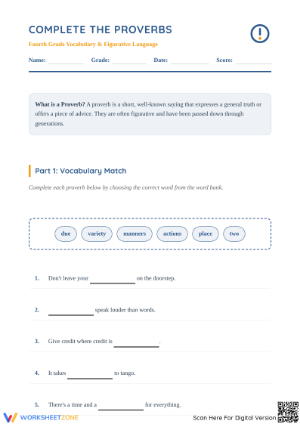
Idiom worksheets draw from expressions students encounter in classroom texts and everyday conversation — "let the cat out of the bag," "burn the midnight oil," "bite off more than you can chew" — and ask students to write the meaning in their own words, then use the expression in an original sentence. Adage and proverb worksheets follow a similar structure but include a short context prompt asking when someone might use the saying, which helps students draw a working distinction between idioms (informal, often playful) and proverbs (traditional, often carrying a moral weight).
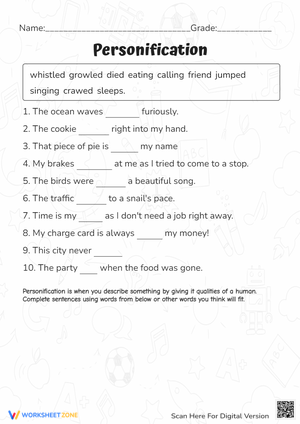
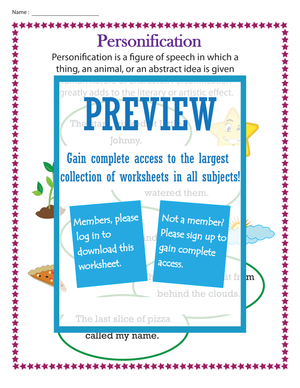
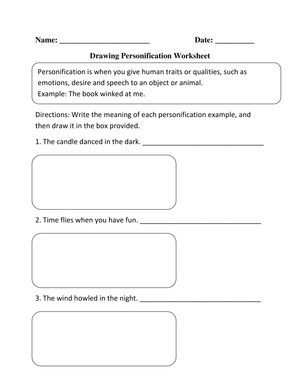
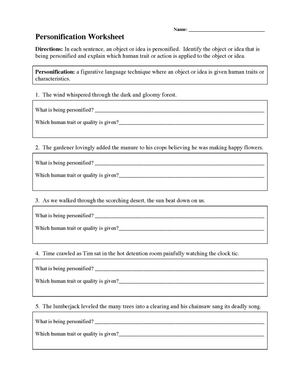
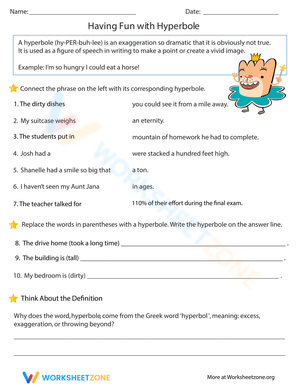
Personification and hyperbole each get their own worksheet rather than appearing together, because students consistently confuse the two when they land on the same worksheet. Each worksheet presents examples embedded in short passage contexts — not isolated sentences — so students practice reading figurative language the way they encounter it in actual novels and basal readers.
Student Error Patterns Worth Knowing Before You Teach This Unit
The most persistent simile error at fourth grade is not confusing simile with metaphor — it's failing to recognize that "like" and "as" don't always signal a comparison. Students who absorb the rule "look for like or as" will mark "I like the way you read" as a simile without hesitation. Worksheets that include deliberate non-examples — sentences where "like" functions as a verb or "as" works as a conjunction — catch this pattern early and give teachers clear formative data about who has genuinely internalized the concept versus who has only memorized the trigger words.
With idioms, the gap is almost never definition recall; it's production. A student who correctly explains that "hit the books" means to study will still write "he hit the books carefully on the library shelf" in a sentence-completion task, reverting to a literal reading the moment the demand shifts from interpretation to output. That gap between knowing a meaning and using the expression is developmentally expected at this stage — fourth graders are still building the working memory capacity to hold a figurative meaning in mind while constructing a sentence around it.
Personification and hyperbole trip students up because both involve saying something literally untrue. Students tend to put "the sun smiled down on us" and "I've been waiting forever" in the same mental category. Worksheets that push students to articulate the type of untruth — does it assign a human trait to something nonhuman, or does it exaggerate for effect? — move them toward the real distinction in a way that pure labeling tasks don't.
Building These Worksheets Into Your Weekly Language Block
The most reliable use pattern is to introduce a new device on Monday with direct instruction, then distribute the corresponding figurative language worksheets for 4th grade for independent practice on Tuesday or Wednesday, after students have worked through examples together as a group. That overnight gap between instruction and practice — spaced retrieval rather than back-to-back coverage on the same day — consistently produces stronger retention. By Thursday, a mixed task pairing the new device with a previously taught one reinforces both recall and discrimination between device types.
For morning warm-ups, the idiom worksheets fit cleanly as a five-minute opener before a lesson transition. Reading a short paragraph containing a familiar idiom and writing the meaning in their own words lands in about the right time window. Teachers who introduce one new idiom at the start of each week and distribute the matching worksheet midweek see better retention than those who run through five idioms in a single Friday block — the gap gives students time to notice the expression in other reading before they practice it on paper.
Small-group instruction is worth treating differently from independent practice. Students who freeze in front of unfamiliar passage contexts — a predictable subset in any fourth-grade class — do better starting with sentence-level identification worksheets before moving to passage-based tasks. That's not a formal accommodation; it's sequencing the available worksheets in the right order for students who need more processing time at each cognitive step.
Standard Alignment
This set aligns to CCSS ELA L.4.5, which requires fourth graders to demonstrate understanding of figurative language, word relationships, and nuance in word meanings. The sub-standards are specific: L.4.5a addresses similes and metaphors in context; L.4.5b covers idioms, adages, and proverbs; L.4.5c deals with antonyms, synonyms, and nuance, though this set focuses on the figurative language elements in L.4.5a and L.4.5b. Because the standard requires interpretation in context — not identification in isolation — every figurative language worksheets for 4th grade task is built around sentences and short passages rather than single-word prompts. Teachers in states using alternate ELA frameworks will find these same device types appear at the equivalent grade band in most state standards, generally within the language strand across grades 3 through 5.
Adjusting the Set for a Range of Learners
For students who need additional support with simile and metaphor, pairing a worksheet with a small reference card — just the definitions and one example of each device — reduces the retrieval load enough that students can focus on interpreting the comparison rather than trying to recall which term is which. The important thing is phasing out that reference card deliberately. Students who still reach for it by the fourth or fifth practice session aren't building durable recall, and that's worth addressing directly rather than letting the support card become permanent.
Advanced students move through the single-device worksheets quickly and accurately, which creates a different planning problem. Adding a production layer resolves it without requiring a separate resource: ask those students to write three original examples of the day's device embedded inside a short paragraph, not as standalone sentences. A student who places a personification naturally inside a descriptive paragraph has genuinely absorbed the device. One who writes "The tree danced." and stops hasn't. That distinction surfaces clearly in written output, and the worksheet practice is what makes it visible early enough to act on.
Frequently Asked Questions
What device types does the set cover?
The set addresses seven device types across both single-device and mixed-review worksheets:
- Similes and metaphors (including transformation tasks where students convert one form to the other)
- Idioms
- Adages and proverbs
- Personification
- Hyperbole
Mixed-review worksheets ask students to distinguish among several device types at once. Those work best as review rather than first practice, since students need confidence with each device individually before they can reliably tell them apart.
Will these work for students who are still developing their English reading skills?
The sentence-level identification worksheets are accessible for students reading at or near grade level in English. The idiom and adage tasks assume familiarity with common English expressions, which creates a genuine comprehension barrier for students whose home language is not English. For those students, explicitly pre-teaching two or three of the idioms before distributing the worksheet — rather than expecting the worksheet itself to introduce the expressions — makes a measurable difference in how accurately students complete the tasks.
Can these serve as formative assessments rather than just practice?
Any worksheet not previously used for practice functions as a solid formative check. A mixed-review worksheet pulled as a ten-minute exit task tells a teacher exactly which students are still treating every "like" sentence as a simile and which have genuinely internalized the distinction. These are not normed assessments and were not built to be — but the data they generate is precisely what a teacher needs to plan the following week's small-group time.
Where in a figurative language unit do these worksheets fit best?
Single-device worksheets belong in the guided and independent practice phase — after direct instruction, before any summative check. Mixed-review worksheets work well as spiral review two to three weeks post-instruction. If your district assesses L.4.5 in a multiple-device format, those mixed-review worksheets also serve as a natural preview of the figurative language worksheets for 4th grade assessment structure. Starting the unit by handing a worksheet to students before any instruction is the least effective use of this set — students who haven't been taught what personification is will not discover it by reading sentences on a page.












 Interactive Worksheet Maker
 Quiz Maker
 Word Search Maker
 Crossword Puzzle Maker
 Word Scramble Generator
 Sentence Scramble Generator
 Handwriting Worksheet Generator
 Name Tracing Generator
 Fill In The Blank Generator




 BACK TOSCHOOL