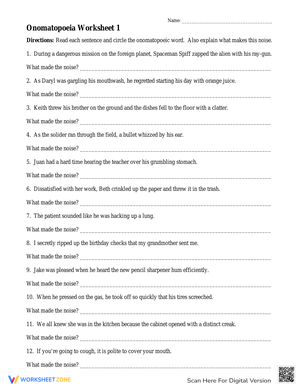
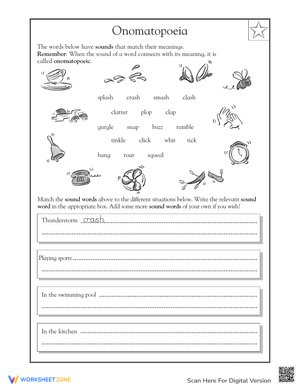
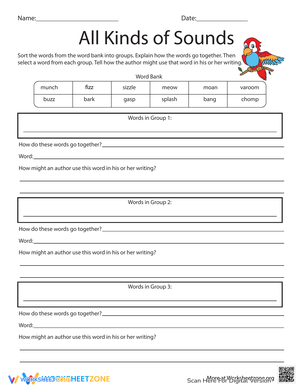
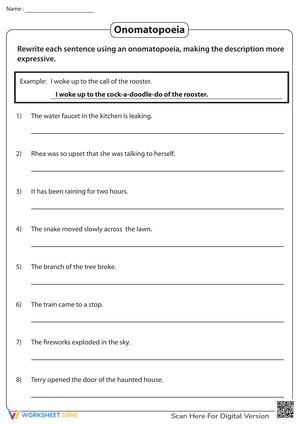
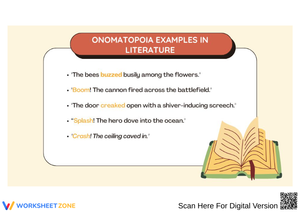
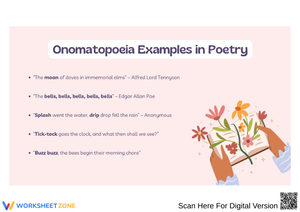
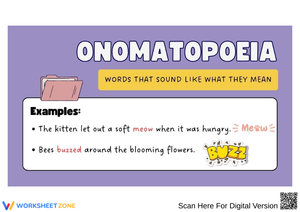
These 4th grade onomatopoeia worksheets resources give teachers print-ready practice for the part of the ELA year when figurative language moves from a vocabulary exercise into an actual writing skill. Each worksheet targets something specific — identifying sound words in mentor text passages, sorting them by category, producing them inside sentence frames, or revising flat paragraphs by replacing weak verbs with precise sound words. The revision exercises produce the most visible growth, because students see exactly what one deliberate word choice does to a sentence's energy.
Skills These Worksheets Build
The skill arc moves from recognition to production. Earlier worksheets ask students to underline sound words in short passages and name what each word imitates — tasks that feel simple until you watch a student circle thunderous and argue it qualifies because "it's about sound." The identification exercises keep that distinction clear. By the time students reach the production worksheets, they have enough experience with the concept to make real choices: the word clatter in a cafeteria scene does something different than hum, and students who have spent time sorting and identifying are ready to feel that difference.
- Identifying sound words in prose and poetry passages
- Sorting onomatopoeia by type: animal, impact, mechanical, and vocal sounds
- Completing sentence frames with an appropriate sound word
- Writing original sentences without a frame
- Revising a provided narrative passage to add onomatopoeia at natural points
- Comic-strip prompts pairing a drawn action scene with a sound burst label
Error Patterns That Show Up in Student Work
The most consistent fourth-grade error is conflating sound-describing adjectives with onomatopoeia. A student circles deafening in a passage and argues confidently that it qualifies because "it's about sound." What they haven't grasped is that onomatopoeia doesn't describe a sound from the outside — the word itself imitates what it names. The most direct fix is showing both types in the same passage: The blast was deafening placed next to The blast boomed through the canyon. Worksheets that include both types in close proximity give students that comparison without requiring a separate teacher-created example.
A second pattern surfaces during the production tasks. Students who correctly identify sizzle and crunch on the identification worksheet will still write "the leaves made a crunching sound" in their own sentences — they know the word but haven't internalized that it can stand alone as the verb. Requiring students to cross out any instance of "made a sound" or "made a noise" from their revised sentences before turning in the worksheet addresses this quietly but directly.
Standard Alignment
The primary anchor is CCSS.ELA-LITERACY.W.4.3.D, which requires students to use concrete words, phrases, and sensory details to convey experiences precisely. Onomatopoeia fulfills this standard not as a peripheral vocabulary item but as a mechanism — a sound word is sensory detail compressed into a single verb or noun. The broader figurative language standard, CCSS.ELA-LITERACY.L.4.5, covers understanding figurative language and nuances in word meanings; a 4th grade onomatopoeia worksheets that includes annotation and effect-analysis questions ties directly to that standard by asking students to explain what a sound word does in context, not just label it. In terms of instructional placement, most teachers introduce onomatopoeia during a figurative language unit in the first trimester, then return to the revision worksheets mid-year when personal narrative writing is underway — the second exposure is where the standard actually gets met, because students are now using the device rather than identifying it.
Working These Worksheets Into Your ELA Block
The identification worksheets function well as ten-minute warm-ups during your figurative language unit. Students can work through them independently while you handle morning logistics, then a two-minute whole-class check moves things into the day's main lesson. The sorting worksheets take longer and belong at a literacy center — cut the word cards apart so students physically move them into columns, because that sorting action requires them to articulate the reasoning out loud to a partner in ways that simply circling an answer doesn't.
The revision and production worksheets pay off most when you introduce a 4th grade onomatopoeia worksheets revision task in the middle of a narrative draft cycle rather than as a standalone figurative language exercise. The sequence that works: students revise the sample passage on the worksheet, then immediately find one sentence in their own in-progress draft to improve the same way. That transfer step — worksheet to their own writing, same day — is the difference between a skill students can demonstrate on an exercise and one they actually reach for when writing independently.
Adjusting the Set for Students at Different Levels
For students who are still building their vocabulary, the identification and sorting worksheets are the right starting point. Pairing the sort with a class-generated word bank on the board removes the retrieval barrier and lets students focus on what they're actually learning — what makes a word onomatopoetic — rather than stalling on "I can't think of one." These students can move to the production tasks once the sort is solid; they just need the bank accessible while they write.
Advanced writers often grab the ten most familiar options — boom, crash, bang — and stop there. A useful constraint for these students is to ban those high-frequency words from the revision task and require something more specific. The difference between thwack and hit, or between skitter and move, is real and worth pursuing. The open-ended production prompts give these students room to stretch; adding a brief written explanation of why they chose a particular word over a more obvious one introduces the metacognitive step that separates vocabulary knowledge from vocabulary judgment.
Frequently Asked Questions
When do most teachers use these worksheets in the school year?
Most introduce onomatopoeia during a figurative language unit in the fall or early winter, then return to the revision exercises mid-year during the personal narrative unit. That second pass matters more. Students who met the concept as a vocabulary item months earlier are ready at that point to use it as a writing tool rather than a definition to memorize. The first exposure is recognition; the second is application.
Do these worksheets work for students who read below grade level?
Yes. The identification and sorting worksheets use short, controlled passages where sentence length and vocabulary load are low. A student reading below grade level can still successfully underline a sound word in a two-sentence excerpt. For students working significantly below grade level, reading the passage aloud together before independent work removes the decoding barrier without changing what the exercise is actually practicing.
How do the poetry exercises connect to the broader figurative language unit?
The poetry-focused exercises in this 4th grade onomatopoeia worksheets set ask students to annotate sound words inside actual poems and explain the effect — not simply name the device. That explanation step is where CCSS.ELA-LITERACY.RL.4.4 applies: the standard requires students to determine how word choice in a poem creates specific effects. Worksheets that pair a short poem with annotation prompts and open-ended response questions address both the device identification and the analytical thinking the standard expects.
Can the shorter exercises function as formative assessments?
The identification and sentence-completion worksheets make efficient exit tickets. A teacher can review a full class set in about three minutes and see clearly which students confused sound-describing adjectives with actual onomatopoeia — that distinction is the conceptual hinge for everything else. Students who marked deafening as their answer need different follow-up than students who marked boom, and that separation shapes the next day's instruction without requiring a formal rubric.












 Interactive Worksheet Maker
 Quiz Maker
 Word Search Maker
 Crossword Puzzle Maker
 Word Scramble Generator
 Sentence Scramble Generator
 Handwriting Worksheet Generator
 Name Tracing Generator
 Fill In The Blank Generator




 BACK TOSCHOOL