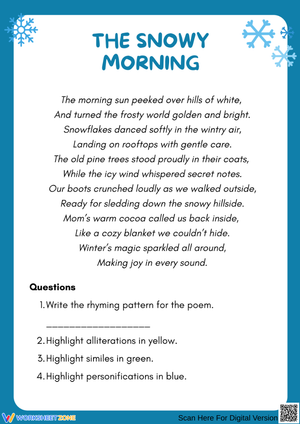
These alliteration worksheets for 4th grade move students through three distinct levels of work: identifying repeated initial sounds in context, completing sentence prompts using words that share a target sound, and writing short analytical responses that explain what a particular sound pattern does to the mood or pace of a scene. The set is built around the understanding that fourth grade is where figurative language shifts from "neat trick" to genuine craft — students at this stage are ready to ask not just what alliteration is, but why an author reaches for it.
Skills Each Worksheet Targets
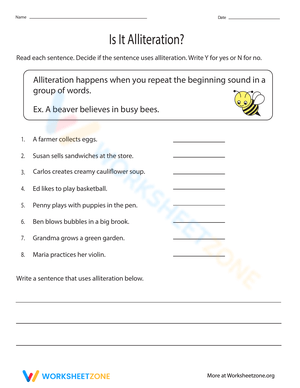
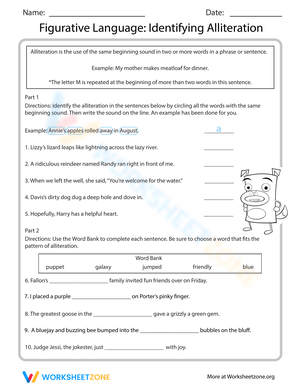
The recognition exercises present short passages — a paragraph from an adventure story, a few lines of nature poetry — and ask students to underline alliterative phrases, then name the repeated sound rather than the letter. That distinction is the point. A student who circles "slithering snakes" and writes S has done half the job; the worksheet pushes them to write /s/ sound, training the ear rather than the eye.
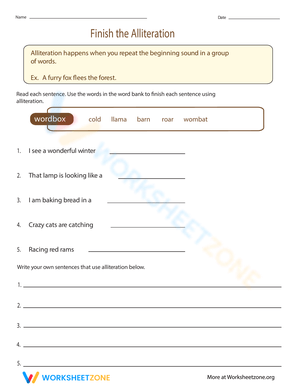
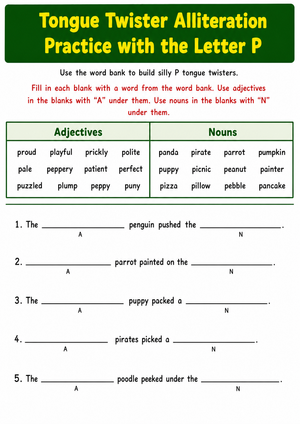
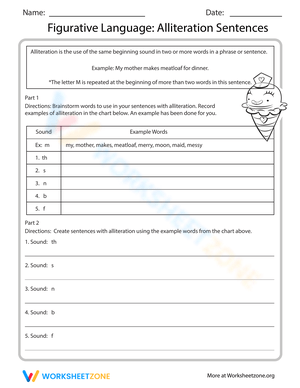
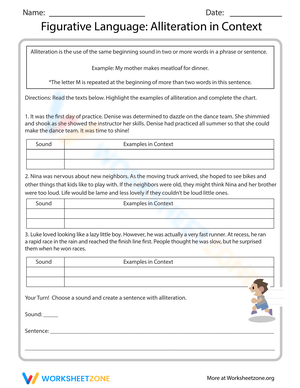
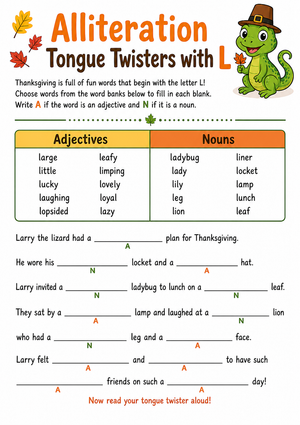
Sentence-completion prompts give students a partial phrase and a target sound, asking them to fill in two or three words that fit both the meaning and the sound pattern. A prompt like "The _____ fox _____ across the frozen field" (target: /f/ sound) requires students to think about vocabulary range — they cannot just grab the nearest word. The analysis tasks ask students to respond in two or three sentences: what sound does the author repeat, and what does it do to the scene? Does the hissing /s/ make the snake passage feel slower and more threatening? Does the hard /k/ in "cracking, crashing canyon" make the action feel louder and more violent? These are genuine questions, and fourth graders — with the right prompt structure — can answer them.
Where Students Go Wrong With Sound Patterns
The most persistent mistake at this grade level is treating alliteration as a spelling pattern rather than a sound pattern. Students will confidently circle both "city" and "careful" as alliterative because both start with the letter c, but the /s/ sound in "city" and the /k/ sound in "careful" are entirely different. The reverse error is just as common: students skip past "phone" and "forest" because one starts with ph and one with f, even though both carry the /f/ sound. This confusion surfaces most visibly in the identification exercises, before any direct instruction on the sound-versus-letter distinction, which is why the recognition tasks work best when preceded by a brief whole-class example that deliberately uses a misleading pair like those two.
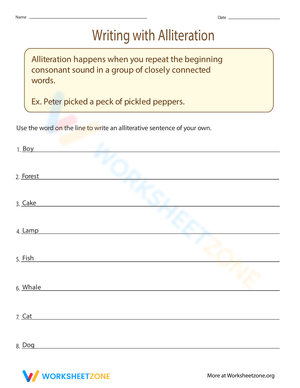
A second pattern shows up in creative writing responses: students who understand alliteration in theory produce strings like "big bad brown bouncy bears" — technically correct, rhythmically clumsy, and semantically empty. The analysis tasks are what break this habit. Asking "Why did you choose all /b/ words? What does it do to the sentence?" is a question most nine-year-olds have never been asked about their own writing, and the first time they wrestle with it, the quality of their word choices tends to shift noticeably.
Fitting These Worksheets Into the Week
Most teachers drop alliteration worksheets for 4th grade into a poetry unit, and that placement makes sense — but the identification exercises also work well as Monday warm-ups during the week after you introduce the device. Five minutes of underlining alliterative phrases in a short passage keeps the concept active without pulling time from the main lesson. The sentence-completion prompts fit naturally in the 10-to-15 minute window before a literacy center rotation; they are focused enough that students need minimal setup before working independently.
The analysis tasks are worth reserving for a full 20-minute stretch, at minimum. The first time students write analytical responses about sound choices, expect confusion about what counts as a complete explanation. Modeling one written response together on the board — thinking aloud, rejecting a weak answer, replacing it with a stronger one — before sending students to work independently removes most of that confusion and makes independent work far more productive. That gradual release structure is especially important here because "explain the author's sound choice" is not a task most students have attempted before fourth grade.
Standard Alignment
RL.4.4 — Determine the meaning of words and phrases as they are used in a text, including those that refer to significant characters found in mythology. In classroom terms, this standard moves students past vocabulary-in-isolation work and into understanding that the sounds and connotations of words are part of their meaning. Alliteration is one of the most teachable entry points into RL.4.4 because the effect is audible — students can hear it before they can fully explain it, which means the analytical writing tasks feel grounded in something real rather than abstract. The analysis exercises in this set are specifically positioned to support that standard; identifying the device is a warm-up, but explaining its effect on meaning is where the standard lives.
Adapting the Set for Mixed-Ability Classrooms
Students still building phonemic confidence get more from these alliteration worksheets for 4th grade when the identification exercises include a read-aloud step first. Have them read the passage quietly, then again while mouthing the words — the repeated initial sound often registers physically before it registers visually. Pre-highlighting two or three confirmed examples in the opening paragraph gives these students anchors to reference before they begin searching on their own, which keeps the exercise productive rather than frustrating.
Students working above grade level tend to move through the identification and completion exercises quickly. The extension move is to hand them an unmarked paragraph from a class read-aloud and ask them to insert alliteration in two or three places, then write a sentence explaining what each addition does to the mood of the scene. That task — adding sound patterns to existing prose with a stated purpose — requires a level of intentionality that the standard exercises rarely demand, and it produces some genuinely interesting student writing.
For students who freeze when facing the blank analytical response lines, a sentence frame ("The author repeats the /___/ sound to make the scene feel _____ because _____") removes the blank-page paralysis without removing the thinking. Most students stop relying on the frame after using it two or three times, once they internalize what a sufficient answer looks like.
Frequently Asked Questions
Does alliteration require the same letter, or just the same sound?
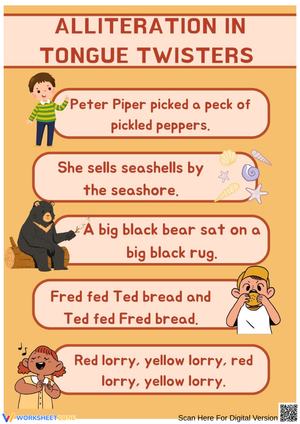
The same sound — always. "Phone" and "forest" are alliterative; "city" and "call" are not, despite both beginning with the letter c. Fourth graders who have learned alliteration mainly through tongue twisters often assume the letter is the relevant unit, because tongue twisters are usually built around a single letter for visual clarity. Teaching the sound-based definition explicitly, early, is what makes the concept transferable to actual reading and writing.
Where do these exercises fit if I am not running a dedicated poetry unit?
The identification exercises slot easily into a read-aloud debrief — pull one alliterative sentence from whatever the class is currently reading and use the worksheet as a five-minute follow-up. The analysis tasks work as a formative check-in after you introduce figurative language as part of a broader language arts block. The set does not require a poetry unit to be useful; the skill is general enough that it connects to almost any text students encounter.
What if students have seen tongue twisters but have never done analytical work with alliteration?
Start with the completion exercises rather than the identification ones. Students who already know tongue twisters understand that words can share an opening sound — they just have not named the device or applied it with purpose. Beginning with completion prompts uses that existing knowledge as a launch point and avoids the feeling of re-labeling something they already learned in first grade. Move to the identification and then the analysis tasks once students have confirmed they can generate alliteration intentionally.
Are these exercises better suited for in-class work or homework?
The identification and sentence-completion exercises in this alliteration worksheets for 4th grade set travel well as homework, because students can complete them independently once the concept has been introduced. The analysis tasks are worth keeping in class, at least at first — the quality of analytical writing drops noticeably when students work through it at home without peer discussion or a teacher model to reference. Once students have written analytical responses in class two or three times and understand what "explain the effect" means, the format is portable enough for independent practice at home.












 Interactive Worksheet Maker
 Quiz Maker
 Word Search Maker
 Crossword Puzzle Maker
 Word Scramble Generator
 Sentence Scramble Generator
 Handwriting Worksheet Generator
 Name Tracing Generator
 Fill In The Blank Generator




 BACK TOSCHOOL