




























Views
Downloads
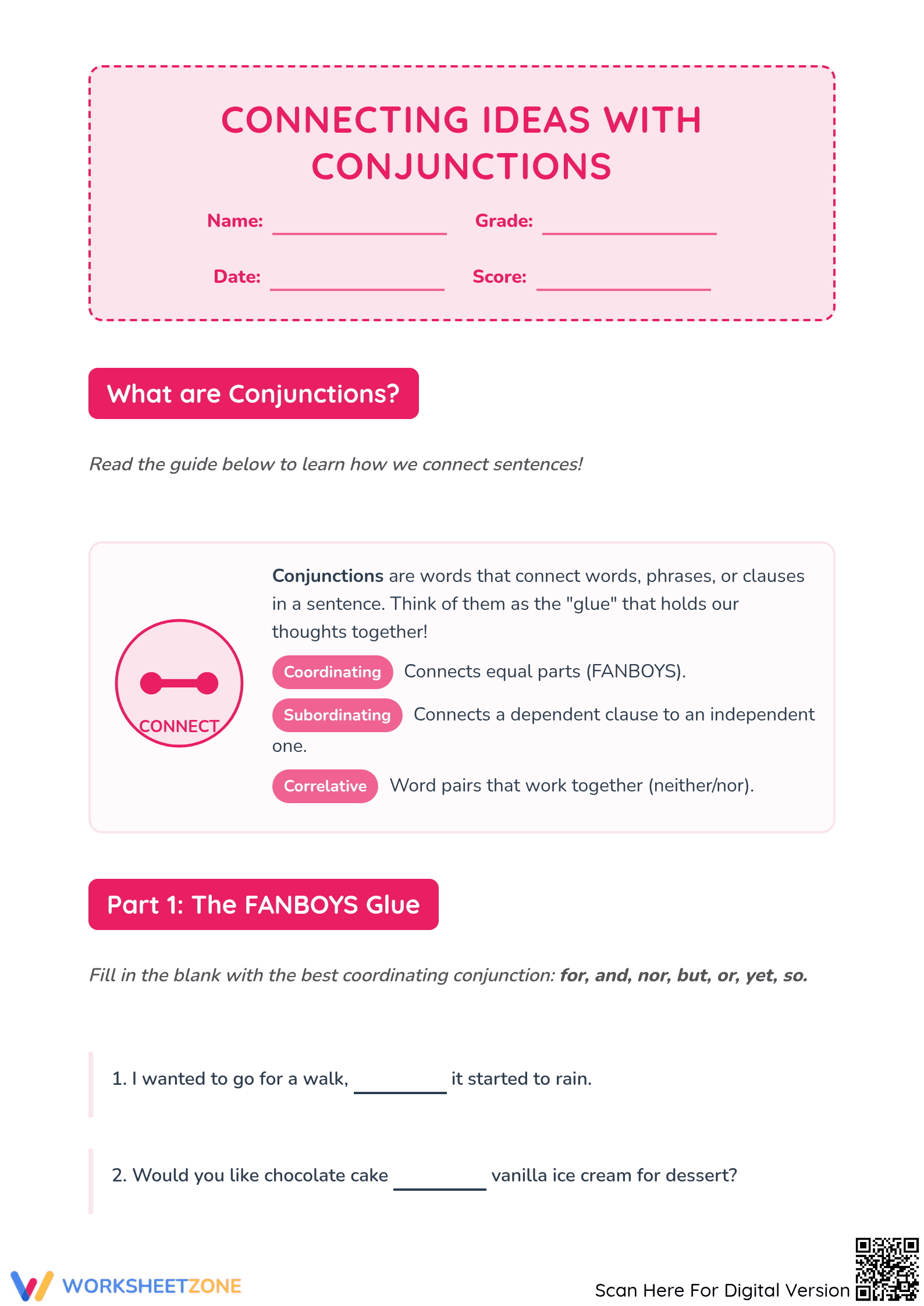



Printable Conjunctions Worksheet | Grade 3-4 ELA

Paste this activity's link or code into your existing LMS (Google Classroom, Canvas, Teams, Schoology, Moodle, etc.).
Students can open and work on the activity right away, with no student login required.
You'll still be able to track student progress and results from your teacher account.
This comprehensive grammar worksheet helps students master the three main types of conjunctions: coordinating, subordinating, and correlative. By completing these targeted exercises, learners will understand how to effectively connect words, phrases, and clauses, ultimately improving their sentence variety and overall writing fluency.
At a Glance
- Grade: 3-4 · Subject: ELA
- Standard:
CCSS.ELA-LITERACY.L.3.1.H— Use coordinating and subordinating conjunctions- Skill Focus: Coordinating, subordinating, and correlative conjunctions
- Format: 3 pages · 17 problems · Answer key included · PDF
- Best For: Independent practice and grammar review
- Time: 15–20 minutes
This three-page resource begins with a clear, student-friendly reference guide explaining the differences between coordinating (FANBOYS), subordinating, and correlative conjunctions. Following the guide, students will work through 17 diverse problems divided into four distinct sections. Task types include fill-in-the-blank sentences, identifying and circling conjunctions within context, completing correlative pairs, and a multiple-choice challenge zone. A complete answer key is provided to ensure quick and accurate grading.
- Guided practice: The worksheet opens with a built-in reference guide and straightforward fill-in-the-blank exercises (5 problems) focusing purely on coordinating conjunctions, allowing students to apply basic rules immediately.
- Supported practice: Students then move to identifying subordinating conjunctions in complete sentences (5 problems) and matching correlative conjunction pairs (5 problems), building their analytical grammar skills.
- Independent practice: The final "Challenge Zone" requires students to analyze underlined conjunctions in complex sentences and categorize them correctly (2 problems) without direct prompts.
This gradual-release structure follows the I Do, We Do, You Do model, ensuring students build confidence before tackling more complex sentence structures.
This resource is directly aligned to CCSS.ELA-LITERACY.L.3.1.H, requiring students to use coordinating and subordinating conjunctions. It also introduces correlative conjunctions, providing an excellent bridge to upper-elementary language standards. Both standard codes can be copied directly into lesson plans, IEP goals, or district curriculum mapping tools.
Teachers can use this worksheet as a primary practice activity immediately following direct instruction on sentence structure. It works perfectly as an independent center activity or a homework assignment. For formative assessment, observe how students handle the correlative conjunctions section; if they struggle to match the pairs (like either/or), it may indicate a need for a mini-lesson on parallel structure. Most students will complete the full three-page packet in 15 to 20 minutes.
This worksheet is designed for third and fourth-grade students developing their foundational grammar skills. The clear reference guide at the top makes it highly accessible for students who need visual reminders or those receiving specialized language support. It pairs wonderfully with a mentor text activity where students hunt for FANBOYS in their favorite reading passages.
Mastering conjunctions is a critical step in developing advanced reading comprehension and writing proficiency. According to EdReports 2024, explicit grammar instruction that connects directly to sentence combining significantly improves students' ability to decode complex texts and express nuanced ideas. This resource supports that evidence-based approach by targeting CCSS.ELA-LITERACY.L.3.1.H, ensuring students can accurately use coordinating and subordinating conjunctions. By providing a structured progression from basic identification to application in context, educators can effectively bridge the gap between isolated grammar drills and authentic writing application. The inclusion of correlative conjunctions further challenges learners to recognize paired relationships within sentences. Implementing targeted practice materials like this ensures that foundational language mechanics are solidified, paving the way for more sophisticated communication skills in upper elementary grades and beyond.


