These community culture worksheets pdf for 3rd grade give teachers a set of standalone resources for building the foundational social studies understanding that communities are shaped by shared practices, values, and history — not just by where people happen to live. Each worksheet addresses one specific dimension of cultural understanding, so teachers can use them as read-aloud follow-ups, station work, or family project assignments without redesigning a unit around them. The set moves from accessible entry points — food, celebration, clothing — toward the more demanding reasoning about why cultural practices take the shapes they do.
The Specific Skills These Worksheets Build
Third grade is the grade where most students first encounter the idea that their own family's practices are not universal — that another child might eat a different meal on a shared holiday, use a different language at home, or follow different household rules, and that none of those things make any family more or less correct. The worksheets address that developmental moment directly.
Each worksheet focuses on one or two skills rather than trying to survey culture in one sitting:
- Identifying the five core elements of community culture: language, food, traditions, arts, and values
- Sorting cultural traits into visible practices (clothing, food, architecture) and less visible ones (beliefs, social rules, family roles)
- Completing Venn diagrams to compare two communities' traditions while identifying shared human themes like harvest, celebration, and mourning
- Using a map-based worksheet to draw connections between geographic features — climate, terrain, nearby water sources — and specific cultural practices
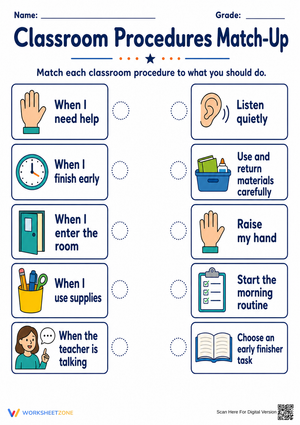
- Matching vocabulary: tradition, custom, heritage, diversity, and community, using context sentences drawn from real cultural examples
- Short constructed responses asking students to explain a family tradition and identify what need it meets for the community
That last task is intentionally harder than it looks. Most third-graders can name a tradition; fewer can articulate its function. The short-response prompts push students past description into a basic explanatory frame, which is where the deeper cultural thinking actually lives.
Patterns in Student Thinking Worth Addressing Early
The most persistent error at this grade is conflating nationality with culture. Students write "American culture is..." and mean their own household's practices, or they describe an entire country's culture as a single unified set of behaviors. This isn't carelessness — it reflects a developmental tendency to treat "people like us" as normal and everyone else as the group that has a culture. Several worksheets address this directly by presenting two communities from within the same country with visibly different traditions, forcing students to revise that binary.
A second pattern worth watching: students reliably treat culture as costume. They can list foods and holidays, but when asked why a community gathers for a particular annual meal, the typical written response is "because they like it" — not any recognition that shared rituals reinforce belonging and mark time. The worksheets' short-response prompts specifically ask for function, not just description, which surfaces this gap cleanly. If most of the class writes purely descriptive answers on the first attempt, that's useful formative data. It tells you the group needs explicit instruction on the "why" before they'll produce it independently.
One more: students at this age frequently conflate race and culture. They write broad racial categories as monolithic cultural ones, without recognizing that practices vary widely within any racial group. This misconception hardens quickly if left unaddressed, and these activities surface it early enough to redirect. Teachers who catch it during a worksheet debrief — rather than during a culminating project — have a much easier correction to make.
How to Build These Worksheets Into Your Lesson Plans
The most reliable entry point is the read-aloud follow-up. After reading something like The Name Jar or Last Stop on Market Street, hand students a cultural elements worksheet and ask them to identify which elements appeared in the story. The move from "what happened" to "what this tells us about this community" is exactly the analytical shift these activities train. It takes about 12 minutes at the end of a read-aloud block, and the results — even on the first attempt — give a clear picture of where individual students are in their thinking.
Station rotations work well mid-unit. One station uses a Venn diagram worksheet to compare two traditions students have already encountered. A second station pairs a map with questions about how a community's geography might have shaped their food or shelter practices. A third station focuses on vocabulary. Running three stations simultaneously keeps the class engaged and frees teachers to spend those 15 to 20 minutes pulling a small group for direct instruction on the misconceptions above rather than managing the whole room at once.
The family interview worksheet — where students ask a parent or grandparent about a tradition, record the answers, and identify which cultural element it represents — works particularly well as a take-home assignment the week before the unit's culminating discussion. Students arrive the next day with specific, personal examples that ground the abstract vocabulary in something real. That Monday-morning share-out, when students read their notes aloud, is typically the richest conversation of the unit because every example is authentic.
Standard Alignment
These worksheets align with two specific standards from the NCSS C3 Framework. The first is D2.Geo.6.3-5, which asks students to explain how cultural and environmental characteristics of places are connected — exactly what the geography-and-culture worksheets require when students examine how terrain and climate influence housing, food, and clothing. The second is D2.His.4.3-5, which calls on students to explain why individuals and groups during the same period hold different perspectives. The comparison activities, particularly the Venn diagrams contrasting community traditions, build directly toward that standard's demands.
In classroom terms, these aren't end-of-unit assessment standards — they're inquiry standards. A student meeting D2.Geo.6.3-5 isn't recalling a fact; they're constructing a reasoned connection between a place's physical features and its people's practices. That's a thinking skill, and these worksheets give students repeated, low-stakes practice at it before any summative task asks them to demonstrate it independently. The community culture worksheets pdf for 3rd grade fits into this standard's progression most naturally during the middle of a culture unit, after students have built vocabulary but before they attempt an extended writing or project task.
Differentiating These Worksheets Across Ability Levels
For students who find the abstract vocabulary inaccessible, the most effective move is to start with their own family before asking them to analyze an unfamiliar community. The "my family's traditions" worksheet provides that anchor — once a student has written about something they already know, applying the same categories to a different community requires significantly less cognitive effort. Sentence frames ("This community practices _____ because _____") give students who freeze on open-ended prompts a clear structure without removing the thinking the task requires.
For students who move through the standard activities quickly, the "why" extension is the right lever. Instead of completing a second identifying worksheet, they answer an added column: what human need does this practice meet? That question — connecting a specific cultural practice to a universal function like safety, belonging, or remembrance — is genuinely demanding at this age and will challenge even strong readers. It also models the kind of analysis the C3 Framework asks for at grades 6 through 8, so students who develop it early are building toward that later work rather than just doing more of the same.
The community culture worksheets pdf for 3rd grade set includes a mix of task types — sorting, short response, graphic organizer, vocabulary match — which means teachers aren't locked into one format across the unit. Swapping in a different activity type for a student who consistently shuts down on open-ended writing is straightforward because the core skill transfers across formats.
Frequently Asked Questions
Do these worksheets work as a unit entry point, or do they assume students have had prior instruction?
The vocabulary and identifying worksheets work well as entry points — students don't need prior knowledge to name a food their family eats or circle an image of a holiday tradition. The comparison and short-response activities work better after at least one direct-instruction lesson on the five cultural elements, because those tasks ask students to apply terminology they won't have developed independently. A workable sequence: one vocabulary worksheet on day one, identifying activities over the next several days, then comparison and short-response work once the language is in place.
What should teachers do when a student's family practices differ significantly from the examples shown in the worksheets?
That difference is the teaching point, not a problem to manage around. When a student says "we don't do that," the follow-up question — "what does your family do instead, and why?" — models exactly the inquiry these activities are building. Worksheets that include a "my family" column alongside broader community examples create structured space for that kind of divergence. Teachers can name the variation explicitly: the entire point of this unit is that different communities have different practices, and your family's way is one real example of that principle in action.
Can individual worksheets be pulled out and used selectively, or does the set work best in sequence?
Individual worksheets hold up well as standalone drop-ins. The vocabulary match works any time students need to shore up their terminology. The geography-culture connection worksheet works after almost any map-focused lesson, regardless of where a class is in a culture unit. The Venn diagram comparison worksheet needs at least two traditions introduced beforehand, so that one has the most context-dependence. The community culture worksheets pdf for 3rd grade set was built with selective use in mind — teachers commonly pull two or three activities across several weeks rather than running through the full set in order, and the activities are coherent either way.