


























Views
Downloads
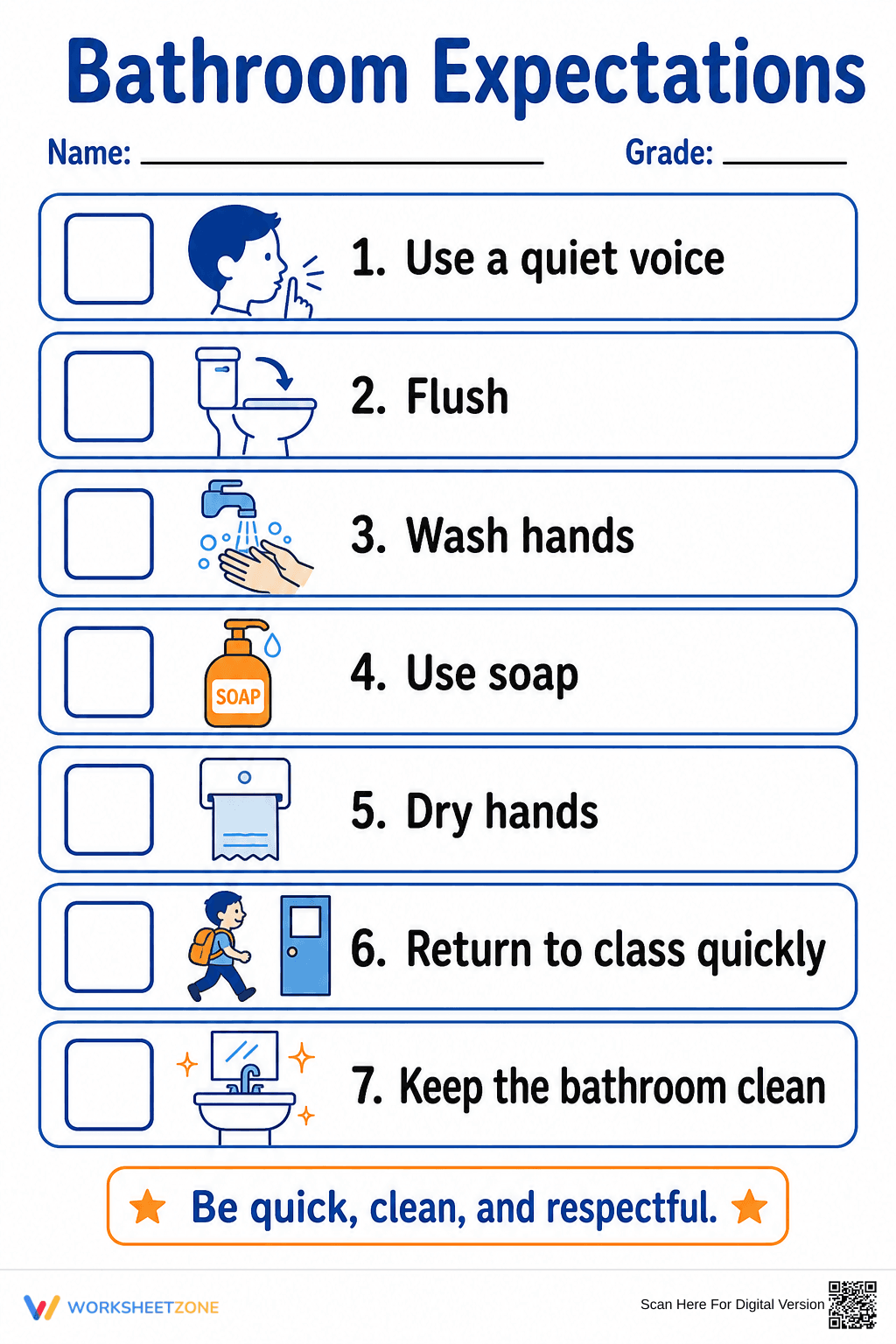

Bathroom Expectations Checklist | Grade K-3 Essential
Paste this activity's link or code into your existing LMS (Google Classroom, Canvas, Teams, Schoology, Moodle, etc.).
Students can open and work on the activity right away, with no student login required.
You'll still be able to track student progress and results from your teacher account.
This Grade K-3 Bathroom Expectations Checklist provides a clear, visual framework for students to master essential school routines and personal hygiene. By breaking down the process into seven manageable steps, this resource ensures students understand how to be respectful and efficient during bathroom breaks. The use of high-contrast icons supports early readers in achieving behavioral independence.
At a Glance
- Grade: K-3 · Subject: Classroom Management
- Standard:
CCSS.ELA-LITERACY.SL.1.1.A— Follow agreed-upon rules for participating in the school community- Skill Focus: Hygiene and Behavioral Expectations
- Format: 1 page · 7 tasks · Visual Checklist · PDF
- Best For: Establishing routines and classroom posters
- Time: 5–10 minutes
The worksheet features seven distinct tasks, each paired with a clean, professional icon to facilitate visual literacy. Students are guided through a sequence including noise control, flushing, and a comprehensive three-step handwashing process. The layout includes large checkboxes for student interaction and a summary reminder box at the bottom that reinforces the core values of being quick, clean, and respectful.
The zero-prep design allows for immediate implementation in any K-3 setting. First, print the single-page PDF (30 seconds). Second, distribute the checklist to students for a guided walkthrough or post it directly in the bathroom area as a permanent visual reference (1 minute). Third, review the seven specific expectations with the class to ensure total comprehension (5 minutes). This workflow requires less than two minutes of teacher preparation time.
This resource is aligned with `CCSS.ELA-LITERACY.SL.1.1.A`, which focuses on following agreed-upon rules for participating in a group. While often applied to discussions, this standard serves as the foundation for all classroom behavioral expectations and community norms. By explicitly teaching these steps, educators provide the agreed-upon rules necessary for a safe school environment. This standard code can be copied directly into lesson plans or district curriculum mapping tools.
Use this checklist during the first week of school as part of your direct instruction on classroom procedures. Walk the class to the bathroom and model each of the seven steps while referencing the icons. For a formative assessment, observe students during their first independent break and check for the "Return to class quickly" behavior. This resource is also highly effective when laminated and posted as a permanent visual scaffold.
This resource is designed for primary students in Kindergarten through 3rd Grade, particularly those who benefit from visual schedules and explicit behavioral modeling. It is an excellent tool for Special Education teachers and ELL specialists who need to bridge the gap between verbal instructions and physical actions. Pair this checklist with a handwashing song or a classroom anchor chart about community respect.
According to the RAND AIRS 2024 report on classroom climate, visual supports for behavioral expectations significantly reduce instructional friction in early elementary settings. This Bathroom Expectations Checklist targets CCSS.ELA-LITERACY.SL.1.1.A by providing a concrete framework for following agreed-upon rules within the school community. By utilizing clear icons and a sequential 7-step process, the resource supports executive functioning and self-regulation skills. Research from Fisher & Frey (2014) emphasizes that explicit modeling of non-academic routines is essential for establishing a predictable learning environment. This printable tool serves as both a formative assessment of student independence and a permanent visual scaffold. Implementing such structured checklists helps students internalize hygiene habits and time-management skills, ensuring they return to instruction promptly. The inclusion of specific tasks like handwashing and noise control aligns with national health and safety standards, making it a versatile addition to any primary classroom management system.


