


























Views
Downloads
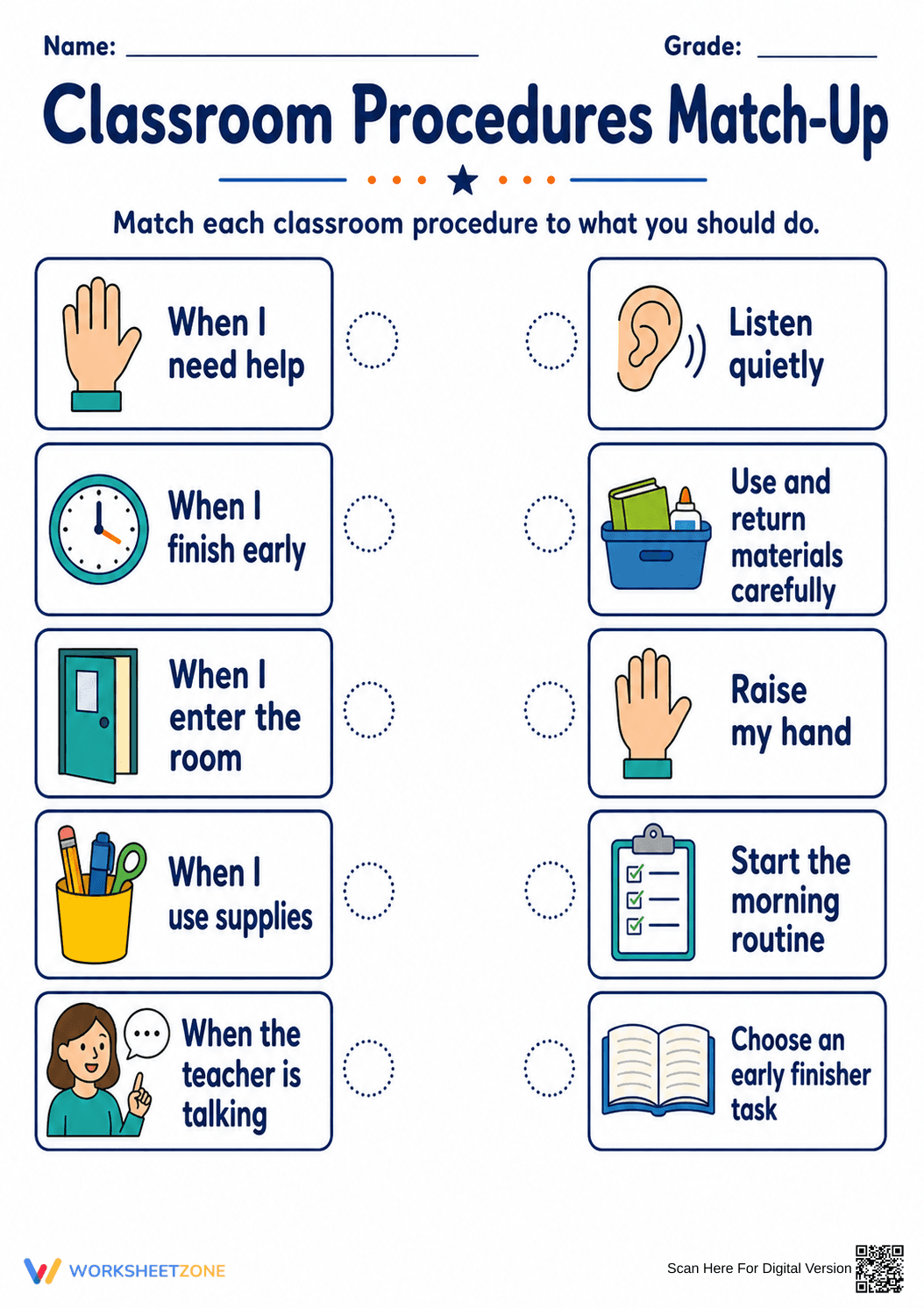

Classroom Procedures Match-Up | Essential Grade 1-4 Guide
Paste this activity's link or code into your existing LMS (Google Classroom, Canvas, Teams, Schoology, Moodle, etc.).
Students can open and work on the activity right away, with no student login required.
You'll still be able to track student progress and results from your teacher account.
This Grade 1-4 classroom procedures worksheet helps students internalize essential school routines through an interactive matching activity. By connecting specific scenarios to appropriate actions, learners develop the self-regulation skills necessary for a productive learning environment. It provides a clear visual framework for behavioral expectations during the first week of school or mid-year resets.
At a Glance
At a Glance
- Grade: 1-4 · Subject: Classroom Management
- Standard:
CCSS.ELA-LITERACY.SL.1.1— Follow agreed-upon rules for discussions and participating in classroom activities- Skill Focus: Routine Recognition
- Format: 1 page · 5 problems · Answer key included · PDF
- Best For: First week of school routines
- Time: 10–15 minutes
What's Inside
This single-page PDF features five distinct classroom scenarios paired with five corresponding behavioral responses. Each item is accompanied by a high-quality, colorful icon to support visual learners and early readers. The layout includes a clear title, student name and grade fields, and intuitive matching circles that guide students to draw connections between procedures like "When I need help" and "Raise my hand."
Zero-Prep Workflow
- Print: Select the single-page PDF and print enough copies for your roster in under 30 seconds.
- Distribute: Hand out the worksheets during your morning meeting or social-emotional learning block with zero additional materials required.
- Review: Spend 5 minutes reviewing the correct matches as a whole group to solidify expectations. This resource is an ideal sub-plan addition for maintaining consistency when the lead teacher is away.
Standards Alignment
The primary standard addressed is `CCSS.ELA-LITERACY.SL.1.1`, which requires students to follow agreed-upon rules for discussions and classroom participation. By identifying the correct response to teacher talk or supply usage, students demonstrate mastery of foundational social-emotional standards. This standard code can be copied directly into lesson plans, IEP goals, or district curriculum mapping tools.
How to Use It
Use this worksheet as a formative assessment during the first week of school to gauge student understanding of your specific room's flow. It also serves as an excellent refresher activity after a long holiday break when routines may have slipped. Observe which students struggle to match the "early finisher" task to identify who may need additional scaffolding during independent work time.
Who It's For
This resource is designed for elementary students in grades 1 through 4, particularly those in general education or inclusion settings. It is especially helpful for students with executive functioning challenges who benefit from explicit, visual reminders of "if-then" classroom scenarios. Pair this with a physical tour of the classroom or a procedures anchor chart for maximum impact.
Effective classroom management relies on the explicit teaching of routines rather than assuming students intuitively understand school expectations. According to research from Fisher & Frey (2014), the gradual release of responsibility begins with clear modeling and guided practice of behavioral norms. This worksheet facilitates that process by providing a structured environment for students to identify and commit to the `CCSS.ELA-LITERACY.SL.1.1` standard. By using visual cues and simplified text, the resource reduces cognitive load, allowing students to focus on the social-emotional objective of routine mastery. Studies from the RAND AIRS 2024 report suggest that consistent visual reminders of classroom procedures significantly reduce transition times and increase instructional minutes. This printable serves as a permanent reference point that can be kept in student folders or posted on bulletin boards to maintain a high-functioning, predictable learning environment throughout the academic year.


