


























Views
Downloads
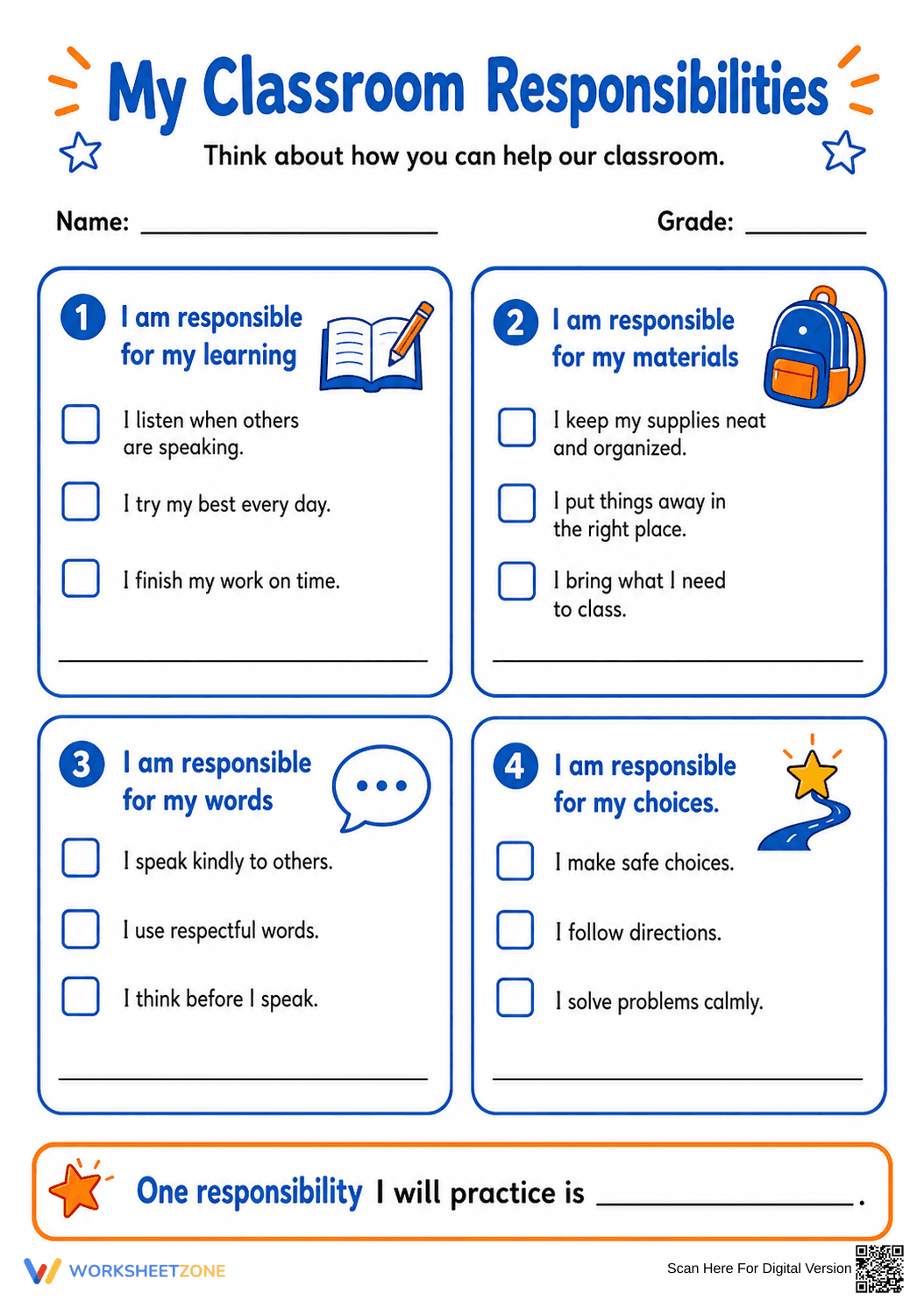

Grade 3 Classroom Responsibilities — Printable Worksheet
Paste this activity's link or code into your existing LMS (Google Classroom, Canvas, Teams, Schoology, Moodle, etc.).
Students can open and work on the activity right away, with no student login required.
You'll still be able to track student progress and results from your teacher account.
This Grade 3 classroom responsibilities worksheet helps students establish positive habits and take ownership of their daily actions. By reflecting on their learning, materials, words, and choices, learners build essential self-management skills. The structured format encourages accountability and sets a clear foundation for a respectful classroom community.
At a Glance
- Grade: 3 · Subject: SEL
- Standard:
CCSS.ELA-LITERACY.SL.3.1.B— Follow agreed-upon rules for discussions and assigned roles.- Skill Focus: Self-Management and Accountability
- Format: 1 page · 17 tasks · No answer key needed · PDF
- Best For: Back-to-school routines
- Time: 15–20 minutes
This single-page resource features four distinct reflection categories: learning, materials, words, and choices. Students review twelve specific behavioral expectations using a simple checklist format, then respond to five short writing prompts to personalize their goals. The clean layout includes visual cues and ample writing space, making it highly accessible for young learners without requiring an answer key.
Zero-Prep Workflow
This resource is designed for immediate classroom implementation with minimal teacher setup:
- Print (1 minute): Generate enough copies for the entire class directly from the PDF file.
- Distribute (1 minute): Hand out the charts during morning meeting or a dedicated advisory period.
- Review (3 minutes): Read the four main categories aloud and model how to check off the boxes and complete the sentence stems.
Total teacher preparation takes under five minutes, making this an excellent option for establishing early-year routines or leaving as a meaningful activity for a substitute teacher.
Standards Alignment
This activity aligns with CCSS.ELA-LITERACY.SL.3.1.B: Follow agreed-upon rules for discussions (e.g., gaining the floor in respectful ways, listening to others with care, speaking one at a time about the topics and texts under discussion) and carry out assigned roles. It also supports broader CASEL competencies in self-management and responsible decision-making. Both standard codes can be copied directly into lesson plans, IEP goals, or district curriculum mapping tools.
How to Use It
Introduce this chart during the first week of school to establish baseline expectations. Before direct instruction begins, have students complete the checklist independently to assess their current habits. During the activity, circulate the room to observe which specific responsibilities students choose to focus on for their final written goal. This serves as an excellent formative assessment of student self-awareness. Expect the entire reflection process to take 15 to 20 minutes.
Who It's For
This worksheet is primarily designed for third-grade students, though it functions beautifully for second through fifth graders needing a behavioral reset. The checklist format provides built-in scaffolding for students who struggle with open-ended reflection, while the writing lines offer space for elaboration. Pair this chart with a whole-class anchor chart detailing specific classroom rules to reinforce the concepts visually.
Establishing clear behavioral expectations through tools like this worksheet directly impacts student success. Aligned with CCSS.ELA-LITERACY.SL.3.1.B, this resource requires students to follow agreed-upon rules for discussions and assigned roles. According to a 2024 report by EdReports, explicit instruction in self-management and classroom routines significantly increases academic engagement and reduces disruptive behaviors. When students actively participate in tracking their own responsibilities—such as managing materials and choosing respectful words—they develop a stronger internal locus of control. This structured reflection process shifts the burden of behavioral management from the teacher to the student, fostering a more collaborative and productive learning environment. By integrating these daily accountability checks, educators can build a foundation of mutual respect that supports rigorous academic instruction throughout the entire school year.


