


























Views
Downloads
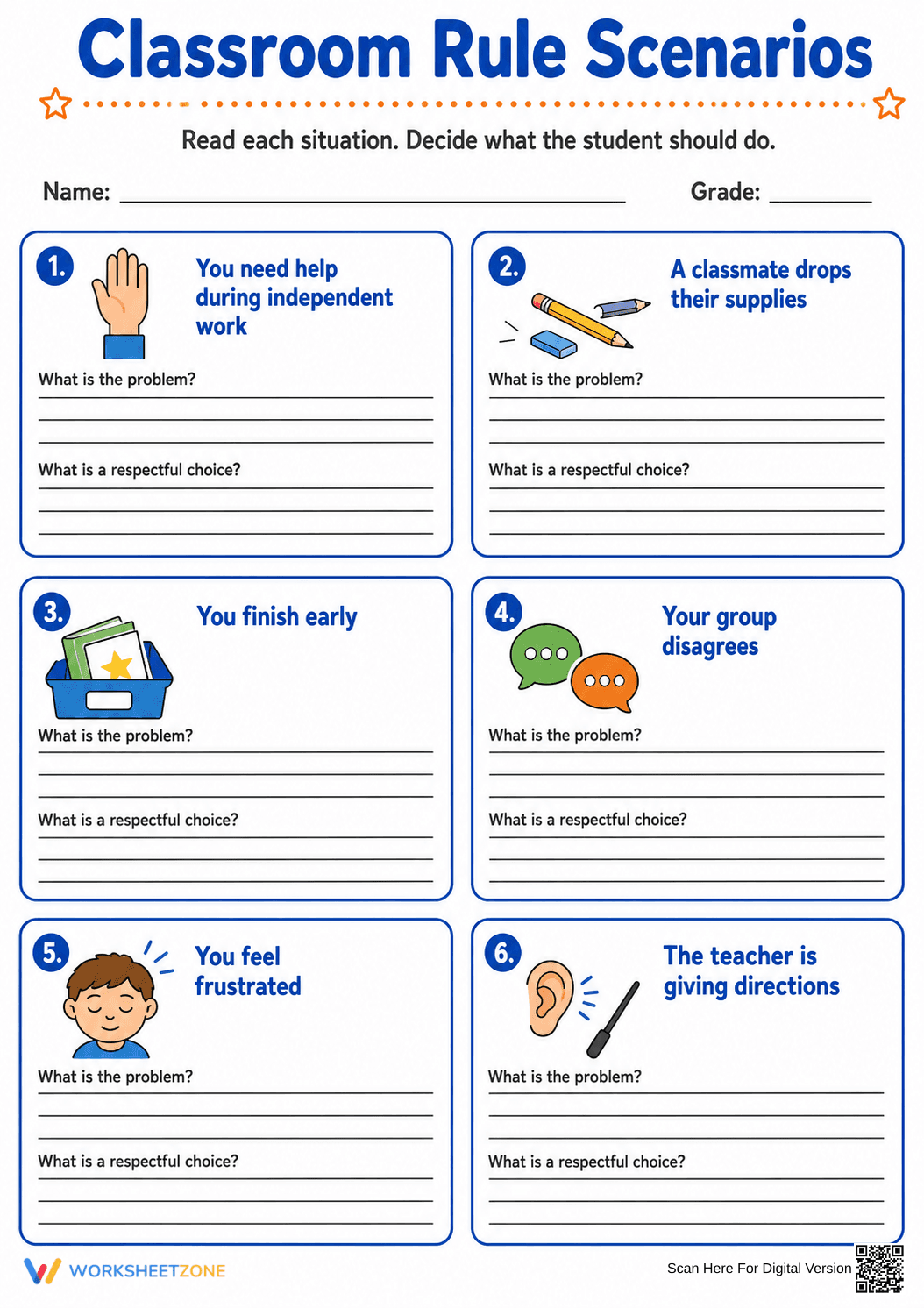

Classroom Rule Scenarios Worksheet | Essential Grade 3-6
Paste this activity's link or code into your existing LMS (Google Classroom, Canvas, Teams, Schoology, Moodle, etc.).
Students can open and work on the activity right away, with no student login required.
You'll still be able to track student progress and results from your teacher account.
This Classroom Rule Scenarios worksheet provides a structured framework for students in Grades 3–6 to navigate common school-based social challenges. By analyzing realistic situations, students develop critical thinking skills to make respectful choices. This activity transforms abstract rules into concrete, actionable behaviors that foster a positive learning community.
At a Glance
- Grade: 3–6 · Subject: Social Emotional Learning
- Standard:
CCSS.ELA-LITERACY.SL.4.1— Engage in collaborative discussions about classroom rules and respectful choices- Skill Focus: Conflict resolution and behavioral expectations
- Format: 1 page · 6 problems · Answer key not required · PDF
- Best For: Morning meetings and classroom management
- Time: 15–20 minutes
The worksheet features six distinct scenario cards with relatable icons to support visual learners. Scenarios include needing help during independent work, handling group disagreements, and managing frustration. Each card provides two prompts: "What is the problem?" and "What is a respectful choice?" with writing lines for student responses. The professional layout uses blue and orange accents to organize information clearly.
Zero-Prep Workflow
- Print: Generate the single-page PDF for your entire class in under 30 seconds.
- Distribute: Hand out the worksheet during a morning meeting or dedicated SEL block.
- Review: Spend 10 minutes reviewing completed scenarios as a group to build consensus on respectful behaviors.
Total teacher preparation time is under 2 minutes, making this an ideal resource for busy mornings or unexpected substitute teacher days.
Standards Alignment
The primary standard addressed is CCSS.ELA-LITERACY.SL.4.1, which focuses on engaging effectively in a range of collaborative discussions with diverse partners on grade-level topics. This worksheet supports the standard by prompting students to reflect on social situations and prepare for group dialogue. This standard code can be copied directly into lesson plans, IEP goals, or district curriculum mapping tools.
How to Use It
Use this worksheet as a formative assessment tool during the first week of school to gauge student understanding of classroom norms. Model the first scenario on the board to demonstrate the difference between a "problem" and a "choice." Observe students as they write to identify those who may need additional social-emotional support. The activity typically takes 15 to 20 minutes before transitioning to a group discussion.
Who It's For
This resource is designed for upper-elementary students in general education, counseling, or special education settings. It pairs naturally with a classroom anchor chart or a PBIS lesson on school-wide expectations. The scenarios are developmentally appropriate for students aged 8 to 12 who are refining their interpersonal skills.
This resource aligns with CCSS.ELA-LITERACY.SL.4.1 by requiring students to engage in collaborative discussions and reflect on behavioral expectations within a classroom setting. By analyzing six distinct scenarios, students practice identifying problems and articulating respectful choices, a core component of social-emotional learning. Research from the RAND AIRS 2024 report emphasizes that explicit instruction in classroom norms and situational problem-solving significantly improves student engagement and reduces disciplinary incidents in upper-elementary environments. The structured format of this worksheet provides the necessary scaffolding for students to transition from reactive behaviors to proactive, thoughtful decision-making. Educators can utilize these scenario cards to establish a common language for conflict resolution and peer interaction. This evidence-based approach ensures that students not only understand the rules but also the underlying rationale for maintaining a respectful learning community. The integration of writing prompts further reinforces the cognitive processing of social norms and expectations.


