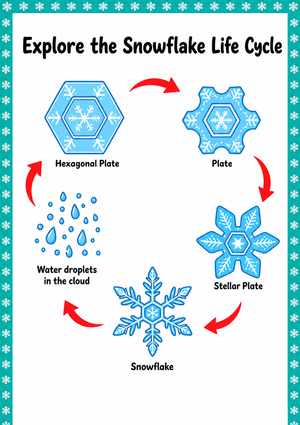
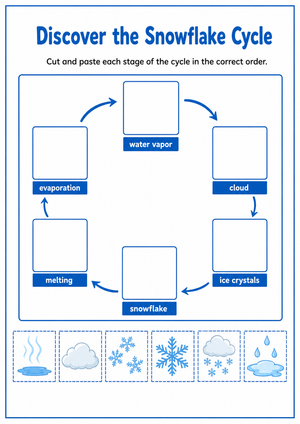
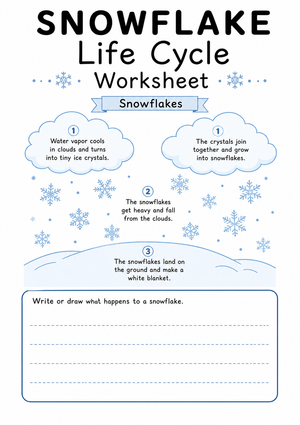
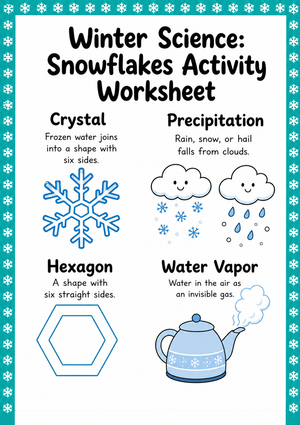
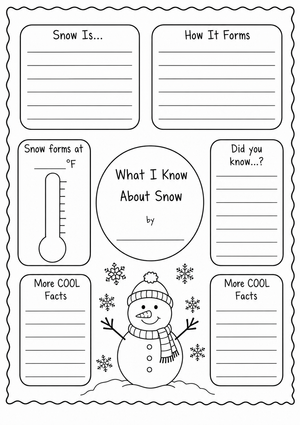
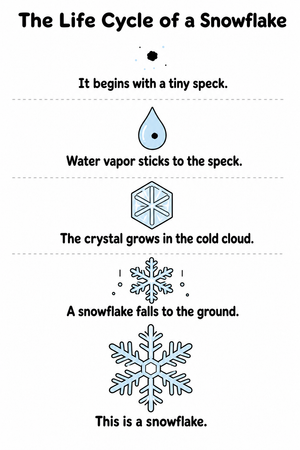
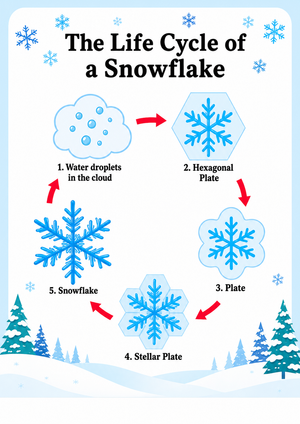
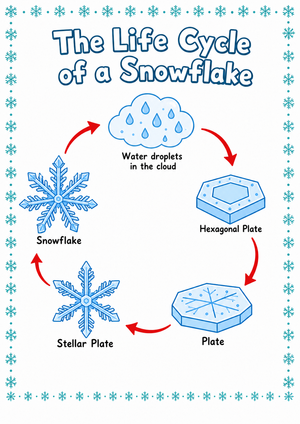
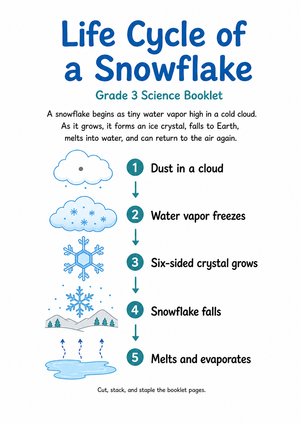
Life cycle of a snowflake printable worksheets for 3rd grade give teachers a concrete anchor for water cycle instruction — the kind where students trace a real, seasonal process rather than read a diagram caption and put their pencils down. Water vapor rises into clouds, cools, condenses, freezes around a dust particle, grows into a branching ice crystal, falls as precipitation, and eventually melts back into liquid water. That seven-step sequence touches most of the Grade 3 matter and weather concepts students are building, wrapped in something they can watch from a window.
The Specific Skills Each Worksheet Targets
The set breaks snowflake formation into distinct tasks so no single worksheet asks students to absorb everything at once. Each worksheet zeroes in on one piece of the process:
- Stage sequencing: Students number or arrange cut-and-paste cards showing evaporation, cloud formation, freezing, crystal growth, precipitation, and snowmelt in the correct order.
- Diagram labeling: Students mark terms — water vapor, freezing nucleus, ice crystal, precipitation — at the correct point on a formation diagram.
- Informational reading and response: Students read a short passage and answer text-dependent questions, identifying main idea and supporting details about how snowflakes form.
- Compare and contrast: Students map the differences between snow and rain formation, noting where the two paths diverge despite sharing the same starting point in the water cycle.
- Written explanation: Students complete sentence frames — A snowflake begins when... and Snow is part of the water cycle because... — before writing an explanation in their own words.
Life cycle of a snowflake printable worksheets for 3rd grade that move students through all five of those task formats build the same core vocabulary — water vapor, condensation, ice crystal, precipitation, snowmelt — across reading, labeling, sequencing, and writing. By the time students reach the unit assessment, those terms have appeared in enough different contexts to hold.
Mistakes Students Make That These Worksheets Help You Catch
The most persistent misconception: students believe snowflakes are frozen raindrops. It is a reasonable inference — both are water falling from clouds — but it is wrong. Rain forms when liquid water droplets in clouds combine and fall as liquid; snowflakes form directly as ice crystals when water vapor freezes without ever becoming liquid first. That distinction matters for water cycle understanding, and it surfaces repeatedly in student writing when teachers do not name it explicitly. A compare-and-contrast worksheet that traces both pathways side by side gives students a visible correction they can refer back to during the unit.
The second common error involves sequencing placement. Students reliably put "snowflake falls" at the beginning of the sequence because that is the event they have actually seen. The instinct is to start with the observable thing. A short teacher model of step one — pointing to the cloud in the diagram and saying this is where the sequence starts, before the snowflake even exists — prevents most of those reversals before students begin their independent work.
A smaller but worth-noting error: students write "water" instead of "water vapor" when labeling the first stage. They understand that snow involves water, but the distinction between liquid water and water vapor is new enough at Grade 3 that it slips during independent work. Checking that one label specifically tells you whether the student has grasped the state-of-matter shift that starts the whole process.
How to Build These Worksheets Into Your Science Lessons
The sequencing worksheet does its best work as the exit activity on day one of the unit, completed before students leave for specials. Reviewing responses the next morning — projecting two or three examples under the document camera — gives you a focused reteach moment while the process is still close to the surface. That eight minutes before the lesson proper starts is one of the most efficient correction windows in the day.
Short reading-and-response worksheets fit the 15 minutes after morning meeting, when the class needs a focused transition before science centers open. Students who finish early can compare their labeled diagrams with a partner, and the disagreements that follow often surface the frozen-raindrop misconception without any prompting. That peer conversation does the first layer of correction on its own.
For sub days, the cut-and-paste sequencing worksheet runs without much explanation. Model the routine once early in the unit, and most students handle it independently. The compare-and-contrast worksheet needs more context — save that one for when you are in the room and can field questions about the snow-versus-rain distinction as they come up.
Standard Alignment
These worksheets connect to NGSS 3-ESS2-1, which focuses on representing and describing seasonal weather patterns — snow being a defining feature of winter precipitation for many regions — and to the Earth's systems crosscutting concept, with water cycling through states in a repeating pattern. The life cycle of a snowflake printable worksheets for 3rd grade also address CCSS ELA-Literacy RI.3.3, which asks students to describe relationships between steps in a technical procedure, making the sequencing and labeling tasks a genuine reading-science integration point rather than add-on literacy work. Instructionally, these worksheets belong in the middle third of a water cycle unit — after students can explain evaporation and condensation with confidence, but before the summative check — so the snow-specific vocabulary reinforces prior learning rather than competing with it.
Adjusting the Worksheets for a Range of Learners
Students still building reading fluency do better with picture-supported sequencing tasks than with paragraph-based work. Letting them arrange image cards before touching the written worksheet removes the reading load from the science thinking. Once they can place the pictures in the correct order, the written labels become manageable because the conceptual sequence is already clear in their heads.
For students ready for more challenge, the compare-and-contrast worksheet becomes significantly harder when the response expectation shifts from a graphic organizer to a written paragraph. Students must explain why the snow and rain pathways diverge, not just identify that they do — which requires connecting the state-of-matter concept to the precipitation outcome. The life cycle of a snowflake printable worksheets for 3rd grade cover enough conceptual ground that a single worksheet can serve two different ability levels simply by adjusting what students are asked to produce in response.
One honest limitation: students who find visual diagrams confusing — and there are always a few — sometimes experience the formation diagram as an obstacle rather than a support. A text-only numbered sequence strip, without arrows or branching shapes, works better for those students. It is not about simplifying the concept; it is about removing the layout friction so the science thinking can actually happen.
Frequently Asked Questions
How does snowflake formation fit into a Grade 3 water cycle unit?
These worksheets work best mid-unit, after students can define evaporation and condensation but before the summative assessment. Snowflake formation draws on the same vocabulary as the broader water cycle, so completing these worksheets deepens existing understanding rather than introducing a parallel topic that students have to manage separately.
How do I address the frozen-raindrop misconception directly?
Use a comparison worksheet that shows rain's formation pathway alongside snow's, and name the misconception at the start: Some people think snowflakes are just frozen raindrops — let's find out if that's accurate. That framing gets students actively looking for the distinction rather than reading past it. The side-by-side format makes the difference visible in a way that a verbal correction alone rarely does.
Which worksheet makes the most reliable formative check?
The sequencing task gives the clearest data: students either have the order correct or they do not, and the errors cluster predictably around the same two or three misplaced stages. A quick scan of completed worksheets tells you exactly which part of the process needs reteaching before you move on, without requiring lengthy written responses to interpret.
Do students need to understand why snowflakes have six sides?
Not in chemical detail. The Grade 3 level explanation — water molecules arrange into a six-sided pattern as they freeze — satisfies curious students without derailing the lesson. The more instructionally important point is that cloud conditions affect how the crystal branches grow, which is why no two snowflakes look identical. That idea connects directly to the systems concept students are responsible for knowing.












 Interactive Worksheet Maker
 Quiz Maker
 Word Search Maker
 Crossword Puzzle Maker
 Word Scramble Generator
 Sentence Scramble Generator
 Handwriting Worksheet Generator
 Name Tracing Generator
 Fill In The Blank Generator