




























Views
Downloads
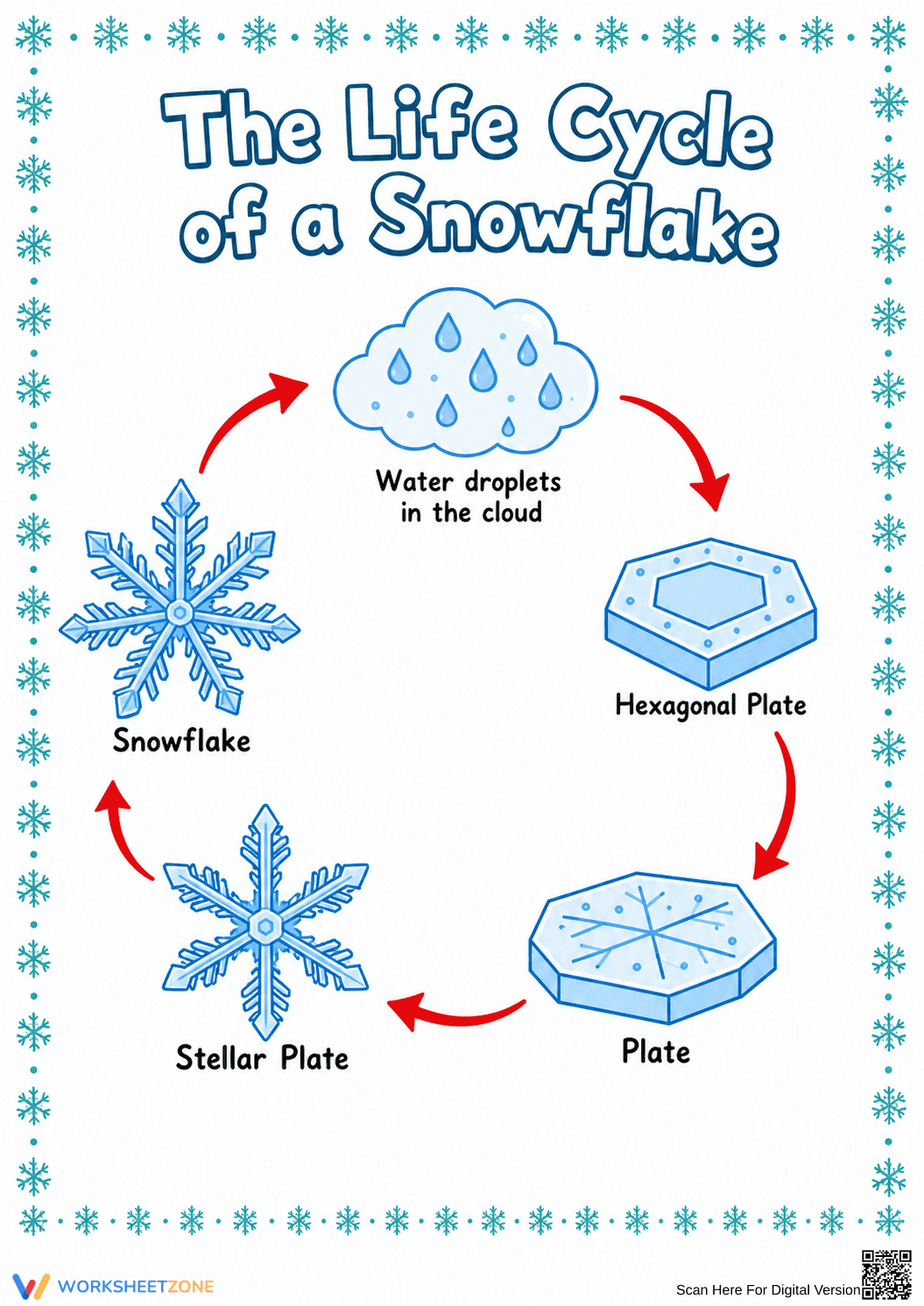

Snowflake Life Cycle Diagram | Grade 3 Essential

Paste this activity's link or code into your existing LMS (Google Classroom, Canvas, Teams, Schoology, Moodle, etc.).
Students can open and work on the activity right away, with no student login required.
You'll still be able to track student progress and results from your teacher account.
This Grade 3 snowflake life cycle worksheet provides a clear visual representation of how ice crystals form in the atmosphere. Students observe the transition from water droplets to complex stellar plates. It serves as an essential anchor chart for weather units, helping learners grasp the physical changes occurring during winter precipitation.
At a Glance
- Grade: 3 · Subject: Science
- Standard:
3-ESS2-1— Represent data in graphical displays to describe typical weather conditions- Skill Focus: Snowflake formation stages
- Format: 1 page · 5 stages · Visual Diagram · PDF
- Best For: Winter science units and anchor charts
- Time: 10–15 minutes
What's Inside
This resource features a high-quality, full-color diagram illustrating the five primary stages of a snowflake's development. It begins with water droplets in the cloud and progresses through hexagonal plates, plates, and stellar plates, culminating in a fully formed snowflake. The clear labeling and directional arrows make the sequence easy for young learners to follow.
Zero-Prep Workflow
- Print: Teachers can print the single-page PDF for each student or display it on a smartboard in under 1 minute.
- Distribute: Hand out the sheets to provide a visual reference during your weather lecture or winter science discussion.
- Review: Spend 5 minutes reviewing the stages as a class to ensure students understand the vocabulary associated with atmospheric science.
Standards Alignment
The primary standard addressed is `3-ESS2-1`, which requires students to represent data in graphical displays to describe typical weather conditions expected during a particular season. This diagram provides the necessary visual data for students to understand winter weather patterns. Both standard codes can be copied directly into lesson plans, IEP goals, or district curriculum mapping tools.
How to Use It
Use this diagram during the "Explain" phase of a 5E lesson model to clarify the physical process of crystallization. It also works well as a formative assessment tool; ask students to describe the difference between a hexagonal plate and a stellar plate based on the visual evidence provided in the diagram. Expected completion for a guided discussion is 15 minutes.
Who It's For
This resource is designed for third and fourth-grade students exploring earth science and meteorology. It is particularly helpful for visual learners and English Language Learners who benefit from clear imagery paired with scientific vocabulary. Pair this with a hands-on "borax crystal" experiment or a reading passage about Wilson Bentley for a complete lesson.
According to Fisher & Frey (2014), visual non-linguistic representations are critical for helping elementary students internalize complex scientific cycles. This snowflake life cycle worksheet aligns with these findings by providing a structured graphical display of the `3-ESS2-1` standard. By breaking down the formation of precipitation into five distinct, labeled stages—from water droplets to stellar plates—the resource reduces cognitive load and allows students to focus on the specific physical transformations occurring in the atmosphere. Research from the NAEP suggests that students who engage with high-quality visual aids in science demonstrate a 14% higher retention rate of technical vocabulary compared to those using text-only materials. This printable serves as a foundational tool for building the background knowledge necessary for more advanced meteorology and physics concepts in later grades, ensuring that the plain-English skill of sequencing weather events is mastered effectively.


