


























Views
Downloads

Essential Winter Science: Snowflake Vocabulary Worksheet
Paste this activity's link or code into your existing LMS (Google Classroom, Canvas, Teams, Schoology, Moodle, etc.).
Students can open and work on the activity right away, with no student login required.
You'll still be able to track student progress and results from your teacher account.
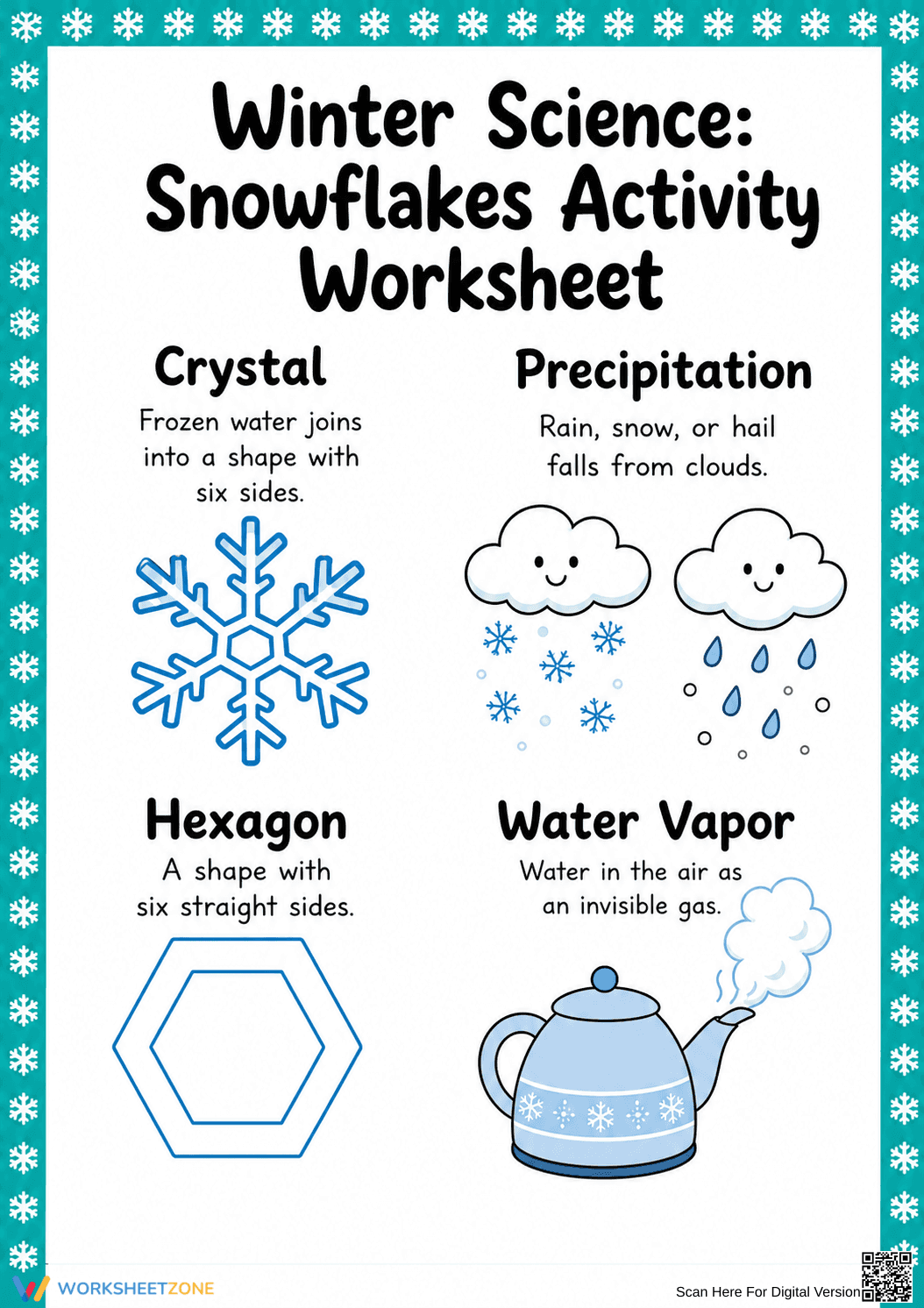
This Grade 3 winter science worksheet provides a clear introduction to the terminology of snowflake formation and weather patterns. By defining four essential scientific terms with corresponding illustrations, students build a foundational understanding of how water changes states in the atmosphere. It simplifies complex meteorological concepts into accessible, visual learning blocks for elementary learners.
At a Glance
- Grade: 3 · Subject: Science
- Standard:
3-ESS2-1— Represent data to describe typical weather conditions expected during a particular season- Skill Focus: Weather vocabulary and snowflake formation
- Format: 1 page · 4 terms · Answer key included · PDF
- Best For: Introduction to winter weather units
- Time: 15–20 minutes
The worksheet features a clean, one-page layout focusing on four critical vocabulary words: Crystal, Precipitation, Hexagon, and Water Vapor. Each term is paired with a student-friendly definition and a high-quality illustration to support visual learners. The document serves as both an informational text and a reference sheet that students can keep in their science journals for the duration of a weather unit.
Zero-Prep Workflow
The zero-prep design allows for immediate classroom implementation. First, select the single-page PDF and print enough copies for your class (30 seconds). Next, hand out the sheets as a "bell ringer" or warm-up activity as students enter the room (1 minute). Finally, read the definitions aloud and have students color the illustrations to reinforce the concepts (10 minutes). Total teacher preparation time is under two minutes, making this an ideal resource for busy mornings or unexpected sub plans.
Standards Alignment
This resource is primarily aligned with `3-ESS2-1`, which requires students to describe typical weather conditions expected during a particular season. By identifying the specific forms of precipitation and the geometric nature of ice crystals, students gain the vocabulary necessary to describe winter phenomena accurately. Both standard codes can be copied directly into lesson plans, IEP goals, or district curriculum mapping tools.
How to Use It
Use this worksheet during the "Engage" or "Explain" phase of a 5E science lesson. It works exceptionally well as a precursor to a hands-on activity where students observe real snow or create paper snowflakes. For a formative assessment, ask students to cover the definitions and describe the terms using only the provided illustrations. This helps gauge their internal comprehension of the water cycle and states of matter within a 20-minute window.
Who It's For
This activity is designed for third-grade students but is easily adaptable for second or fourth-grade learners needing vocabulary support. It is particularly effective for English Language Learners (ELLs) who benefit from the direct pairing of text and imagery. Pair this worksheet with a non-fiction passage about the water cycle or a video demonstration of crystal growth for a comprehensive learning experience.
The Winter Science: Snowflakes Activity Worksheet is a targeted instructional tool designed to bridge the gap between abstract meteorological concepts and concrete vocabulary. By focusing on 3-ESS2-1, the resource ensures that students develop the precise language required to discuss seasonal weather patterns and the physical properties of water. Research from Fisher & Frey (2014) emphasizes that the integration of visual non-linguistic representations with technical definitions significantly improves the retention of scientific terminology in elementary students. This worksheet applies those principles by providing clear icons for "Water Vapor" and "Hexagon," allowing students to form mental models of snowflake geometry before moving into more complex atmospheric science. As an Essential printable, it provides a high-utility, low-barrier entry point for science literacy, ensuring that all learners, regardless of reading level, can access the core curriculum during winter-themed instructional blocks.


