


























Views
Downloads
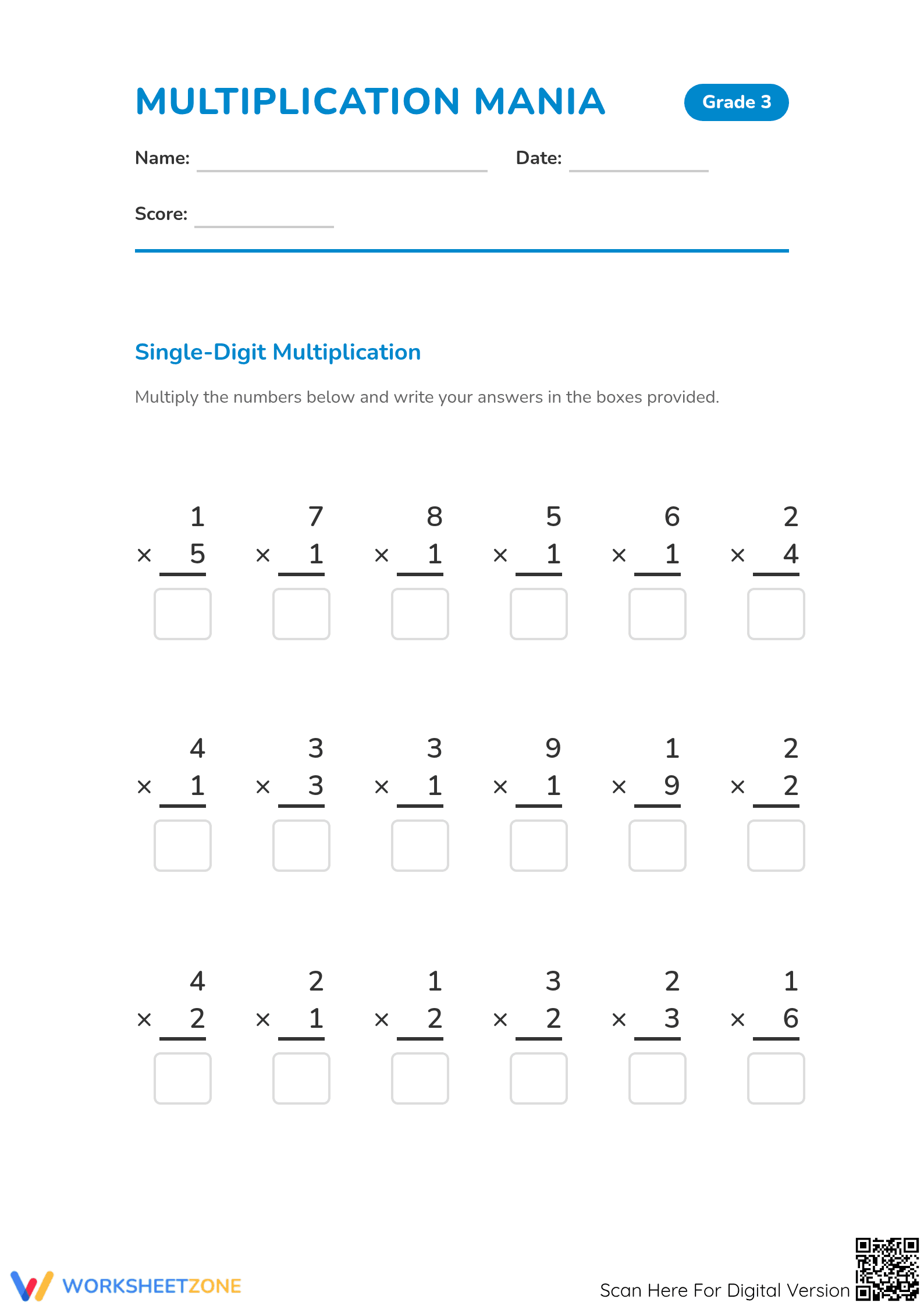
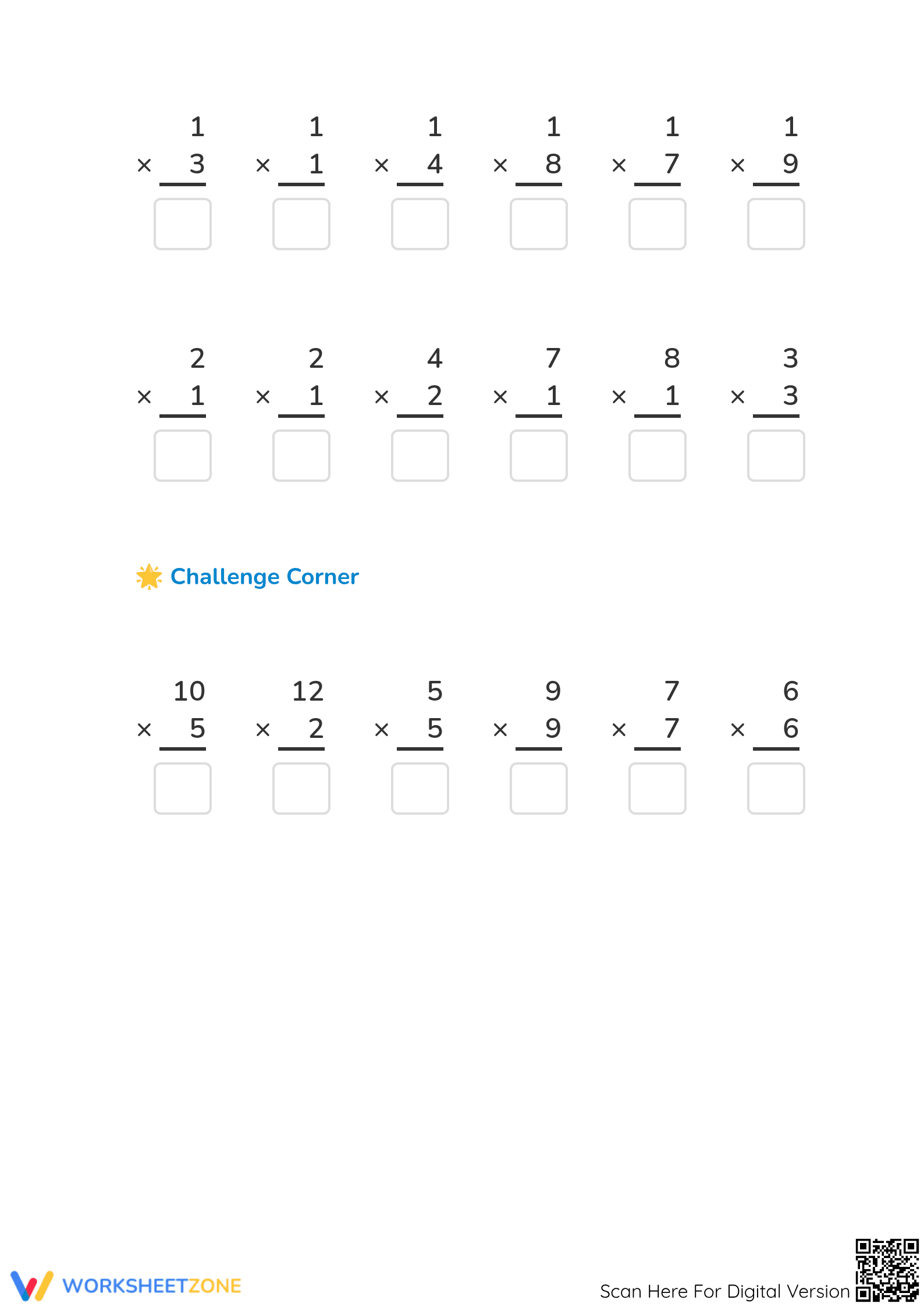

Grade 3 Single-Digit Multiplication Printable Worksheet
Paste this activity's link or code into your existing LMS (Google Classroom, Canvas, Teams, Schoology, Moodle, etc.).
Students can open and work on the activity right away, with no student login required.
You'll still be able to track student progress and results from your teacher account.
This Grade 3 math worksheet helps students build fluency with single-digit multiplication facts. By completing these straightforward problems, learners develop the automaticity needed for advanced mathematical concepts. The clear layout ensures students focus entirely on mastering multiplication skills without distractions.
At a Glance
- Grade: 3 · Subject: Math
- Standard:
CCSS.MATH.CONTENT.3.OA.C.7— Fluently multiply within 100- Skill Focus: Single-Digit Multiplication
- Format: 2 pages · 36 problems · Answer key included · PDF
- Best For: Independent practice and review
- Time: 10–15 minutes
This resource includes two pages of focused multiplication practice with 36 total problems. The first page provides 18 vertical multiplication equations using factors 1 through 9. The second page continues with 12 basic facts and concludes with a six-problem "Challenge Corner" introducing larger numbers like 10 and 12. A complete answer key is provided for quick grading.
Designed for immediate classroom use, this worksheet requires no teacher setup. The zero-prep workflow is simple:
- Print (1 minute): Generate the two-page PDF and the accompanying answer key.
- Distribute (1 minute): Hand out the worksheets for morning work, math centers, or independent practice.
- Review (2 minutes): Use the provided answer key to quickly check student work or allow for peer grading.
With a total teacher prep time of under two minutes, this resource is an ideal, self-explanatory activity to leave in a substitute teacher plan.
This worksheet aligns to CCSS.MATH.CONTENT.3.OA.C.7: Fluently multiply and divide within 100, using strategies such as the relationship between multiplication and division. By the end of Grade 3, know from memory all products of two one-digit numbers. Both standard codes can be copied directly into lesson plans, IEP goals, or district curriculum mapping tools.
This worksheet is highly versatile and can be deployed at various instructional moments. Use it as a daily warm-up activity before direct instruction to activate prior knowledge, or assign it as independent practice immediately following a lesson on multiplication strategies. As a formative assessment tip, observe students as they work to see if they are relying on skip-counting on their fingers or if they have achieved true fact recall. Expected completion time is between 10 and 15 minutes.
This resource is designed primarily for third-grade students who are actively working on memorizing their multiplication tables. It serves as an excellent reinforcement tool for on-level learners, while the "Challenge Corner" provides a gentle extension for early finishers ready to tackle two-digit by one-digit problems. For a complete lesson, pair this worksheet with a multiplication anchor chart or a set of physical manipulatives like arrays to support visual learners.
Developing automaticity with basic math facts is a critical milestone in early elementary education. This worksheet targets CCSS.MATH.CONTENT.3.OA.C.7, helping students fluently multiply within 100. According to a recent EdReports 2024 analysis, students who achieve rapid recall of single-digit multiplication facts demonstrate significantly higher success rates when transitioning to complex algorithms, fractions, and algebraic reasoning in upper grades. Without this foundational fluency, cognitive load becomes overwhelmed during multi-step problem-solving tasks. By providing structured, repetitive practice with a clear progression toward slightly more challenging equations, this resource ensures learners build the necessary neural pathways for long-term retention. Consistent engagement with targeted drill sheets allows educators to efficiently monitor progress and identify students who may require additional strategic interventions before moving forward in the curriculum.


