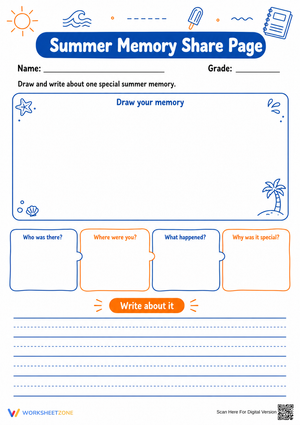
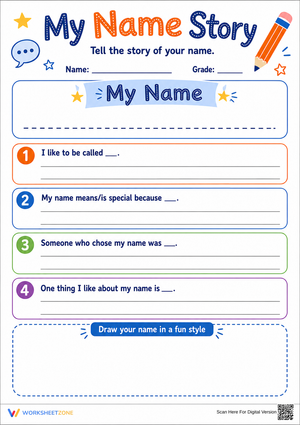
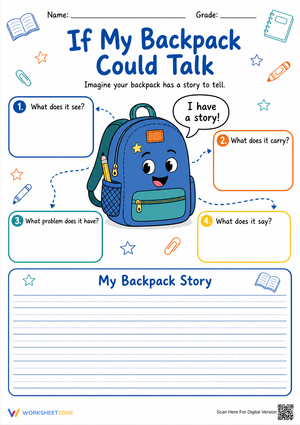
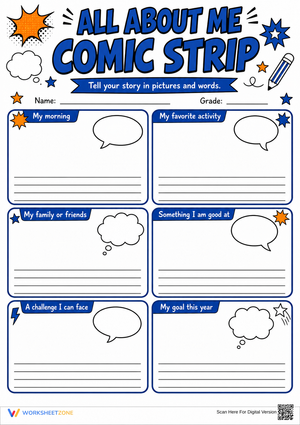
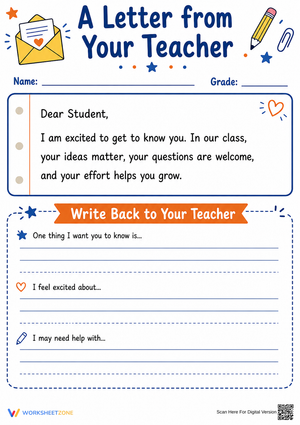
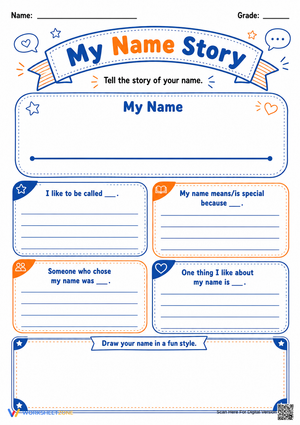
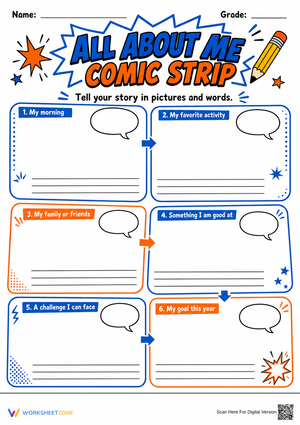
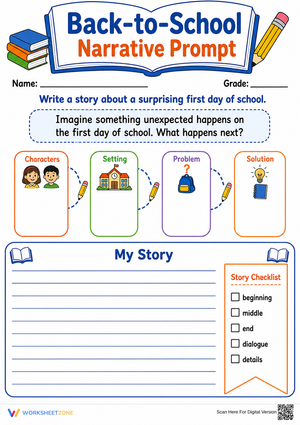
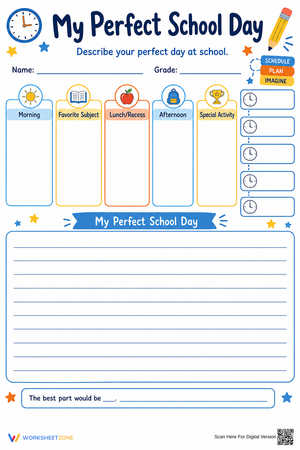
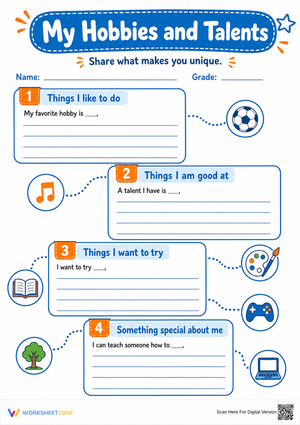
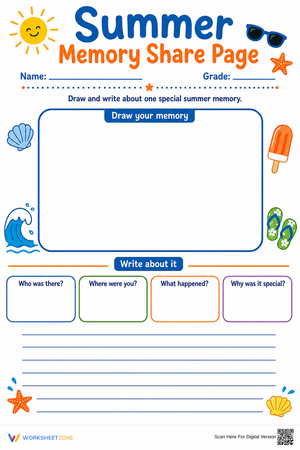
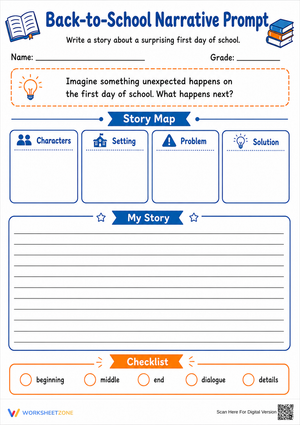
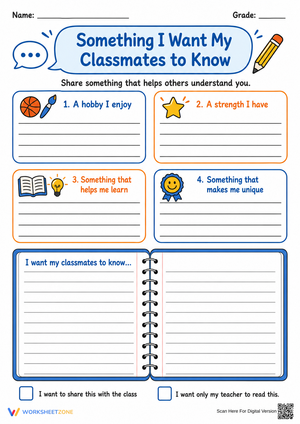
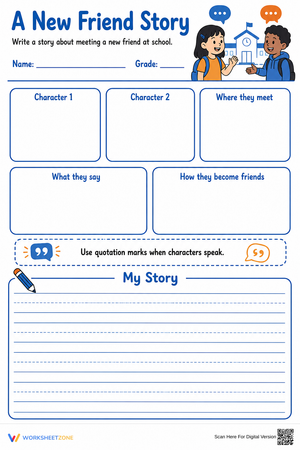
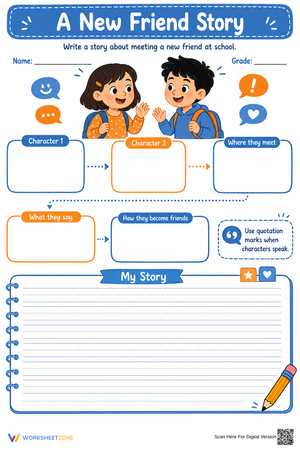
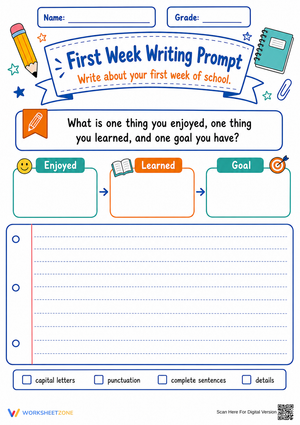
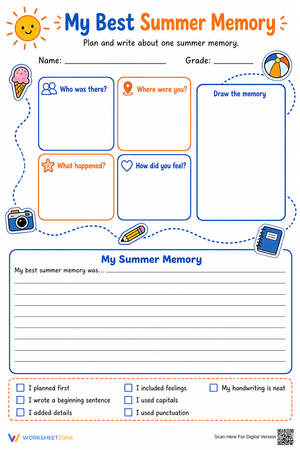
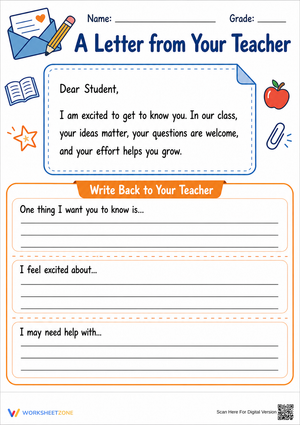
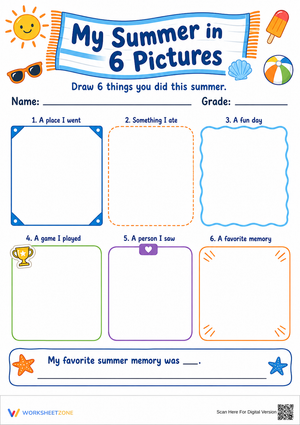
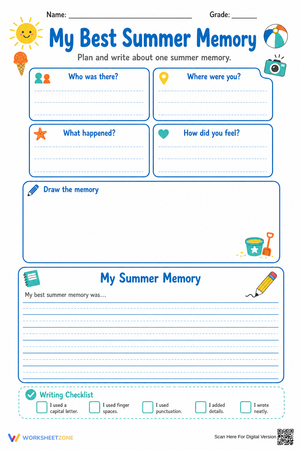
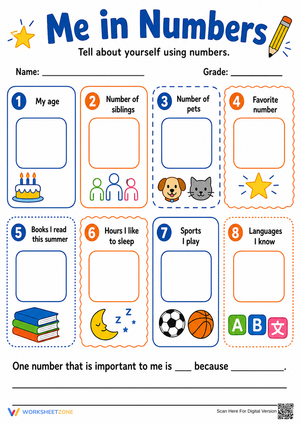
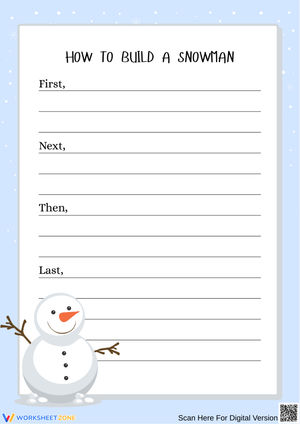
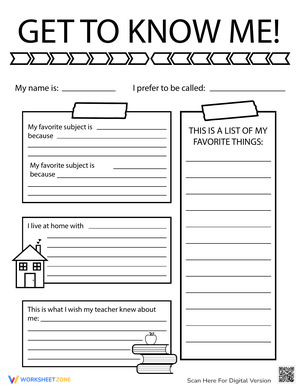
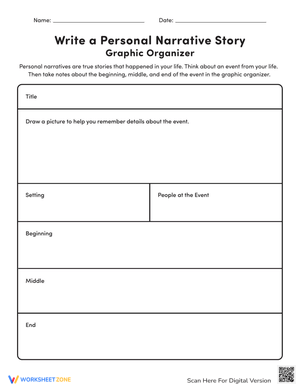
These narrative writing printable worksheets for 3rd grade give teachers a targeted set of resources for the transition year when students are expected to move past "and then... and then..." stories and into structured narratives with a real beginning, middle, and end. Each worksheet focuses on one discrete skill — establishing a narrator, sequencing events, using temporal transitions, punctuating dialogue, writing a conclusion that actually closes — so teachers can work through them in order or pull individual ones to address a gap they're already seeing in student writing.
What Each Worksheet Targets
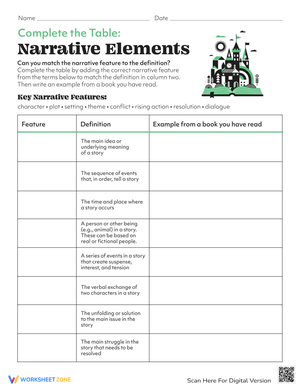
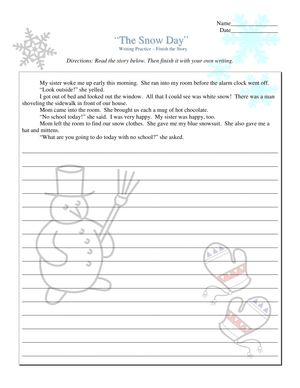
The skills covered address the five areas where third graders most need focused practice: setting up the situation and identifying who tells the story, organizing events in a logical sequence, signaling time and order through transitional language, bringing characters to life through dialogue and sensory detail, and ending with a conclusion that reflects on events rather than just stops. Some worksheets ask students to read and annotate a short model paragraph before producing their own response — this follows a gradual release pattern, where students analyze the skill in someone else's writing first and then apply it independently. Others give students a story opening and ask them to continue from there, which removes the blank-page pressure of generating a premise from scratch while still requiring all the structural decisions that matter.
Errors That Show Up in Student Work — and What to Watch For
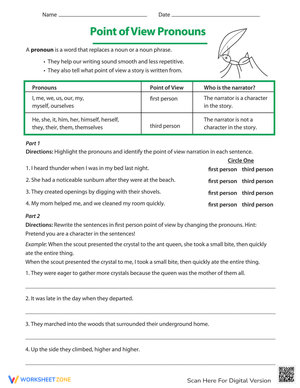
The most persistent error in third-grade narrative writing is narrator drift. A student starts a story using "I" in the first sentence, stays consistent through the second, and then — right when the action gets interesting — shifts to writing about "he" or "the boy." This isn't confusion about pronouns; it happens because students are concentrating so hard on what occurs next in the story that the narrator question drops out of working memory. Worksheets that ask students to circle every narrator pronoun before revising bring that attention back to the surface.
The second major error is the "and then" chain. Nearly every first draft in a class of third graders reads: First he went outside and then he saw his friend and then they started playing and then it got dark. The problem isn't that students lack temporal vocabulary — most of them can name transition words when directly asked. The problem is that "and then" is the default because it demands the least cognitive effort. Worksheets that include a word bank of alternatives — "suddenly," "meanwhile," "before long," "by the time" — and explicitly restrict "and then" to one use per paragraph do more to fix this than a lesson on transitions alone ever will.
Dialogue punctuation is the third consistent trouble spot. Students understand that quotation marks surround spoken words, but they place the closing comma outside the quotation mark — writing "I'm ready" she said. instead of "I'm ready," she said. — or leave the comma out entirely. This error is worth flagging early because it appears on state writing rubrics at grades 4 and 5 as well.
Building These Worksheets Into Weekly Instruction
The most practical use of this set is one worksheet per writing block as a focused warm-up before students move into drafting or revising their own longer pieces. The temporal transitions worksheet works especially well on Monday, when students return to a draft from the previous week and need a low-stakes re-entry task. The dialogue worksheet pairs naturally with a read-aloud that uses heavy character dialogue — a five-minute mentor text read before the worksheet sends students to the task with fresh examples still in their ears. Save the conclusion worksheet for the week when students are actually finishing their first full narrative draft; the timing makes the skill immediately applicable rather than abstract.
The narrative writing printable worksheets for 3rd grade in this set also work well in small-group rotations. While one group conferences with the teacher, two others work independently on the narrator-setup and sequencing worksheets. Both tasks require enough writing that students stay occupied for eight to ten minutes — long enough to make the rotation practical — without asking them to produce a full-length draft they'll abandon mid-sentence when the timer ends.
Standard Alignment
These resources address CCSS.ELA-LITERACY.W.3.3, which requires third graders to write narratives about real or imagined experiences using effective techniques, well-chosen details, and a clear event sequence. The standard breaks into four specific expectations: establish a situation and introduce a narrator or characters; use dialogue and descriptions of actions, thoughts, and feelings; use temporal words and phrases to signal event order; and provide a sense of closure. Each worksheet in the set targets one of those sub-skills, so teachers can use early observations to decide whether the whole class needs more work on closure or whether only a subset needs to revisit transitions.
W.3.3 sits at a meaningful developmental moment. Second grade's writing standard (W.2.3) asks only for a recounted sequence of events with a reaction — essentially a list with a feeling tacked on at the end. W.3.3 adds structural requirements — narrator, dialogue, closure — that are qualitatively more demanding. Teachers who see students writing "I went to the park. I played. It was fun." are watching them perform at a W.2.3 level; these worksheets target exactly what they need to reach the W.3.3 benchmark.
Adjusting the Worksheets for a Range of Writers
For students who freeze in front of a blank prompt, the sentence-starter approach works well: provide the opening line — "The moment Maya opened the door, she knew something was different." — and ask them to continue using the worksheet's structural focus. This removes the premise-generation step without removing the writing decisions. Worth noting: students who are strong idea-generators sometimes find a pre-set opening constraining and actually produce less writing than they would with a fully open prompt. Read the room before making that swap class-wide.
For students already writing fluent, organized narratives, assign the sequencing or dialogue worksheet as a revision task rather than a drafting task — they rewrite a paragraph from their current piece applying the target skill, then compare the two versions. That pushes them toward refinement, which is where those writers actually are. For students working below grade level in written language, narrative writing printable worksheets for 3rd grade that include word banks, sentence frames, and story-map organizers give them enough structure to produce real writing rather than sitting with a blank page for the full period.
Frequently Asked Questions
Does the set address both personal and fictional narratives, or just one type?
Both. W.3.3 covers "real or imagined experiences," and the worksheets reflect that. The narrator-establishment worksheet uses a personal-narrative premise; the plot-sequencing worksheet uses a fictional one with invented characters. Teachers can assign based on what their current unit requires or give students a choice of which version to complete.
How do I handle students who rush through every worksheet without reading carefully?
Build in a short annotation step before the worksheet counts as complete: students circle every temporal word they used, underline every piece of dialogue, or put a box around the sentence that establishes the narrator. That extra step slows down rushing without adding more writing, and it gives teachers a fast way to confirm whether students are actually applying the target skill or just filling space.
Can these worksheets support preparation for state writing assessments?
Most state writing assessments at grades 3 through 5 include a narrative prompt, and the skills these worksheets reinforce — logical event order, closure, dialogue punctuation — appear directly in the rubrics those assessments use. Using narrative writing printable worksheets for 3rd grade in the weeks before a writing assessment builds familiarity with the structural features scorers look for, without requiring a shift into a test-prep-only instructional mode. The format stays consistent with regular writing instruction, which means the practice transfers.












 Interactive Worksheet Maker
 Quiz Maker
 Word Search Maker
 Crossword Puzzle Maker
 Word Scramble Generator
 Sentence Scramble Generator
 Handwriting Worksheet Generator
 Name Tracing Generator
 Fill In The Blank Generator