


























Views
Downloads

My Summer in 6 Pictures | Essential Grade 1-4 Worksheet
Paste this activity's link or code into your existing LMS (Google Classroom, Canvas, Teams, Schoology, Moodle, etc.).
Students can open and work on the activity right away, with no student login required.
You'll still be able to track student progress and results from your teacher account.
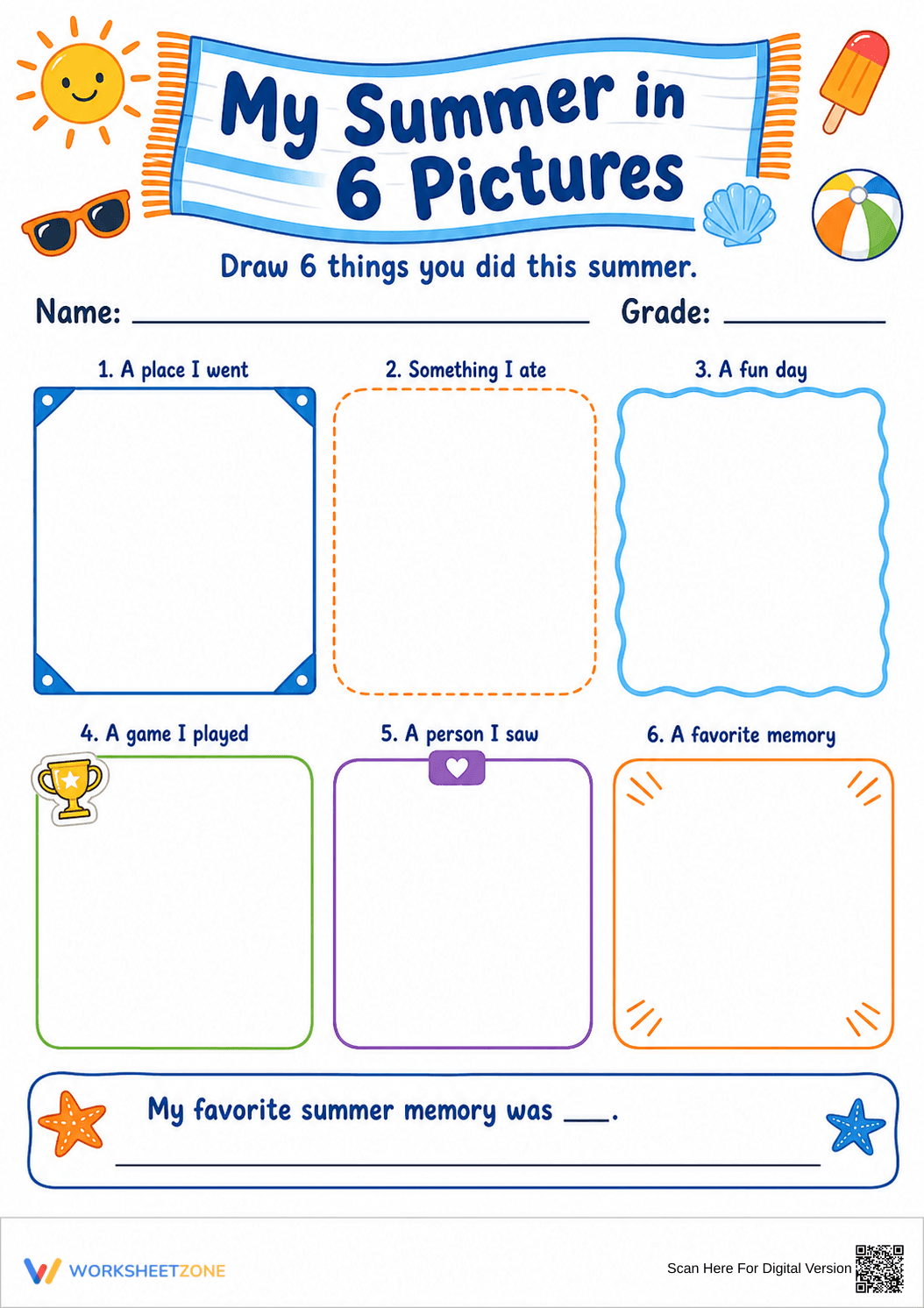
This Grade 1-4 summer reflection worksheet helps students transition back to the classroom by sharing personal experiences through visual storytelling. Students use six themed drawing prompts to illustrate their summer break before completing a concluding sentence. It provides a low-stakes way for educators to assess fine motor skills and narrative ability during the first week of school.
At a Glance
- Grade: 1-4 · Subject: ELA
- Standard:
CCSS.ELA-LITERACY.W.1.3— Write narratives recounting sequenced events with details and a sense of closure- Skill Focus: Narrative Drawing & Writing
- Format: 1 page · 7 tasks · Answer key N/A · PDF
- Best For: First week icebreaker and SEL
- Time: 20–30 minutes
The worksheet features a clean, playful layout with six distinct drawing frames. Each frame includes a specific prompt, such as "A place I went" and "Something I ate," to guide student brainstorming. At the bottom, a dedicated writing strip provides a ruled line for a summary sentence, ensuring students practice both artistic expression and formal sentence construction in a single session.
This resource is designed for a zero-prep morning work or transition activity. Teachers can print the single-page PDF in less than a minute. Distribution takes seconds, and because the prompts are self-explanatory, students can begin working immediately without lengthy verbal instructions. Reviewing the completed sheets allows teachers to learn about student backgrounds while checking for basic writing conventions in under two minutes per child.
This activity aligns with `CCSS.ELA-LITERACY.W.1.3`, which requires students to write narratives that recount two or more appropriately sequenced events, include some details regarding what happened, and provide some sense of closure. By drawing specific moments and writing a concluding memory, students practice the foundational components of narrative structure. This standard code can be copied directly into lesson plans, IEP goals, or district curriculum mapping tools.
Use this worksheet as a "First Day" desk activity to keep students engaged while you handle administrative tasks. It also serves as an excellent formative assessment; observe how students handle the drawing prompts to gauge their ability to follow multi-step directions. Expected completion time ranges from 20 to 30 minutes depending on the level of detail students provide in their illustrations.
This resource is ideal for general education classrooms in grades K-4, English Language Learners (ELLs) who benefit from visual communication, and Special Education students requiring structured prompts. It pairs naturally with a "Summer Share" circle time or a classroom bulletin board display where students can present their favorite memories to their peers.
The use of drawing as a precursor to formal writing is a proven strategy for early elementary literacy development. According to Fisher & Frey (2014), visual representation allows students to organize their thoughts and rehearse their narratives before committing to complex sentence structures. This worksheet leverages that cognitive bridge by providing six specific visual anchors that align with CCSS.ELA-LITERACY.W.1.3. By asking students to recount sequenced events through both illustration and a concluding written statement, the activity supports the development of narrative coherence and detail. Research from the RAND AIRS 2024 report suggests that low-stakes, high-interest writing prompts in the early weeks of school significantly improve student engagement and teacher-student rapport. This printable resource provides a structured framework for students to practice essential ELA skills while offering educators immediate insight into student writing readiness and fine motor control.


