


























Views
Downloads
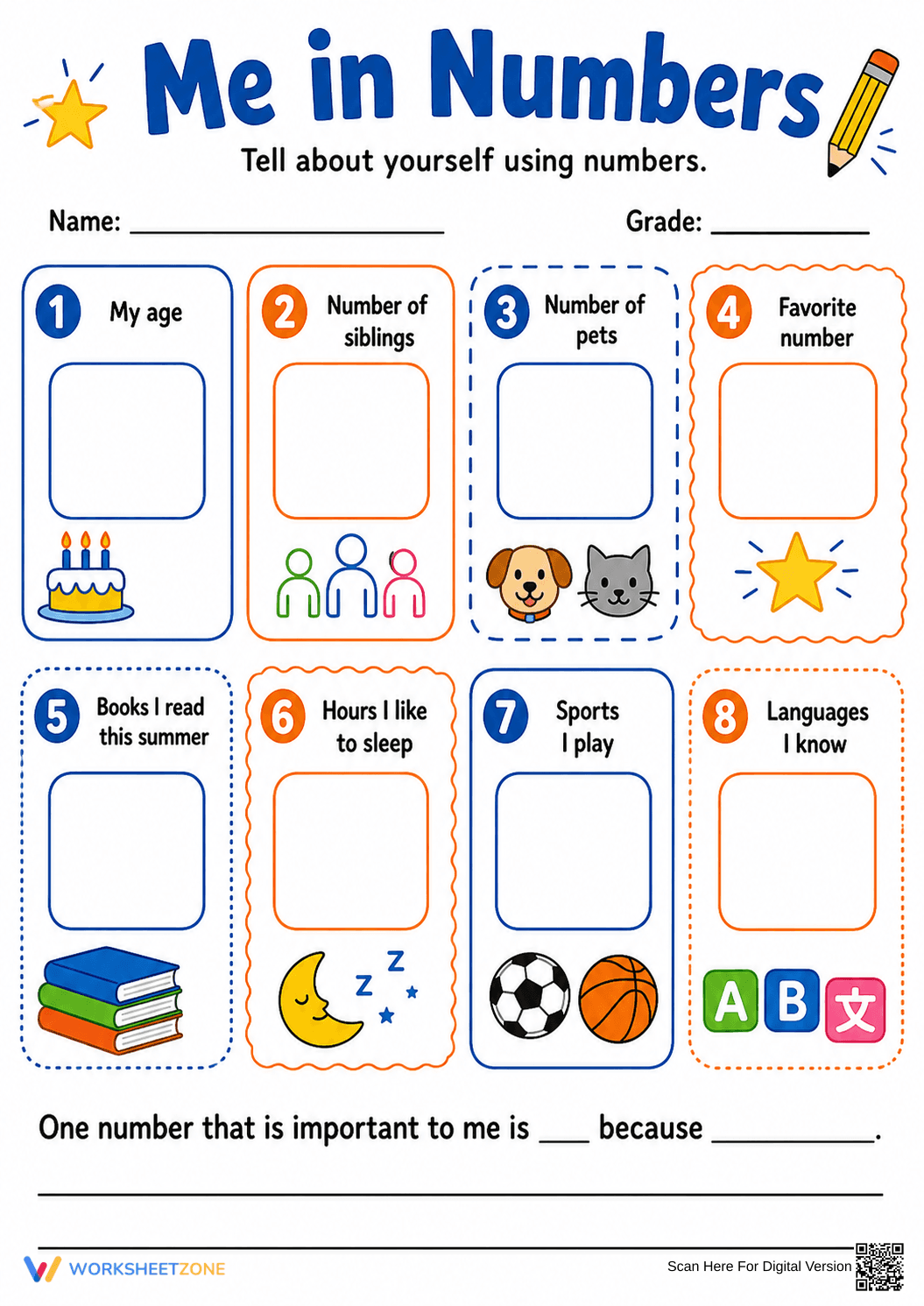

Printable Me in Numbers Worksheet | Grade 3 Icebreaker
Paste this activity's link or code into your existing LMS (Google Classroom, Canvas, Teams, Schoology, Moodle, etc.).
Students can open and work on the activity right away, with no student login required.
You'll still be able to track student progress and results from your teacher account.
This "Me in Numbers" worksheet helps students introduce themselves by sharing personal facts through numerical data. By completing nine distinct prompts, learners practice recalling personal experiences and organizing information. This activity builds classroom community while introducing basic data collection concepts at the start of the school year.
At a Glance
- Grade: 3 · Subject: Back to School
- Standard:
CCSS.ELA-LITERACY.W.3.8— Recall information from experiences and sort into categories- Skill Focus: Personal narrative and data collection
- Format: 1 page · 9 problems · No answer key needed · PDF
- Best For: First week icebreaker activities
- Time: 15–20 minutes
This single-page printable features an infographic-style layout designed to capture student interest. The page includes eight distinct boxes with clear icons, prompting students to record numbers related to their age, siblings, pets, favorite number, summer reading, sleep habits, sports, and languages. At the bottom, a sentence frame provides a structured opportunity for students to write a brief explanation about one important number. An answer key is not required.
This resource is designed for immediate classroom implementation with a zero-prep workflow:
- Print (1 minute): Download the PDF and print a class set. The design prints beautifully in grayscale.
- Distribute (1 minute): Hand out during morning work. The visual cues make instructions self-evident.
- Review (10 minutes): Have students pair up to discuss their numbers and build peer connections.
Total teacher preparation requires under two minutes, making this an excellent option for busy first-week schedules.
This activity aligns with CCSS.ELA-LITERACY.W.3.8: Recall information from experiences and sort evidence into provided categories. By categorizing personal details into numerical prompts, students practice foundational information sorting. It also supports early speaking standards when used as a presentation tool. Both standard codes can be copied directly into lesson plans, IEP goals, or district curriculum mapping tools.
Teachers can utilize this worksheet during the first week of school as a low-stakes morning work assignment. It serves as an excellent foundation for a "Math About Me" bulletin board. As a formative assessment observation tip, teachers can circulate while students complete the bottom sentence frame to gauge baseline handwriting skills. Most students will finish within 15 to 20 minutes.
This resource is primarily designed for second through fifth-grade students. The heavy use of visual icons and structured boxes provides built-in differentiation for English Language Learners and students who benefit from clear spatial boundaries. It pairs perfectly with a read-aloud book about community building or a direct instruction lesson on creating bar graphs, as teachers can aggregate the class data for a follow-up math activity.
Integrating structured icebreakers like this CCSS.ELA-LITERACY.W.3.8 aligned activity helps students recall information from experiences and sort into categories while fostering a positive classroom climate. According to a RAND AIRS 2024 report, early school year activities that blend personal identity sharing with low-stakes academic tasks significantly improve student engagement and peer-to-peer relationships across diverse learner populations. By asking students to quantify their personal experiences through specific prompts, educators bridge the gap between social-emotional learning and foundational academic skills. This specific format reduces cognitive load through visual scaffolding and clear boundaries, allowing learners to focus on community building rather than complex task decoding. Utilizing such targeted, standards-aligned introductory tasks establishes a supportive environment where students feel valued and understood, setting a highly productive tone for the remainder of the academic year.


