


























Views
Downloads
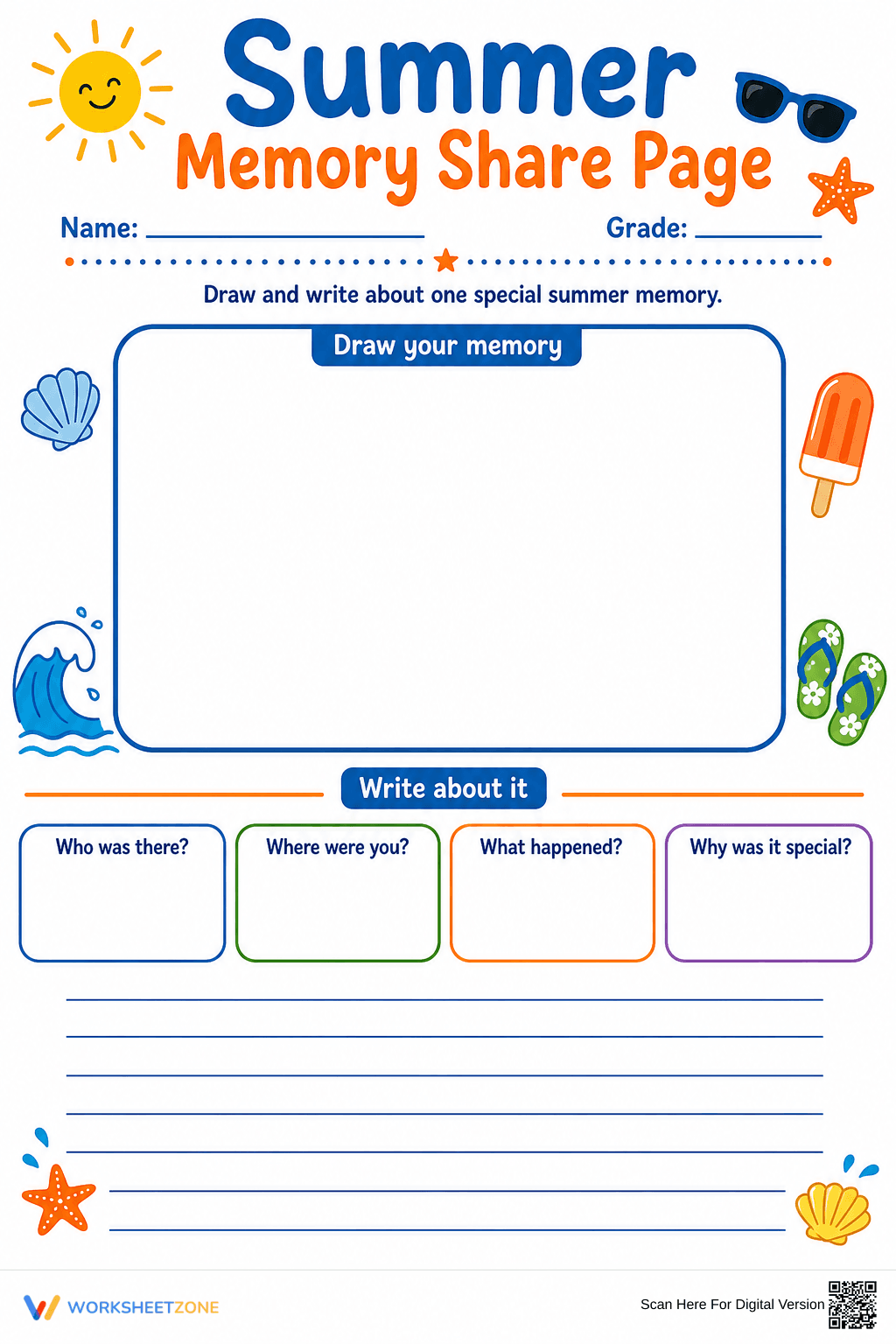

Summer Memory Share Page | Grade 3-6 Essential
Paste this activity's link or code into your existing LMS (Google Classroom, Canvas, Teams, Schoology, Moodle, etc.).
Students can open and work on the activity right away, with no student login required.
You'll still be able to track student progress and results from your teacher account.
This Grade 3-6 Summer Memory Share Page worksheet helps students transition back to the classroom by reflecting on personal experiences. By combining visual art with structured narrative writing, students practice descriptive techniques and chronological sequencing. It provides a low-stakes entry point for teachers to assess baseline writing skills while building classroom community through shared stories.
At a Glance
- Grade: 3-6 · Subject: ELA
- Standard:
CCSS.ELA-LITERACY.W.3.3— Write narratives to develop real experiences using effective technique and clear event sequences- Skill Focus: Narrative Writing & Reflection
- Format: 1 page · 6 tasks · No answer key · PDF
- Best For: First week icebreaker and writing baseline
- Time: 20–30 minutes
What's Inside
This single-page PDF features a clean, cheerful design with summer-themed icons. It includes a large "Draw your memory" frame for visual brainstorming, followed by four specific prompt boxes (Who, Where, What, Why) to scaffold the writing process. The bottom half provides 7 wide-ruled lines for a cohesive paragraph, ensuring students have enough space to develop their narrative without feeling overwhelmed by a blank page.
Zero-Prep Workflow
- Print: Select the single-page PDF and print enough copies for your class in under 30 seconds.
- Distribute: Hand out the sheets as a morning work activity or a dedicated writing block during the first week.
- Review: Allow students to share their drawings and read their paragraphs in small groups or a gallery walk format.
Total teacher preparation time is under 2 minutes, making this an ideal sub plan or first-day activity.
Standards Alignment
The primary standard addressed is `CCSS.ELA-LITERACY.W.3.3`, which requires students to write narratives to develop real or imagined experiences or events using effective technique, descriptive details, and clear event sequences. The prompt boxes specifically target the "who, where, and what" components of narrative structure. Both standard codes can be copied directly into lesson plans, IEP goals, or district curriculum mapping tools.
How to Use It
Use this worksheet during the first week of school as a formative assessment to observe student handwriting, sentence structure, and ability to follow multi-step directions. It works best after a brief whole-class brainstorm where students list potential summer highlights. Expect students to spend 10 minutes on the illustration and 15 minutes on the written response. This allows for a 25-minute instructional block.
Who It's For
This resource is designed for upper elementary students in grades 3 through 6. It is particularly effective for English Language Learners (ELLs) because the drawing component provides a non-verbal way to organize thoughts before writing. Pair this with a mentor text about summer vacations or a classroom anchor chart on "W" questions to provide additional support for struggling writers.
Narrative writing in the early weeks of the school year serves as a critical bridge for student engagement and diagnostic assessment. According to Fisher & Frey (2014), providing students with scaffolds like the "Who, Where, What, Why" boxes found in this worksheet supports the gradual release of responsibility, moving from guided brainstorming to independent narrative production. This Summer Memory Share Page aligns with `CCSS.ELA-LITERACY.W.3.3` by requiring students to sequence events and use descriptive details to convey real-life experiences. Research from the RAND AIRS 2024 report suggests that integrating visual arts with writing tasks increases student motivation and helps struggling writers organize complex thoughts more effectively. By utilizing this 1-page printable, educators can capture a high-quality writing sample while fostering a positive classroom culture. The structured layout ensures that students meet grade-level expectations for narrative clarity while allowing for individual creative expression.


