


























Views
Downloads

Grade 3 Summer Memory — Printable No-Prep Worksheet
Paste this activity's link or code into your existing LMS (Google Classroom, Canvas, Teams, Schoology, Moodle, etc.).
Students can open and work on the activity right away, with no student login required.
You'll still be able to track student progress and results from your teacher account.
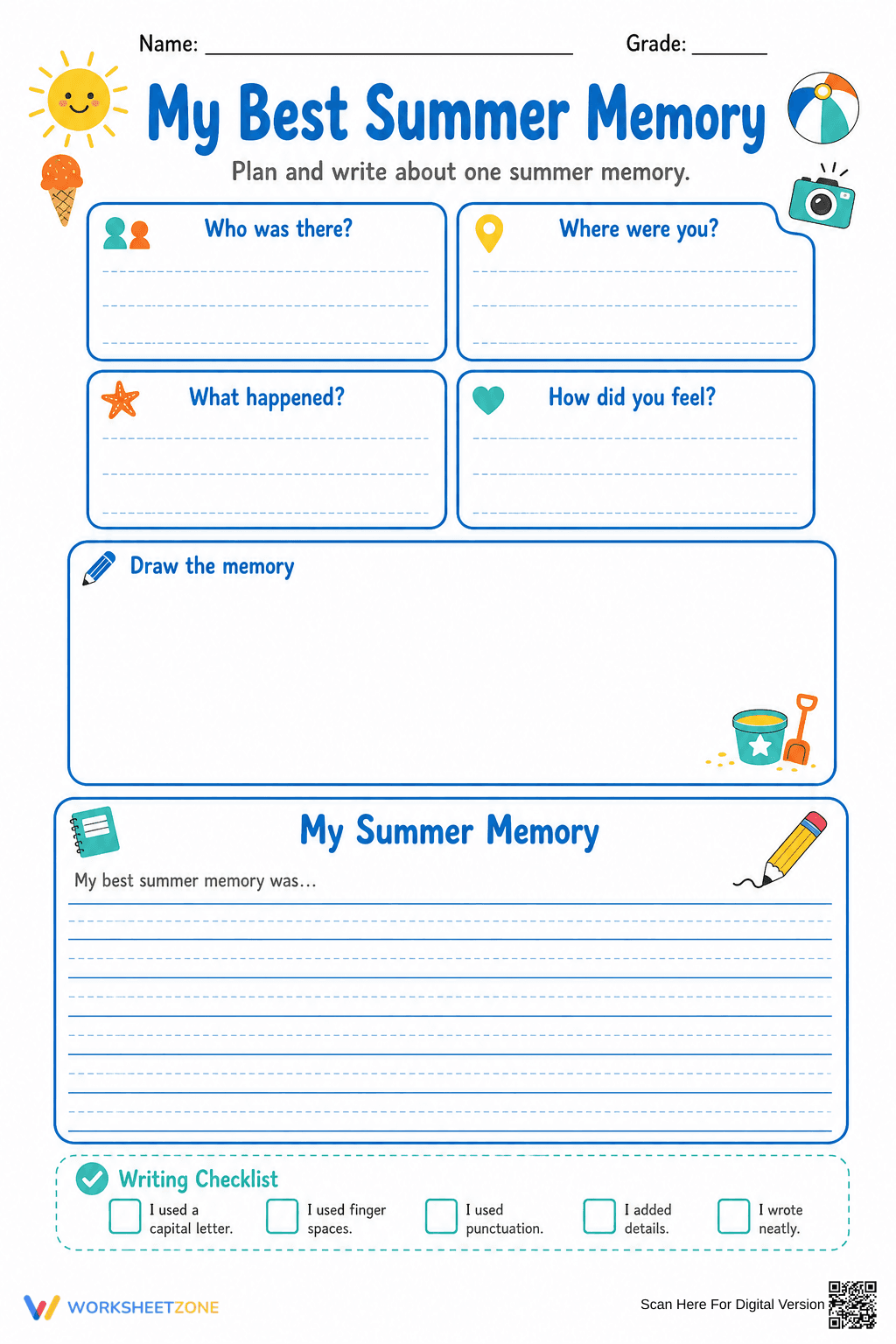
This Grade 3 narrative writing worksheet guides students through the process of planning and drafting a personal recount of their summer break. By breaking the writing process into manageable steps, young authors can organize their thoughts, sketch their ideas, and produce a structured paragraph with confidence.
At a Glance
- Grade: 3 · Subject: ELA
- Standard:
CCSS.ELA-LITERACY.W.3.3— Write narratives to develop real experiences using descriptive details.- Skill Focus: Personal narrative writing and planning
- Format: 1 page · 6 tasks · No answer key required · PDF
- Best For: Back-to-school writing assessment
- Time: 25–35 minutes
This single-page resource features four targeted brainstorming boxes prompting students to identify the who, where, what, and how of their memory. A dedicated drawing space allows visual learners to sketch their experience before writing. The bottom half provides primary-lined writing space with a sentence starter, concluding with a five-point student self-assessment checklist covering capitals, spacing, punctuation, details, and neatness.
This resource requires minimal teacher setup:
- Print (1 minute): Generate class sets directly from the PDF file. Prints easily in color or grayscale.
- Distribute (1 minute): Hand out to students during the literacy block. The clear headings make instructions self-evident.
- Review (3 minutes): Briefly model how to use the planning boxes and check off the self-assessment criteria at the bottom.
With under five minutes of prep, this is an ideal first-week activity or sub plan.
This activity aligns directly with CCSS.ELA-LITERACY.W.3.3, requiring students to write narratives to develop real or imagined experiences or events using effective technique, descriptive details, and clear event sequences. It also supports foundational language standards by encouraging self-correction of capitalization and punctuation. Both standard codes can be copied directly into lesson plans, IEP goals, or district curriculum mapping tools.
Use this worksheet as a baseline writing assessment during the first week to gauge proficiency in narrative structure and mechanics. Alternatively, it serves as an excellent independent center activity following a whole-group lesson on the writing process. Circulate and use the planning boxes for quick formative assessment, ensuring students have a clear topic before drafting. Expect students to complete the entire planning and writing sequence in 25 to 35 minutes.
Designed for second through fourth-grade students developing independent writing stamina. The graphic organizer provides scaffolding for students with blank-page anxiety, while the checklist supports learners in tracking expectations. Pair this worksheet with a read-aloud of a summer-themed picture book to activate prior knowledge and inspire descriptive vocabulary.
Effective writing instruction requires explicit teaching of the planning and drafting phases, particularly for young learners transitioning to independent paragraph construction. According to Fisher & Frey (2014), providing students with structured graphic organizers significantly reduces cognitive load, allowing them to focus their mental energy on generating descriptive details and maintaining a clear event sequence. This targeted worksheet directly supports CCSS.ELA-LITERACY.W.3.3 by guiding students to write narratives to develop real experiences using descriptive details. The inclusion of a five-point self-assessment checklist at the bottom of the page further empowers young writers to monitor their own use of standard English conventions, such as capitalization and punctuation, fostering greater academic independence. By integrating brainstorming, illustrating, and drafting into a single cohesive activity, educators can facilitate a highly accessible writing process that builds foundational literacy skills and encourages expressive communication in the elementary classroom.


