


























Views
Downloads
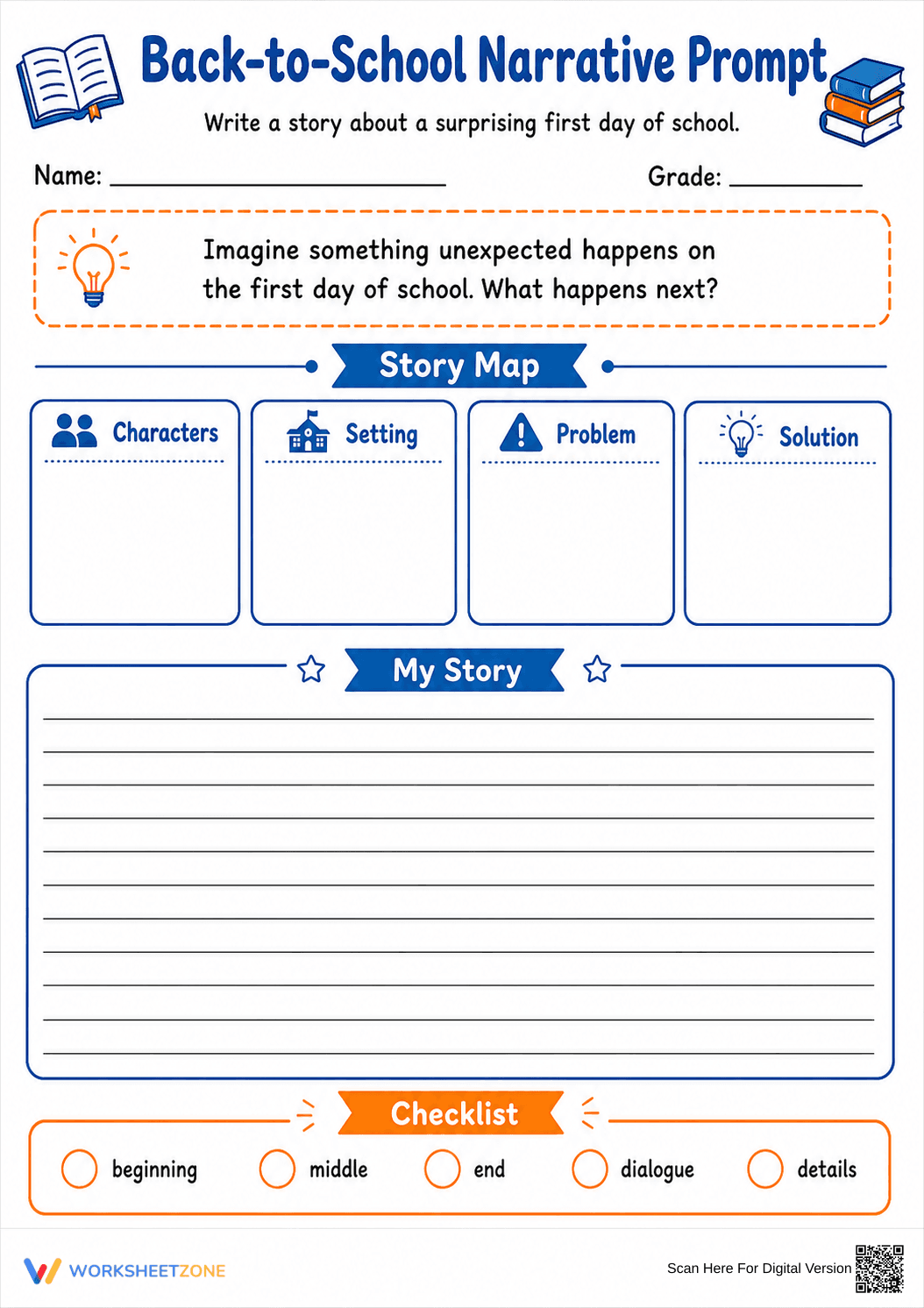

Essential Back-to-School Narrative Writing Prompt
Paste this activity's link or code into your existing LMS (Google Classroom, Canvas, Teams, Schoology, Moodle, etc.).
Students can open and work on the activity right away, with no student login required.
You'll still be able to track student progress and results from your teacher account.
This narrative writing worksheet helps students in grades 3 through 6 craft a compelling story about a surprising first day of school. By providing a structured story map and a clear creative prompt, it ensures students focus on essential narrative elements like character development and plot structure before they begin writing.
At a Glance
- Grade: 4 · Subject: ELA
- Standard:
CCSS.ELA-LITERACY.W.4.3— Write narratives to develop real or imagined experiences using effective technique and descriptive details- Skill Focus: Narrative Planning & Composition
- Format: 1 page · 6 tasks · Answer key not applicable · PDF
- Best For: Back-to-school icebreakers and baseline assessments
- Time: 30–45 minutes
The worksheet features a comprehensive layout designed to support the writing process. It includes a creative prompt box to spark imagination, followed by a four-part story map covering characters, setting, problem, and solution. A large lined area provides space for the final draft, while a bottom checklist ensures students include a beginning, middle, end, dialogue, and descriptive details.
This resource is designed for immediate classroom implementation with a total teacher prep time of under 2 minutes. First, print the single-page PDF for your class. Second, distribute the sheets and spend 3 minutes explaining the "surprising first day" prompt. Finally, review the completed stories using the built-in checklist to provide instant formative feedback on narrative structure. This workflow makes it an ideal choice for busy mornings or unexpected sub days.
This resource aligns with `CCSS.ELA-LITERACY.W.4.3`, which requires students to write narratives to develop real or imagined experiences or events using effective technique, descriptive details, and clear event sequences. It also supports W.5.3 and W.6.3 by encouraging the use of dialogue and pacing. Both standard codes can be copied directly into lesson plans, IEP goals, or district curriculum mapping tools.
Use this worksheet as a baseline writing assessment during the first week of school to gauge student proficiency in narrative structure. It also serves as an excellent creative writing center activity. Teachers should observe how students utilize the story map to ensure they have a clear problem and solution before moving to the lined writing section. This allows for quick intervention for students struggling with plot logic.
This worksheet is ideal for general education students in upper elementary and middle school, as well as English Language Learners who benefit from the visual cues in the story map. It pairs naturally with a mentor text about school experiences or an anchor chart detailing the elements of a plot mountain to provide additional scaffolding.
Narrative writing in the early grades serves as a foundational pillar for complex communication. According to Fisher & Frey (2014), providing students with structured scaffolds like story maps significantly improves the coherence and detail of their independent writing. This worksheet targets CCSS.ELA-LITERACY.W.4.3 by requiring students to organize a clear event sequence and use descriptive details to convey a school-based experience. Research from the RAND AIRS 2024 study suggests that prompt-based writing with integrated checklists helps students internalize the gradual release of responsibility, moving from planning to execution with higher confidence. By focusing on a relatable first day theme, the resource reduces cognitive load, allowing students to focus on the mechanics of storytelling. This 1-page PDF provides a measurable way to track student growth in narrative organization and creative expression throughout the academic year.


