


























Views
Downloads

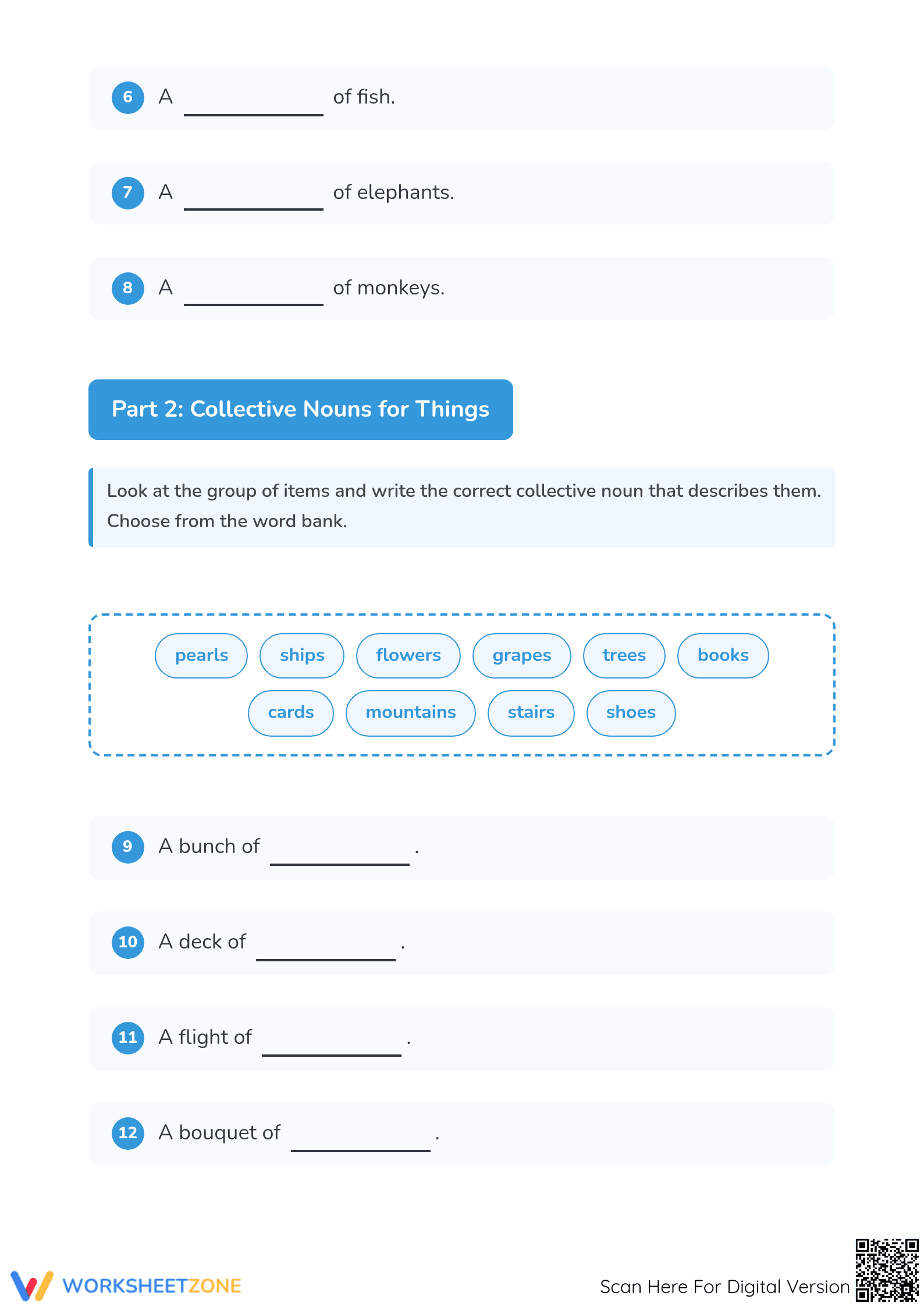


Collective Nouns Worksheet | Grade 2 Essential Practice
Paste this activity's link or code into your existing LMS (Google Classroom, Canvas, Teams, Schoology, Moodle, etc.).
Students can open and work on the activity right away, with no student login required.
You'll still be able to track student progress and results from your teacher account.
This collective nouns worksheet helps students identify and apply specific group names for animals and everyday objects. By connecting nouns like "pride" to lions or "fleet" to ships, learners strengthen their vocabulary and grammatical precision. Students move from simple identification to creative sentence construction, ensuring a comprehensive understanding of this parts-of-speech category.
At a Glance
- Grade: 2 · Subject: ELA
- Standard:
CCSS.ELA-LITERACY.L.2.1.A— Use collective nouns (e.g., pride of lions)- Skill Focus: Collective Nouns
- Format: 3 pages · 20 problems · Answer key included · PDF
- Best For: Independent practice or grammar centers
- Time: 20–30 minutes
The resource contains three distinct sections across three pages. Part 1 focuses on animal groups using a word bank of eight terms. Part 2 shifts to collective nouns for inanimate objects, providing a ten-word bank to complete ten descriptive phrases. Finally, Part 3 requires students to synthesize their learning by writing original sentences. A full answer key is provided for quick grading and immediate feedback.
This resource is designed for a zero-prep classroom environment. First, print the three-page PDF (30 seconds). Next, distribute the packets to students during your grammar block (1 minute). Finally, use the included answer key to review responses as a whole group or for individual grading (5 minutes). Total teacher preparation time is under two minutes, making it an ideal sub plan or emergency filler activity.
This worksheet is primarily aligned with `CCSS.ELA-LITERACY.L.2.1.A`, which requires students to use collective nouns correctly in speech and writing. It also supports `CCSS.ELA-LITERACY.L.3.1`, as students progress toward more complex grammar structures. Both standard codes can be copied directly into lesson plans, IEP goals, or district curriculum mapping tools to ensure instructional compliance.
Use this worksheet as a formative assessment after an introductory lesson on nouns. It works well in a "You Do" phase of instruction where students apply knowledge independently. Teachers should observe if students can correctly match the word bank terms to the specific categories. Completion typically takes 20 to 30 minutes depending on student writing speed and familiarity with the vocabulary.
This activity is designed for second-grade students but serves as an excellent review for third graders or a challenge for advanced first graders. It is particularly helpful for English Language Learners (ELLs) who need explicit vocabulary instruction for idiomatic group names. Pair this with a collective noun anchor chart or a picture book about animal groups for maximum instructional support.
According to Fisher & Frey (2014), the gradual release of responsibility is most effective when students have opportunities to apply new linguistic structures in both scaffolded and open-ended contexts. This worksheet follows that model by providing word banks for initial identification before requiring independent sentence generation. Research indicates that explicit instruction in collective nouns, which are often irregular or culturally specific, prevents common errors in subject-verb agreement and improves overall writing fluency. By engaging with 20 specific examples, students build a mental schema for how English categorizes groups, moving beyond generic terms like "a lot of" to more precise academic language. This alignment with evidence-based literacy practices ensures that the worksheet serves as a functional tool for meeting CCSS.ELA-LITERACY.L.2.1.A benchmarks while fostering long-term retention of complex grammar rules.


