


























Views
Downloads
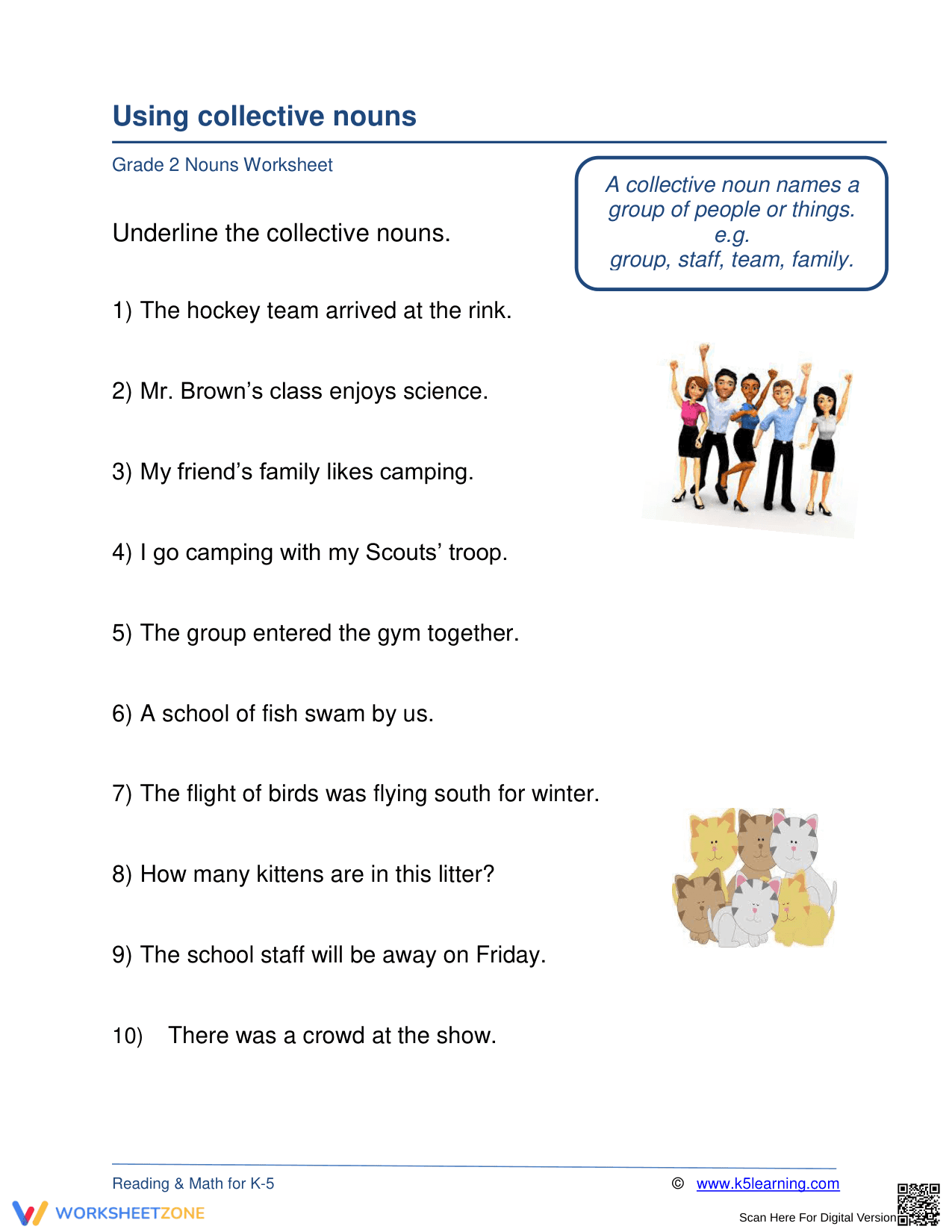
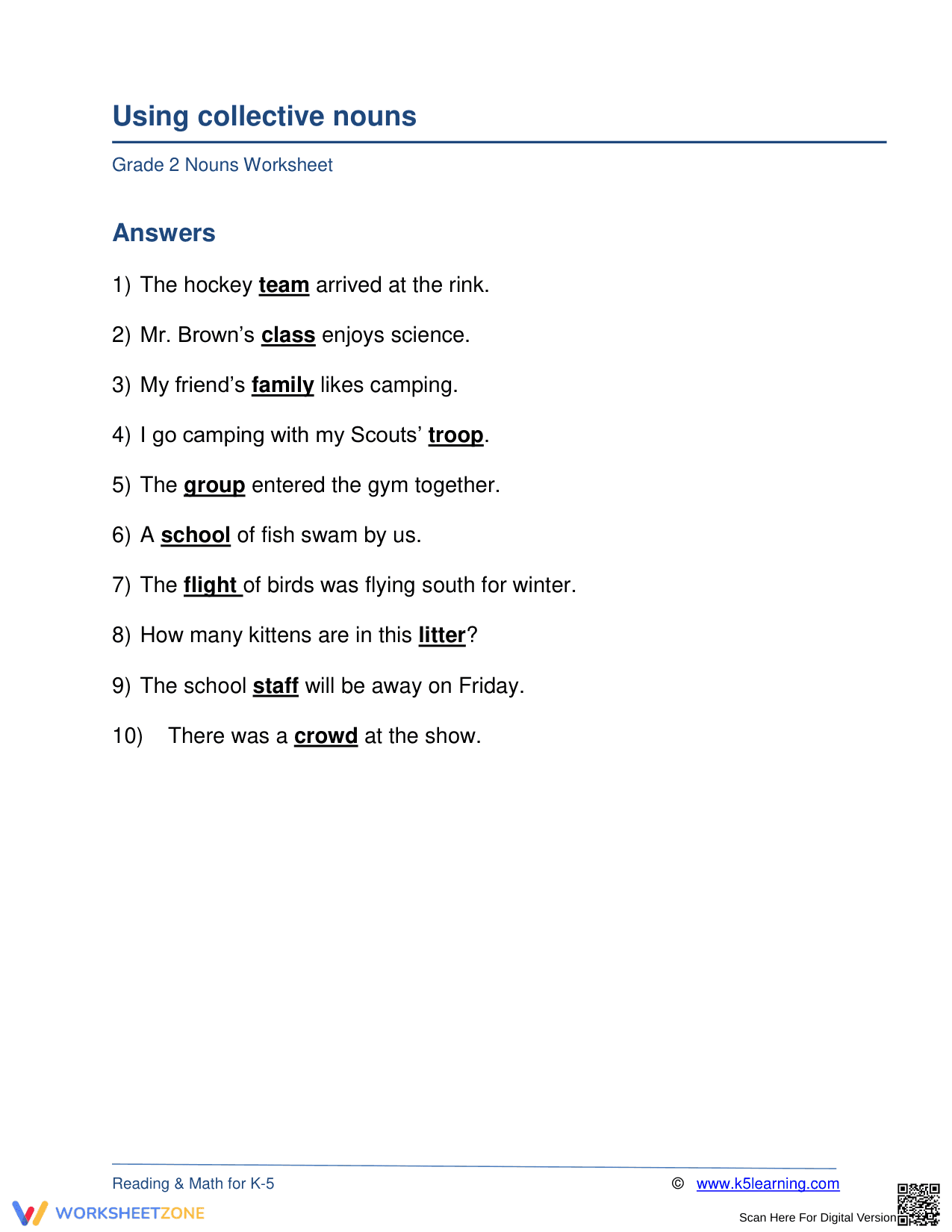

Collective Nouns Worksheet | Printable Grade 2 ELA
Paste this activity's link or code into your existing LMS (Google Classroom, Canvas, Teams, Schoology, Moodle, etc.).
Students can open and work on the activity right away, with no student login required.
You'll still be able to track student progress and results from your teacher account.
Mastering collective nouns is a key step in developing grammatical precision. This worksheet helps Grade 2 learners identify nouns representing groups of people, animals, or objects. By focusing on contextual recognition, students move beyond rote memorization to understand how these unique words function in everyday language and writing.
At a Glance
- Grade: 2 · Subject: ELA
- Standard:
CCSS.ELA-LITERACY.L.2.1.A— Use collective nouns like group, team, or class in sentences- Skill Focus: Collective Nouns
- Format: 1 page · 10 problems · Answer key included · PDF
- Best For: Independent practice or formative assessment
- Time: 10–15 minutes
This single-page PDF features a student-friendly definition of collective nouns with examples like "staff" and "family." Below the header, students find 10 sentences. Each contains one collective noun to underline. The layout is clean, featuring supportive illustrations of a group and kittens to provide visual context for the lexical concepts.
Skill Progression
- Guided Practice: The definition box provides immediate support, establishing the "what" and "how" of the task before students begin.
- Supported Practice: Sentences 1-5 offer practice with common nouns like "team" and "class" that students likely encounter in daily school life.
- Independent Practice: Sentences 6-10 provide practice with specific terms such as "flight" or "litter," requiring application to less familiar contexts.
This gradual release of responsibility ensures that learners can successfully transition from recognizing the concept to applying it independently.
Standards Alignment
This resource is aligned with `CCSS.ELA-LITERACY.L.2.1.A`, requiring students to demonstrate command of standard English grammar by using collective nouns. By isolating this sub-skill, the worksheet allows for targeted intervention. Both standard codes can be copied directly into lesson plans, IEP goals, or district curriculum mapping tools.
How to Use It
Use this as a formative assessment after an introductory lesson. As students work, observe if they confuse plural nouns with collective nouns. This provides immediate data on who needs scaffolding. It also serves as an excellent homework assignment or a quiet bell ringer. Most students complete the 10 items in 12 minutes.
Who It's For
This activity is ideal for second-grade students, third-grade review, or English Language Learners expanding their vocabulary. To extend learning, pair this with a collective noun anchor chart. It works well as a precursor to lessons on subject-verb agreement, where understanding the singular nature of collective nouns is critical.
According to the RAND AIRS 2024 report on foundational literacy, explicit instruction in lexical categories like collective nouns is vital for developing syntactic complexity in early elementary writers. This worksheet targets CCSS.ELA-LITERACY.L.2.1.A by requiring students to recognize nouns that represent groups, such as "team," "class," and "litter." Research by Fisher & Frey (2014) suggests that identifying these specific word classes in the context of complete sentences helps students transition from basic labeling to understanding how language functions to organize information efficiently. By isolating 10 distinct examples, this resource provides the high-frequency exposure necessary for students to internalize the concept of singular nouns representing plural entities. Educators can use this tool to bridge the gap between simple noun identification and the application of collective terminology in diverse writing contexts.


