




























Views
Downloads
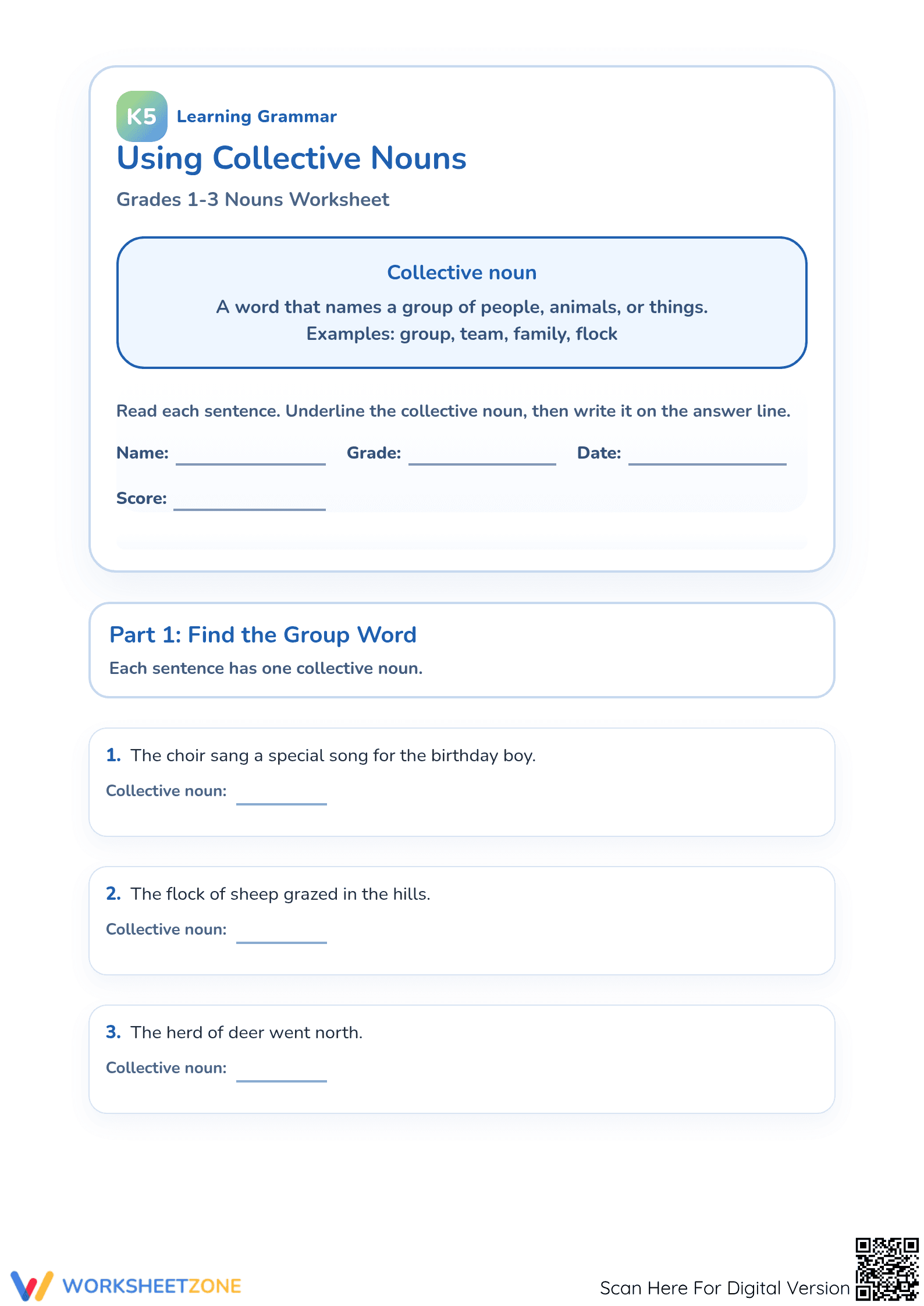


Essential Collective Nouns Worksheet | Grades 1-3 ELA

Paste this activity's link or code into your existing LMS (Google Classroom, Canvas, Teams, Schoology, Moodle, etc.).
Students can open and work on the activity right away, with no student login required.
You'll still be able to track student progress and results from your teacher account.
Collective nouns are essential building blocks for descriptive language. This worksheet helps students recognize that a single word can represent a whole group, such as a "flock" of sheep or a "choir" of singers. By identifying these terms in complete sentences, learners bridge the gap between vocabulary acquisition and functional grammar application in early elementary grades.
At a Glance
- Grade: 2 · Subject: ELA
- Standard:
CCSS.ELA-LITERACY.L.2.1.A— Use collective nouns to describe groups of people, animals, or things- Skill Focus: Identifying collective nouns in context
- Format: 2 pages · 10 problems · Answer key included · PDF
- Best For: Independent grammar practice or quick assessment
- Time: 10–15 minutes
This two-page resource features a clear, student-friendly definition of collective nouns at the top of the first page, serving as a permanent reference point. It contains 10 carefully crafted sentences where students must underline the collective noun and then transcribe it onto a dedicated answer line. This dual-action task reinforces both visual recognition and correct spelling of complex group terms like "choir" and "batch."
The zero-prep design allows teachers to integrate this into a lesson in under two minutes. Simply print the two-page PDF and distribute it to students. Because the instructions are self-explanatory and include a worked definition box, students can begin working immediately without heavy teacher intervention. Reviewing the 10 items as a whole class takes approximately five minutes, making it an ideal sub plan or bell-ringer activity.
Standards Alignment: This resource is specifically designed to meet `CCSS.ELA-LITERACY.L.2.1.A`, which requires students to "use collective nouns (e.g., group)." It also supports Grade 1 and Grade 3 language standards by introducing and reinforcing lexical word classes through contextual application. Both standard codes can be copied directly into lesson plans, IEP goals, or district curriculum mapping tools.
Use this during the "Guided Practice" phase of a grammar lesson. After introducing the concept with an anchor chart, have students complete the first three problems together to ensure they understand the underlining and writing process. Alternatively, use it as a formative assessment to check for understanding before moving on to pluralization rules. Expect students to spend 10 to 15 minutes on the full set.
This worksheet is ideal for general education students in Grades 1-3, as well as English Language Learners (ELL) who need explicit practice with English idioms and group terminology. It pairs naturally with a classroom "Collective Noun Word Wall" or a reading passage focused on animal habitats. The clear layout ensures that students with processing needs are not overwhelmed by visual clutter.
Research by Fisher & Frey (2014) emphasizes the importance of the gradual release of responsibility, which this worksheet supports through its clear definition and structured sentence-level tasks. By isolating the collective noun within a familiar context, students reduce cognitive load and focus on the specific lexical category. According to the NAEP framework, early mastery of word classes like collective nouns is a significant predictor of later reading fluency and syntactic complexity in student writing. This resource provides the 10 repetitions necessary to move these terms from short-term recognition to long-term vocabulary storage. Educators can rely on this structured approach to ensure that students meet the L.2.1.A benchmark during their primary years while building a robust mental lexicon for future composition tasks.


