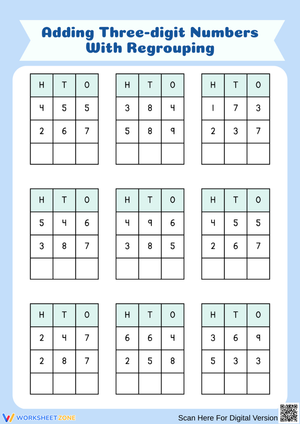
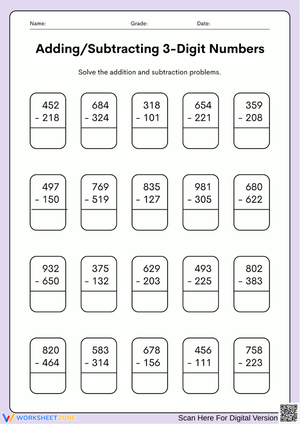
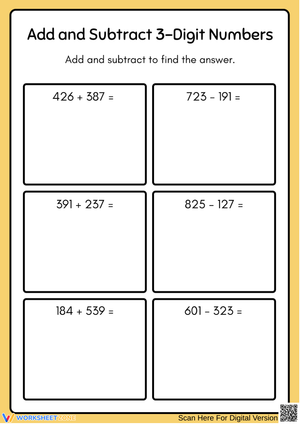
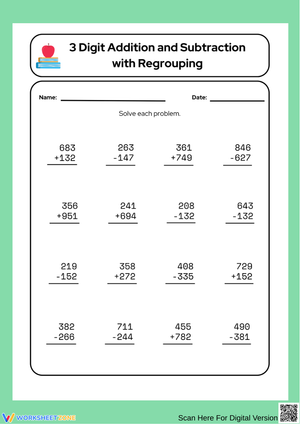
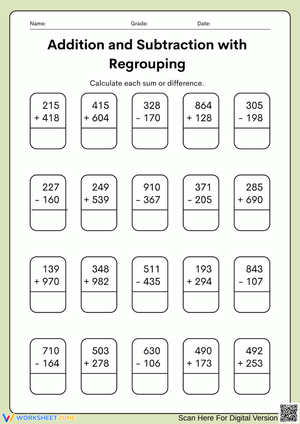
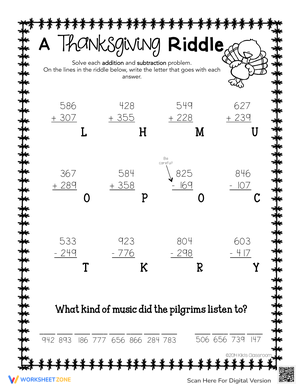
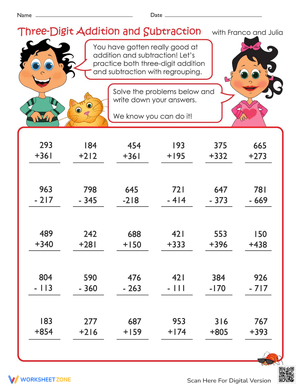
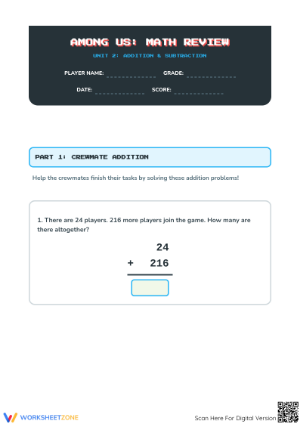
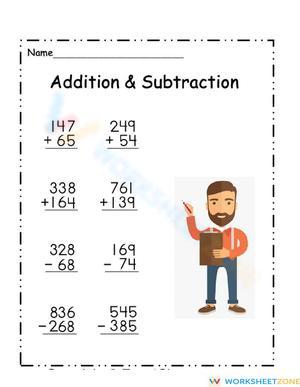
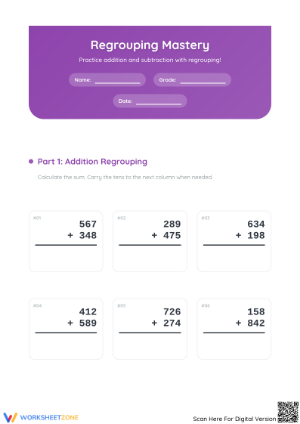
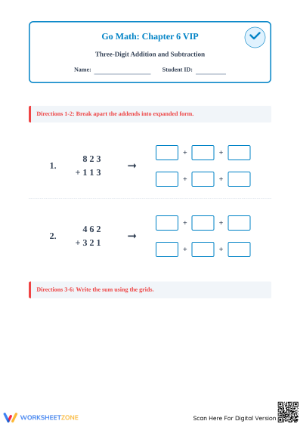
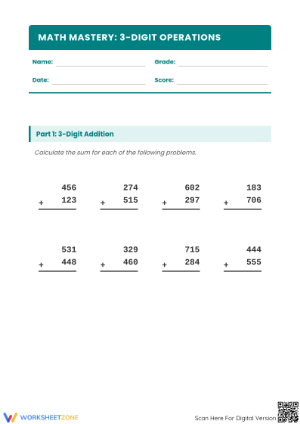
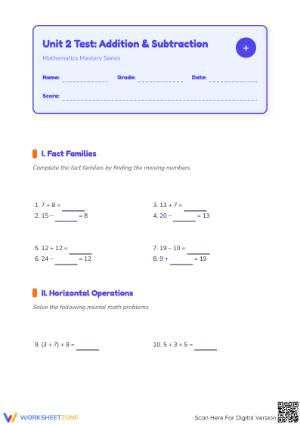
These 3 digit addition and subtraction with regrouping worksheets for 2nd grade give teachers a focused collection of standalone practice resources for the most conceptually demanding arithmetic transition in second grade. Each worksheet targets the moment students must cross a place-value boundary — composing a new ten or hundred when adding, or decomposing one when subtracting. That crossing is where most 7-year-olds lose the thread, and consistent structured practice is what steadies them.
What Each Worksheet in the Set Covers
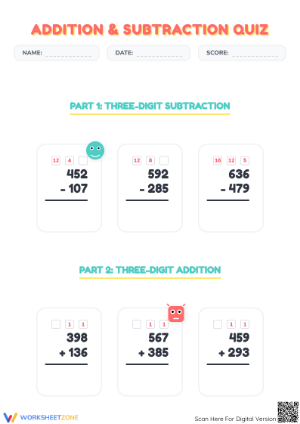
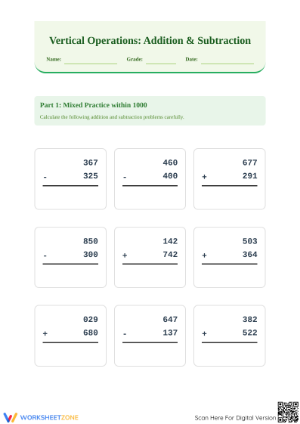
The worksheets move through a deliberate progression, beginning with problems that require regrouping in the ones column only and building toward problems where both the ones and tens columns demand it simultaneously. Across the set, students will:
- Add three-digit numbers where the ones column sums to ten or greater and a ten must be carried
- Add three-digit numbers where regrouping is required in both the ones and the tens columns
- Subtract three-digit numbers by decomposing a ten into ten ones
- Subtract when the tens digit is zero, requiring decomposition of a hundred before the ones column can borrow
- Work through mixed-operation problems that ask them to identify the correct operation before computing
- Apply regrouping in context through short word problems using key terms like in all, remaining, and difference
The vertical format used throughout keeps columns visually distinct, and most worksheets include small regrouping boxes positioned above the tens and hundreds columns. Those boxes do meaningful work — without a dedicated space to write the carried digit, students hold it in working memory and drop it the moment attention shifts to the next column.
Standard Alignment
These worksheets address CCSS 2.NBT.B.7, which requires students to add and subtract within 1000 using strategies based on place value, properties of operations, and the relationship between addition and subtraction. The standard specifically names composing and decomposing tens and hundreds — language that maps directly onto what students practice here, writing the regrouped value explicitly as a discrete step rather than treating carrying or borrowing as something that just happens automatically. Teachers in states that have adapted Common Core language will find matching expectations under equivalent benchmarks, making this set broadly applicable across state frameworks.
The Place Value Foundation That Has to Come First
Students who struggle with regrouping almost always have an unstable grasp of how ones, tens, and hundreds relate to each other. A child can recite "ten ones make one ten" as a phrase without internalizing it well enough to apply under the pressure of a subtraction problem. When a student looks at 500 and must subtract 247, recognizing that a hundred can be decomposed into ten tens — and then one of those tens into ten ones — requires a kind of numerical flexibility that develops over weeks of varied exposure, not a single lesson. Worksheets that pair a numerical problem with a base-ten block diagram alongside it help students move from visual counting toward abstract computation more reliably than bare-number problems alone. That pairing keeps the meaning attached to the procedure during the weeks when fluency is still forming.
Mistakes Students Make That These Worksheets Help You Catch
The most predictable subtraction error is what many teachers call "flip subtraction" — the student subtracts the smaller digit from the larger one regardless of position. In a problem like 432 minus 185, the student writes 3 in the ones place (taking 2 from 5 rather than borrowing) and moves forward confidently. The error feels smooth to them, which is exactly why it persists. The regrouping box format helps because it forces a student to record whether they borrowed — and when the box is empty but the ones-column digit is wrong, you know immediately what happened without having to reconstruct their thinking.
A second pattern concentrates in problems with zeros. When subtracting something like 400 minus 163, students see the zero in the tens column and either freeze or attempt to borrow from it directly, skipping the step that first decomposes the hundred into ten tens. The resulting tens digit is usually 9 when the answer calls for something entirely different. Asking students to annotate their borrowing steps in a contrasting color — crossing out and rewriting the affected digits in red or blue — makes these sequence errors visible at a glance rather than leaving just a wrong answer to decode. In addition, the dropped carry is a persistent problem: a student correctly determines that 7 plus 6 equals 13, records the 3, then adds the next column as if no ten was generated. Regrouping boxes reduce this error substantially because writing the 1 becomes a deliberate physical act rather than a mental note.
Fitting These Worksheets Into Your Week
The strongest use pattern for a 3 digit addition and subtraction with regrouping worksheets for 2nd grade set is short and frequent rather than long and occasional. One worksheet as a 10-minute warm-up three times a week builds more durable fluency than a 40-minute Friday block. The reason is spaced retrieval: returning to the regrouping procedure before it fully fades keeps it accessible under the mild cognitive load of multi-step computation. Massing all the practice into one session doesn't give the forgetting-and-retrieval cycle a chance to operate, and that cycle is what makes the skill stick.
These worksheets also work well at independent stations during math workshop rotations. Because each worksheet stands alone, students don't need a teacher to re-explain context — they pick it up and work. For teachers running small-group instruction at the back table, this keeps the rest of the class on a meaningful task without requiring active monitoring. The last two or three problems on any worksheet make clean exit slips that give a formative read on where the class stands before the next day's lesson opens.
Adjusting the Set for a Range of Learners
For students who aren't yet ready to regroup in both columns simultaneously, limit their practice to problems that require carrying or borrowing in the ones column only. This doesn't require a separate resource — circle only those problems or tell the student to work through the first portion of each worksheet, where single-column regrouping problems tend to concentrate. They're still working the format and building procedural fluency; they're simply not being pushed into double regrouping before the single-column step is solid.
Students who've already mastered the core regrouping steps gain more from the mixed-operation and word-problem worksheets, where the cognitive demand shifts from procedure execution to problem interpretation. One extension worth trying: after finishing a worksheet, ask the student to write a word problem that matches one of the bare-number equations they just solved. That task reveals whether they understand what the operation represents, not just how to carry it out. On the support end, allowing a student to keep a labeled place-value chart next to each worksheet — ones, tens, and hundreds clearly marked — removes a memory burden without eliminating the regrouping work itself. They still have to carry and borrow; they just have the column labels as a reference while the procedure becomes automatic.
Frequently Asked Questions
When should 2nd graders start working on three-digit regrouping?
The clearest readiness signal is reliable fluency with two-digit regrouping combined with the ability to explain — not just perform — what the carried or borrowed digit represents. A quick informal check: ask the student to solve 67 plus 45, then ask what the small "1" above the tens column stands for. If the answer is "that's just what you write there" rather than "that's the ten we made from the ones," they need more two-digit work before moving on. The 3 digit addition and subtraction with regrouping worksheets for 2nd grade in this set work best for students who can answer that question in terms of tens and ones, not procedure steps.
How do I help a student who computes accurately on bare problems but falls apart on word problems?
That gap is almost always a translation problem, not a computation one. The student is reading the word problem as a text comprehension task rather than as a mathematical situation. A useful intermediate step before they write any numbers: have them underline the two quantities and circle the action word — phrases like "gave away," "collected altogether," or "had left." Then ask them to write the equation structure with blanks — blank operation-symbol blank equals blank — before filling in actual values. Separating the translation step from the computation is where most students stabilize, and it usually takes only a few guided repetitions before they begin doing it on their own.
My students handle across-zeros subtraction correctly during focused practice but make errors when they rush. Is this a fluency issue or a conceptual one?
Both, in most cases. Subtracting across zeros involves two sequential decompositions, and any procedure that length is vulnerable when attention drops. The 3 digit addition and subtraction with regrouping worksheets for 2nd grade that include across-zeros problems support fluency through repeated practice, but the conceptual layer needs active maintenance alongside it. Periodically asking a student to narrate their steps aloud — even weeks after they've been handling these problems independently — keeps the reasoning connected to the procedure and surfaces students who've learned the sequence by rote without enough understanding to self-correct when a step misfires.













 Interactive Worksheet Maker
 Quiz Maker
 Word Search Maker
 Crossword Puzzle Maker
 Word Scramble Generator
 Sentence Scramble Generator
 Handwriting Worksheet Generator
 Name Tracing Generator
 Fill In The Blank Generator