


























Views
Downloads

Essential 3-Digit Math Exam: CCSS.MATH.CONTENT.2.NBT.B.7
Paste this activity's link or code into your existing LMS (Google Classroom, Canvas, Teams, Schoology, Moodle, etc.).
Students can open and work on the activity right away, with no student login required.
You'll still be able to track student progress and results from your teacher account.
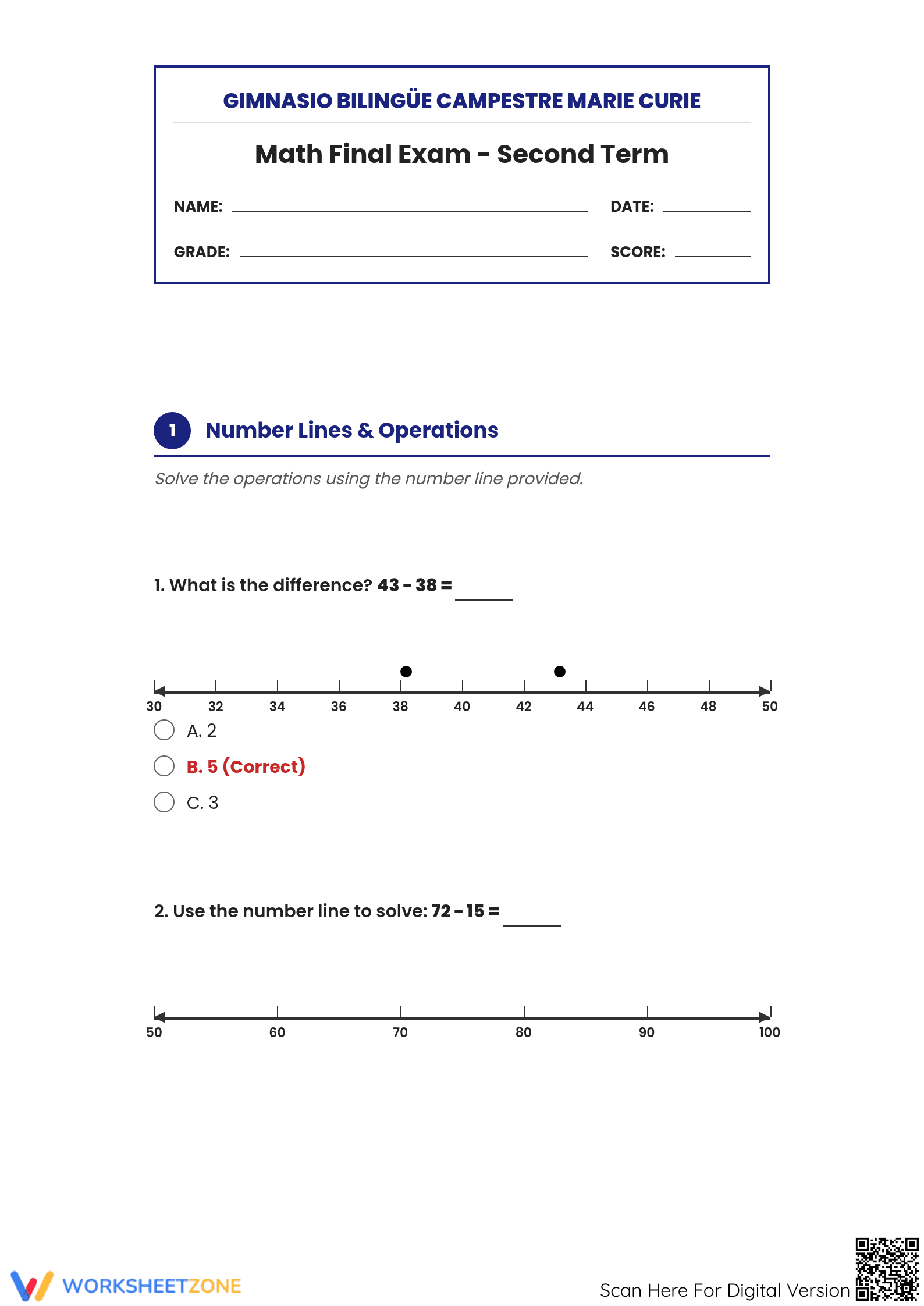
This comprehensive Grade 2 math assessment focuses on 3-digit addition and subtraction with regrouping. Students demonstrate their mastery of place value strategies through number lines, HTO tables, and expanded form decomposition. It provides a clear snapshot of student proficiency in multi-digit operations and number logic essential for moving toward higher-level mathematics.
At a Glance
- Grade: 2 · Subject: Math
- Standard:
CCSS.MATH.CONTENT.2.NBT.B.7— Add and subtract within 1000 using place value strategies and regrouping models- Skill Focus: 3-Digit Addition and Subtraction
- Format: 4 pages · 11 problems · Answer key included · PDF
- Best For: End-of-term assessment or summative practice
- Time: 30–45 minutes
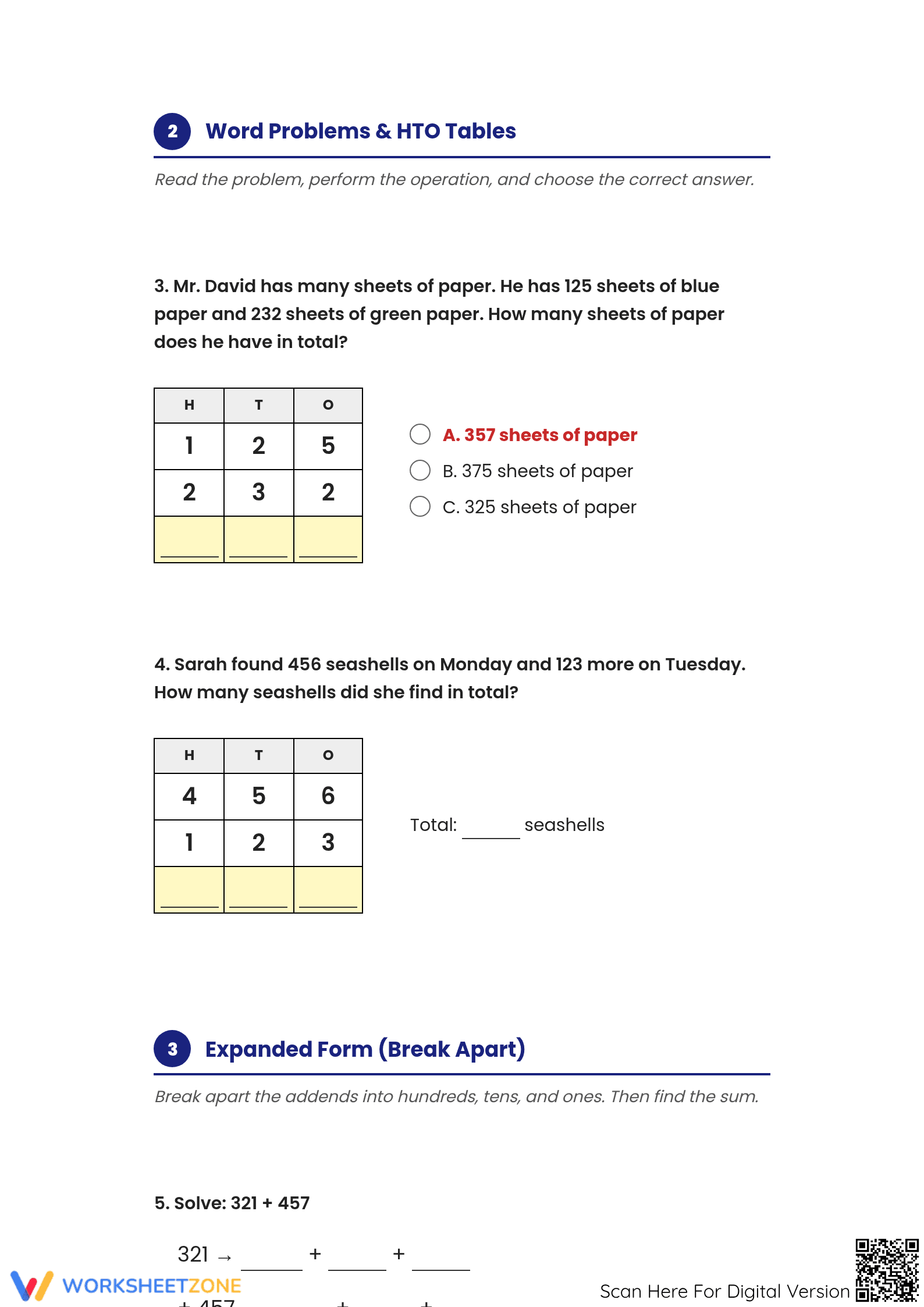
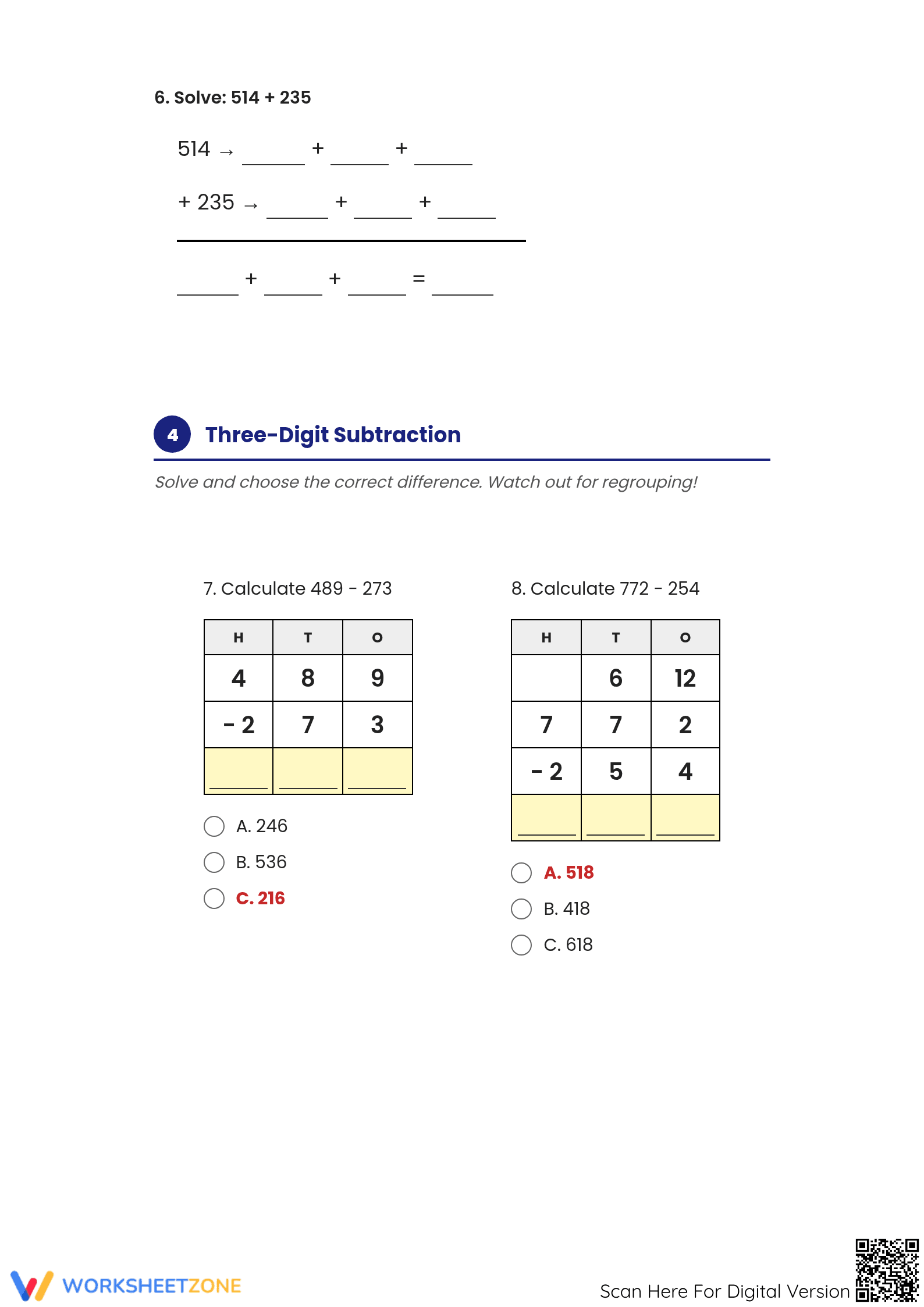
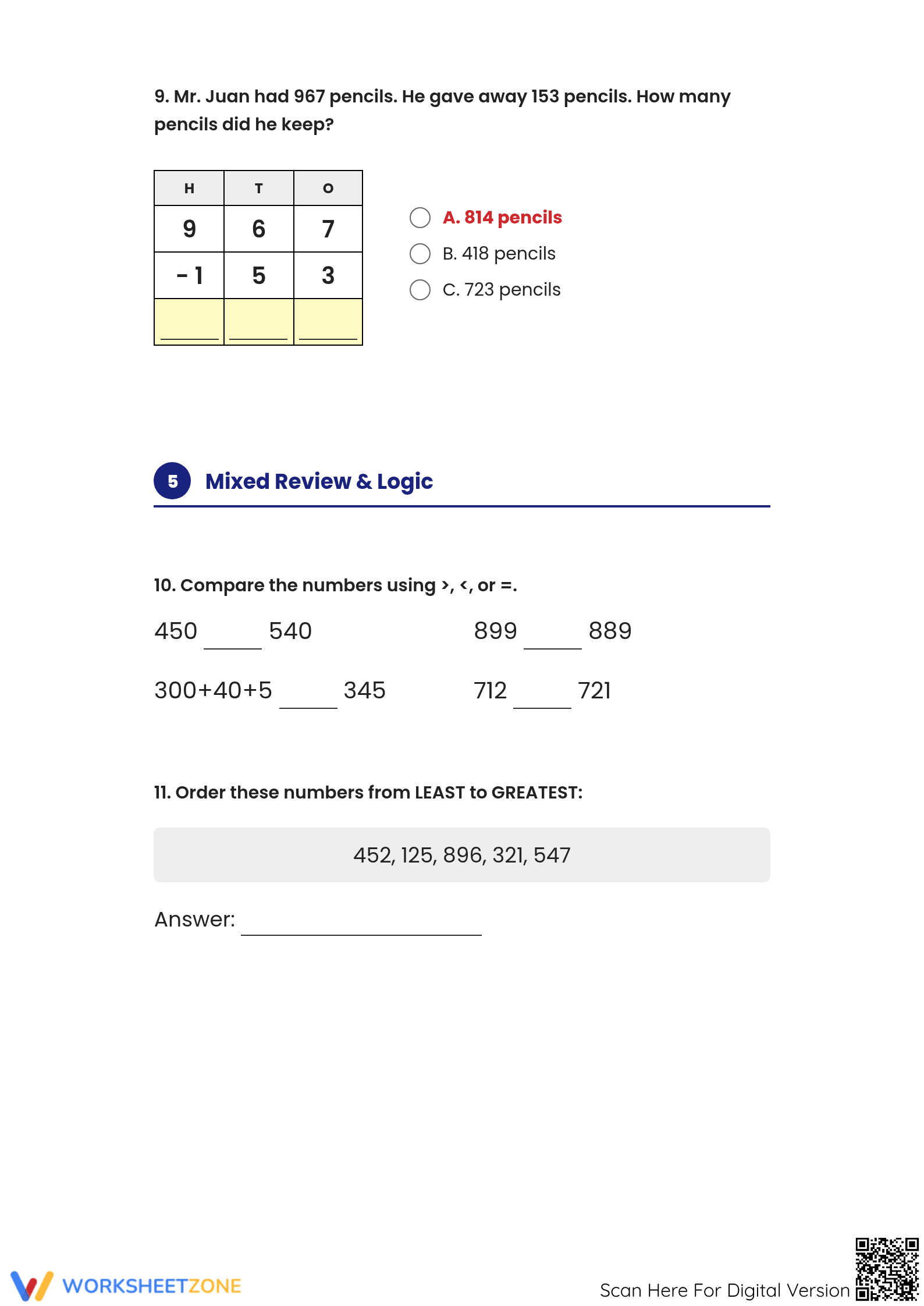
This 4-page PDF document contains 11 structured tasks that progress from visual number line operations to abstract 3-digit word problems. The resource features clear HTO (Hundreds, Tens, Ones) tables to scaffold regrouping, expanded form "break apart" templates, and inequality comparisons. A full answer key is included to facilitate rapid grading and provide immediate feedback.
Each task in this final exam is meticulously mapped to specific sub-skills within the Grade 2 Number and Operations in Base Ten domain. The use of HTO charts provides evidence of whether students understand the place value logic behind the standard algorithm, while the expanded form sections verify their ability to decompose numbers. Scores can be entered directly into gradebooks or used to inform IEP progress notes regarding multi-digit calculation mastery.
Aligned to CCSS.MATH.CONTENT.2.NBT.B.7, this worksheet requires students to add and subtract within 1000, using concrete models or drawings and strategies based on place value. It also supports CCSS.MATH.CONTENT.2.NBT.A.4 through its number comparison section. Both standard codes can be copied directly into lesson plans, IEP goals, or district curriculum mapping tools.
Use this worksheet as a summative assessment at the conclusion of your 3-digit operations unit. Alternatively, assign individual pages as formative checks during direct instruction to observe how students handle regrouping across zeros. During the exam, observe if students are correctly carrying or borrowing within the HTO tables to identify common place value misconceptions. Expect completion within 45 minutes.
This resource is designed for Grade 2 students working toward standard mastery and Grade 3 students requiring remedial review of regrouping strategies. It is particularly effective for learners who benefit from visual place value scaffolds like HTO charts. Pair this assessment with a place value mat or base-ten blocks for students requiring tier-two support during guided practice.
The integration of visual models like HTO tables and number lines within this assessment aligns with the recommendations of Fisher & Frey (2014) regarding the gradual release of responsibility in mathematics. Research indicates that using multiple representations for multi-digit addition and subtraction helps bridge the gap between concrete understanding and abstract procedural fluency. This worksheet addresses CCSS.MATH.CONTENT.2.NBT.B.7 by requiring students to relate concrete place value drawings to the written method of regrouping. By assessing both procedural calculation and number logic through comparisons, the tool provides a holistic view of a student's base-ten competency. Such multi-faceted assessments are critical for identifying specific gaps in place value understanding before students progress to Grade 3 multiplication and division. The structure ensures that students are not just memorizing steps but applying mathematical reasoning to 3-digit problems.


