




























Views
Downloads

Essential Among Us Math Review: Grade 2 Addition/Subtraction

Paste this activity's link or code into your existing LMS (Google Classroom, Canvas, Teams, Schoology, Moodle, etc.).
Students can open and work on the activity right away, with no student login required.
You'll still be able to track student progress and results from your teacher account.
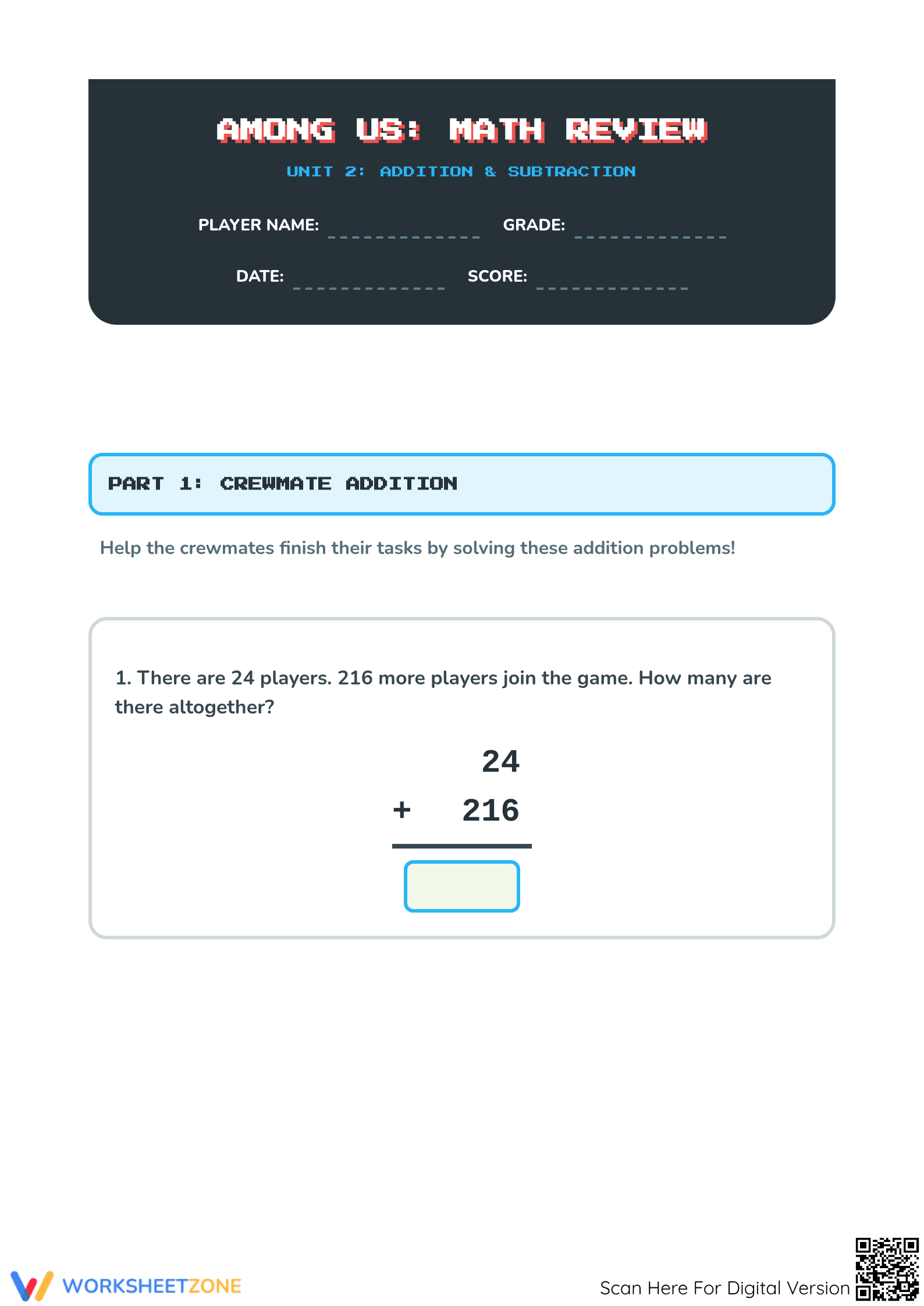
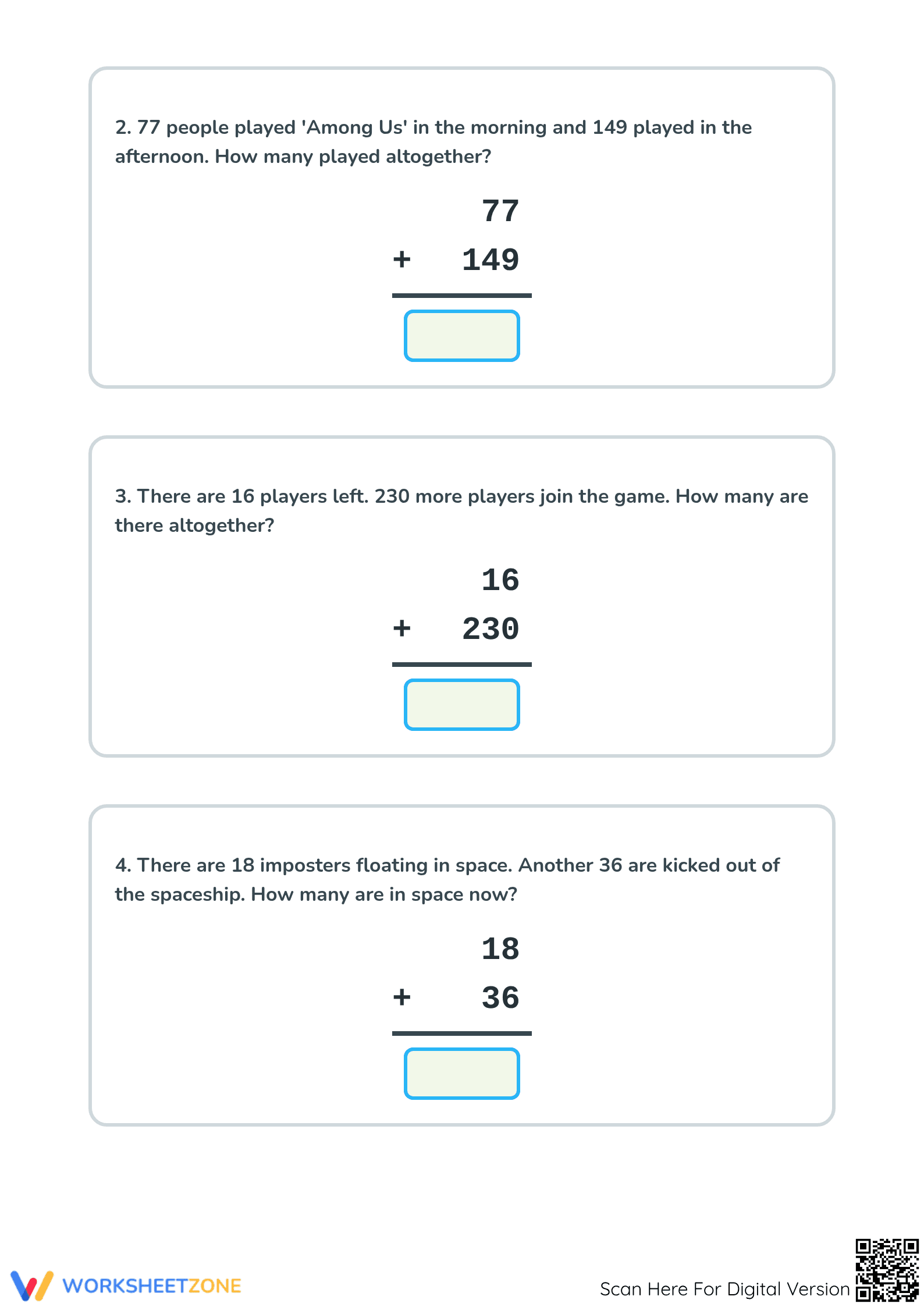
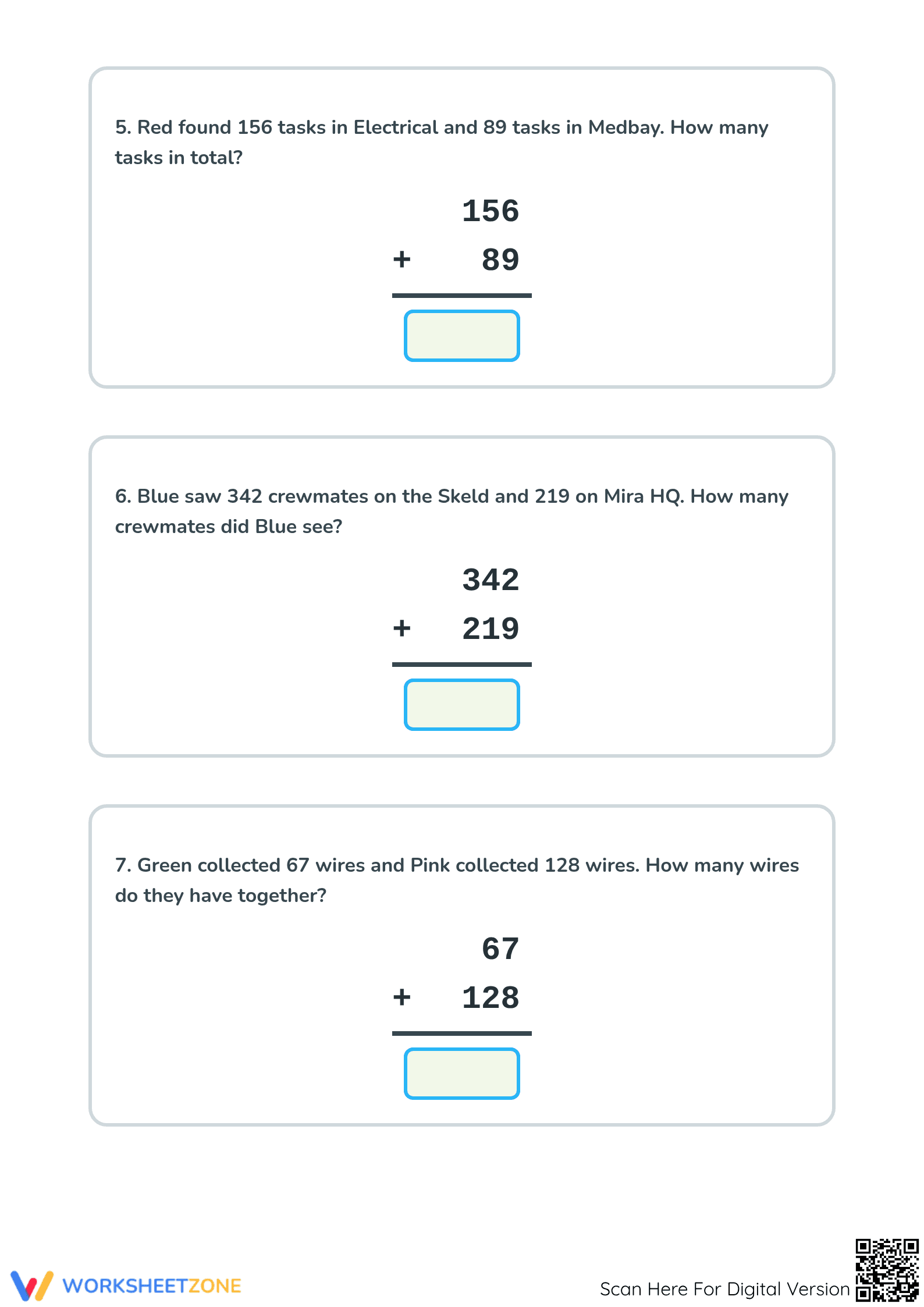
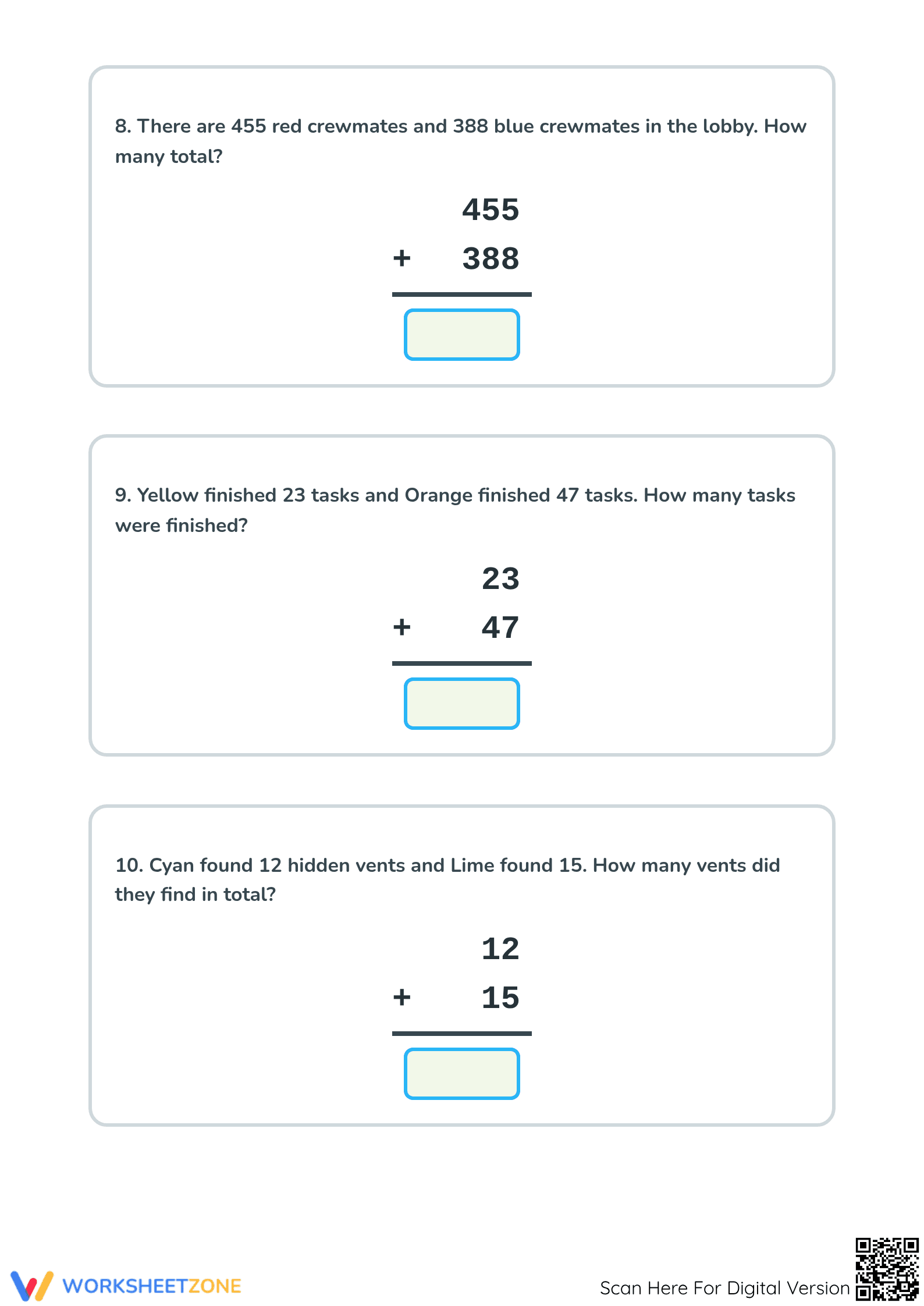
This interactive Among Us themed math review engages Grade 2 and Grade 3 students in mastering multi-digit addition and subtraction. By solving 12 high-interest word problems, learners develop fluency in regrouping and operational logic within 1,000. Students successfully translate thematic scenarios into vertical calculations, ensuring they meet critical standards through gamified learning.
At a Glance
- Grade: 2–3 · Subject: Math
- Standard:
CCSS.MATH.CONTENT.2.NBT.B.7— Add and subtract within 1000 using models or place value strategies- Skill Focus: 3-digit Addition and Subtraction with Regrouping
- Format: 5 pages · 12 problems · Answer key included · Interactive PDF
- Best For: High-interest skill review or sub plans
- Time: 30–45 minutes
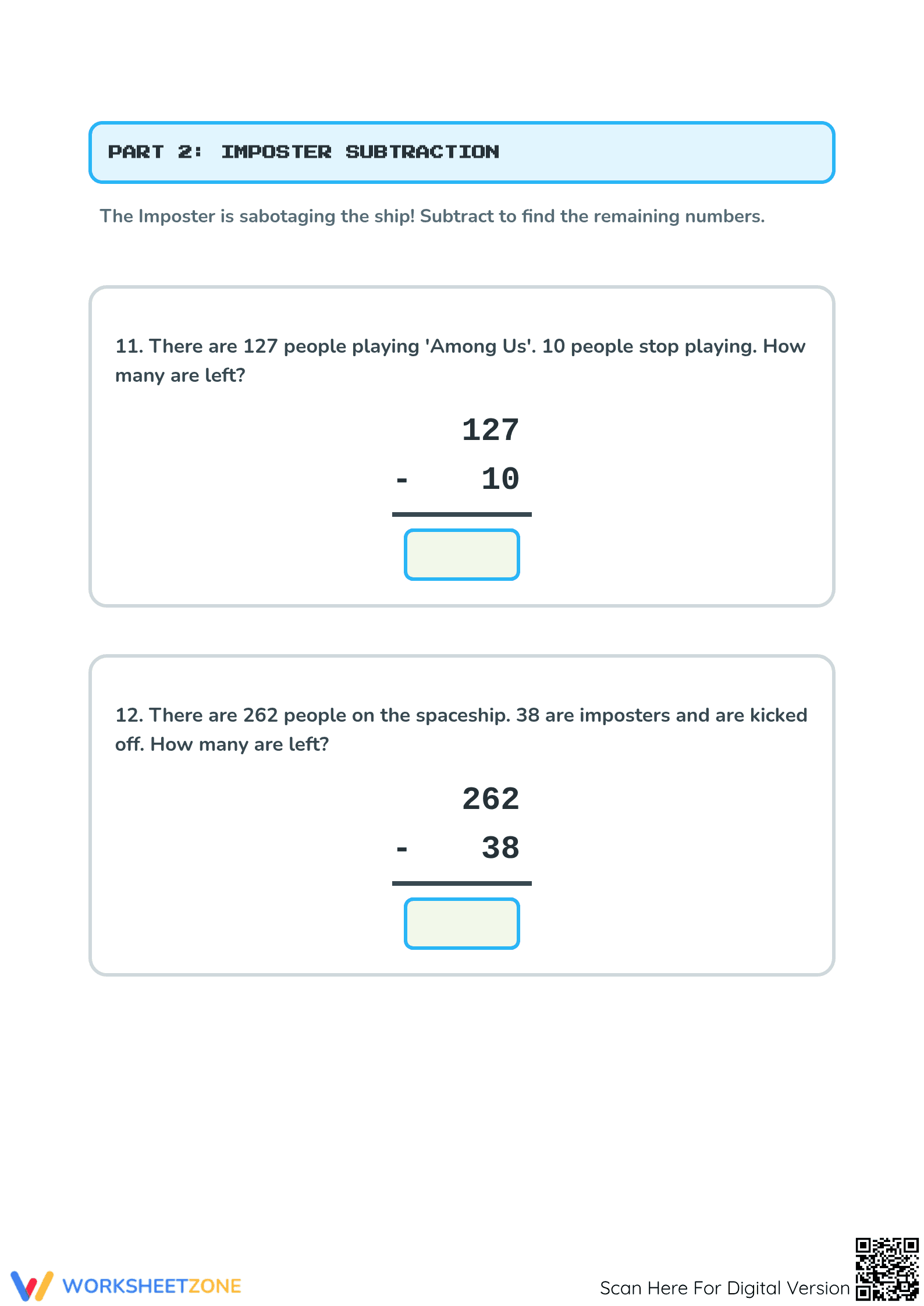
This 5-page printable packet features 12 unique word problems inspired by the popular game Among Us. Each page provides ample white space for students to set up vertical addition or subtraction algorithms. The content includes a mix of "Crewmate Addition" and "Imposter Subtraction" sections, with problems involving regrouping across the tens and hundreds places. A comprehensive answer key is provided for immediate grading or student self-correction.
Teachers can implement this resource with zero lead time. First, print the 5-page PDF for your class (30 seconds). Second, distribute the worksheets and brief the students on the Among Us mission theme to spark immediate engagement (1 minute). Third, use the included answer key to review the 12 problems collectively or as students finish, requiring less than 2 minutes of teacher preparation for a full period of focused math practice.
The primary alignment is CCSS.MATH.CONTENT.2.NBT.B.7, which requires students to add and subtract within 1000 using concrete models or drawings and strategies based on place value. It also supports CCSS.MATH.CONTENT.3.NBT.A.2 for fluent addition and subtraction within 1000. Both standard codes can be copied directly into lesson plans, IEP goals, or district curriculum mapping tools to document rigorous alignment with national numeracy expectations.
Use this worksheet as a summative assessment at the conclusion of your addition and subtraction unit to gauge mastery of regrouping. Alternatively, keep it in your emergency sub folder; the gamified theme ensures students remain on-task even without direct teacher supervision. For a formative check, observe if students correctly line up place values in the provided work boxes during the first three problems.
This resource is designed for Grade 2 and Grade 3 students, particularly those who benefit from thematic hook content to increase motivation. It is excellent for general education classrooms, small group intervention, or as an extension activity for early finishers. Pair this review with a place-value anchor chart or a digital Among Us classroom game for a fully immersive mathematical experience.
The CCSS.MATH.CONTENT.2.NBT.B.7 standard represents a pivotal shift from basic arithmetic to complex place-value operations, requiring students to synthesize multiple regrouping steps. According to the RAND AIRS 2024 report, student engagement increases when mathematical tasks are contextualized within familiar, modern social frameworks, such as popular gaming environments. By embedding 12 rigorous 3-digit problems into an Among Us narrative, this worksheet leverages thematic interest to reduce math anxiety and increase time-on-task during practice. Research indicates that gamified review materials help bridge the gap between abstract calculation and real-world application. This specific resource ensures that the cognitive load remains focused on mathematical accuracy while the thematic wrapper provides the necessary extrinsic motivation for sustained focus. Educators can confidently cite this tool as an evidence-based method for improving multi-digit operational fluency through highly engaging, standards-aligned instructional design.


